Pre-Summer Sale Limited Time 65% Discount Offer - Ends in 0d 00h 00m 00s - Coupon code: 65pass65

300-215 Conducting Forensic Analysis and Incident Response Using Cisco CyberOps Technologies (CBRFIR) is now Stable and With Pass Result | Test Your Knowledge for Free

Exams4sure Dumps

300-215 Practice Questions

Conducting Forensic Analysis and Incident Response Using Cisco CyberOps Technologies (CBRFIR)

Last Update 4 hours ago
Total Questions : 131

Dive into our fully updated and stable 300-215 practice test platform, featuring all the latest CyberOps Professional exam questions added this week. Our preparation tool is more than just a Cisco study aid; it's a strategic advantage.

Our free CyberOps Professional practice questions crafted to reflect the domains and difficulty of the actual exam. The detailed rationales explain the 'why' behind each answer, reinforcing key concepts about 300-215. Use this test to pinpoint which areas you need to focus your study on.

300-215 PDF

300-215 PDF (Printable)
$48.3
$137.99

300-215 Testing Engine

300-215 PDF (Printable)
$52.5
$149.99

300-215 PDF + Testing Engine

300-215 PDF (Printable)
$65.45
$186.99
Question # 31

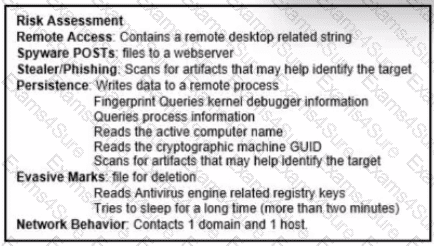
Refer to the exhibit.

Question # 31

The application x-dosexec with hash 691c65e4fb1d19f82465df1d34ad51aaeceba14a78167262dc7b2840a6a6aa87 is reported as malicious and labeled as "Trojan.Generic" by the threat intelligence tool. What is considered an indicator of compromise?

Options:

A.  

modified registry

B.  

hooking

C.  

process injection

D.  

data compression

Discussion 0
Question # 32

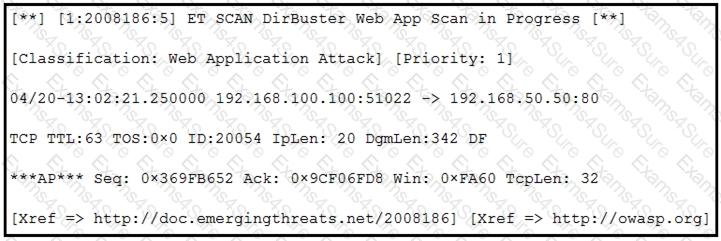
Refer to the exhibit.

Question # 32

According to the SNORT alert, what is the attacker performing?

Options:

A.  

brute-force attack against the web application user accounts

B.  

XSS attack against the target webserver

C.  

brute-force attack against directories and files on the target webserver

D.  

SQL injection attack against the target webserver

Discussion 0
Question # 33

An organization experienced a ransomware attack that resulted in the successful infection of their workstations within their network. As part of the incident response process, the organization's cybersecurity team must prepare a comprehensive root cause analysis report. This report aims to identify the primary factor or factors responsible for the successful ransomware attack and to formulate effective strategies to prevent similar incidents in the future. In this context, what should the cybersecurity engineer emphasize in the root cause analysis report to demonstrate the underlying cause of the incident?

Options:

A.  

evaluation of user awareness and training programs aimed at preventing ransomware attacks

B.  

analysis of the organization's network architecture and security infrastructure

C.  

detailed examination of the ransomware variant, its encryption techniques, and command-and-control servers

D.  

vulnerabilities present in the organization's software and systems that were exploited by the ransomware

Discussion 0
Question # 34

What can the blue team achieve by using Hex Fiend against a piece of malware?

Options:

A.  

Use the hex data to define patterns in VARA rules.

B.  

Read the hex data and transmognify into a readable ELF format

C.  

Use the hex data to modify BE header to read the file.

D.  

Read the hex data and decrypt payload via access key.

Discussion 0
Question # 35

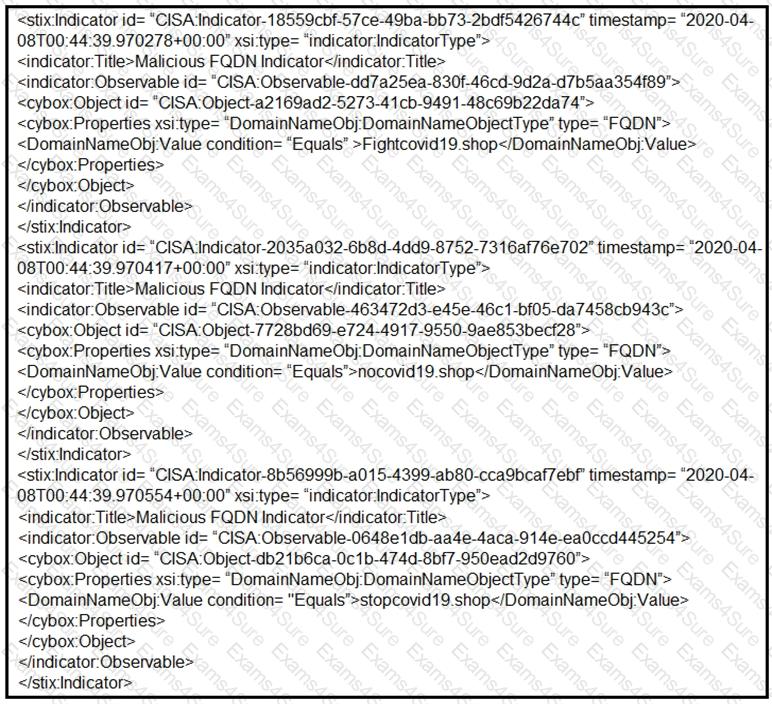
Refer to the exhibit.

Question # 35

Which two actions should be taken based on the intelligence information? (Choose two.)

Options:

A.  

Block network access to all .shop domains

B.  

Add a SIEM rule to alert on connections to identified domains.

C.  

Use the DNS server to block hole all .shop requests.

D.  

Block network access to identified domains.

E.  

Route traffic from identified domains to block hole.

Discussion 0
Question # 36

An attacker modifies a malicious file named TOPSECRET0523619132 by changing its file extension from a .png to a doc in an attempt to evade detection. Which technique is being used to disguise the file?

Options:

A.  

steganography

B.  

obfuscatiofi

C.  

spoofing

D.  

hashing

Discussion 0
Question # 37

Which technique is used to evade detection from security products by executing arbitrary code in the address space of a separate live operation?

Options:

A.  

process injection

B.  

privilege escalation

C.  

GPO modification

D.  

token manipulation

Discussion 0
Question # 38

A cybersecurity analyst detects fileless malware activity on secure endpoints. What should be done next?

Options:

A.  

Immediately quarantine the endpoints containing the suspicious files and consider the issue resolved

B.  

Isolate the affected endpoints and conduct a detailed memory analysis to identify fileless malware execution.

C.  

Delete the suspicious files and monitor the endpoints for any further signs of compromise.

D.  

Share the findings with other government agencies for collaborative threat analysis and response.

Discussion 0
Question # 39

A security team is notified from a Cisco ESA solution that an employee received an advertising email with an attached .pdf extension file. The employee opened the attachment, which appeared to be an empty document. The security analyst cannot identify clear signs of compromise but reviews running processes and determines that PowerShell.exe was spawned by CM

D.  

exe with a grandparent AcroRd32.exe process. Which two actions should be taken to resolve this issue? (Choose two.)



Options:

A.  

Upload the .pdf file to Cisco Threat Grid and analyze suspicious activity in depth.

B.  

No action is required because this behavior is standard for .pdf files.

C.  

Check the Windows Event Viewer for security logs about the incident.

D.  

Quarantine this workstation for further investigation, as this event is an indication of suspicious activity.

E.  

Investigate the reputation of the sender address and temporarily block all communications with this email domain.

Discussion 0
Get 300-215 dumps and pass your exam in 24 hours!

Free Exams Sample Questions