Spring Sale Limited Time 65% Discount Offer - Ends in 0d 00h 00m 00s - Coupon code: 65pass65

350-501 Implementing and Operating Cisco Service Provider Network Core Technologies (350-501 SPCOR) is now Stable and With Pass Result | Test Your Knowledge for Free

Exams4sure Dumps

350-501 Practice Questions

Implementing and Operating Cisco Service Provider Network Core Technologies (350-501 SPCOR)

Last Update 3 days ago
Total Questions : 547

Dive into our fully updated and stable 350-501 practice test platform, featuring all the latest CCNP Service Provider exam questions added this week. Our preparation tool is more than just a Cisco study aid; it's a strategic advantage.

Our free CCNP Service Provider practice questions crafted to reflect the domains and difficulty of the actual exam. The detailed rationales explain the 'why' behind each answer, reinforcing key concepts about 350-501. Use this test to pinpoint which areas you need to focus your study on.

350-501 PDF

350-501 PDF (Printable)
$48.3
$137.99

350-501 Testing Engine

350-501 PDF (Printable)
$52.5
$149.99

350-501 PDF + Testing Engine

350-501 PDF (Printable)
$65.45
$186.99
Question # 46

How does Cisco MPLS TE use OSPF extensions to allow for optimized transit between a headend router and a destination router?

Options:

A.  

Router LSAs share router link advertisements to each router within the MPLS environment so that tunnels can be built bidirectionally.

B.  

ASBR Summary LSAs share OSPF domain information so that the two routers know how to reach each other during tunnel setup.

C.  

Network LSAs share RSVP information to build the tunnel between the two routers.

D.  

Opaque LSAs calculate and establish unidirectional tunnels that are set according to the network constraint.

Discussion 0
Question # 47

How can a network administrator secure rest APIs?

Options:

A.  

They can allow read and write privileges to all users

B.  

They can ensure that user sessions are authenticated using TACACS+ only

C.  

They can have a general administrator login for multiple users to access that has command entries logged

D.  

They can authenticate user sessions and provide the appropriate privilege level

Discussion 0
Question # 48

Refer to the exhibit:

Question # 48

An engineer is preparing to implement link aggregation configuration.

Which statement al about this configuration is true?

Options:

A.  

The switch port actively sends packets to negotiate an EtherChannel using PAgP

B.  

The switch port accepts LACP and PAgP packets from a connected peer and negotiate an EtherChannel using the common EtherChannel mode.

C.  

The switch port passively negotiates an EtherChannel if it receives PAgP packets from a connected peer

D.  

The switch port negotiates an EtherChannel if it receives LACP packets from a connected peer

Discussion 0
Question # 49

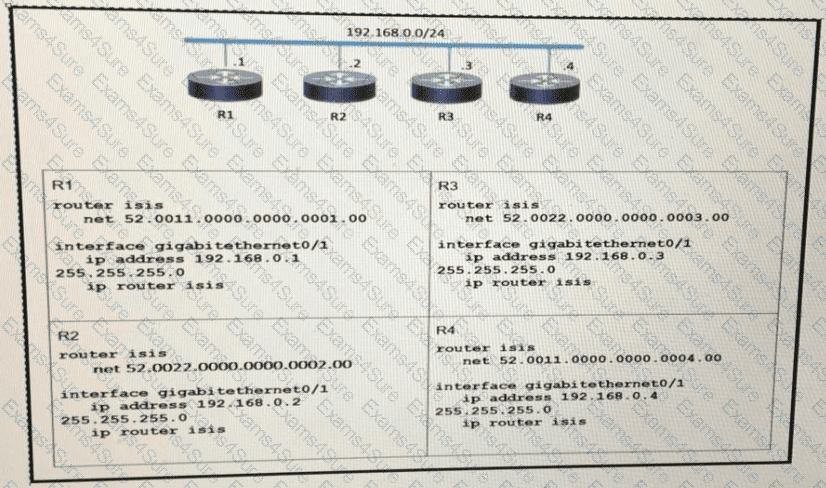
Refer to the exhibit:

Question # 49

Which two statements about the ISIS topology are true? (Choose two.)

Options:

A.  

All four routers are operating as Level 1 routers only.

B.  

All four routers are operating as Level 2 routers only.

C.  

All four routers are operating as Level 1-2 routers.

D.  

R1 and R2 are Level 2 neighbors.

E.  

R1 and R4 are Level 2 neighbors

Discussion 0
Question # 50

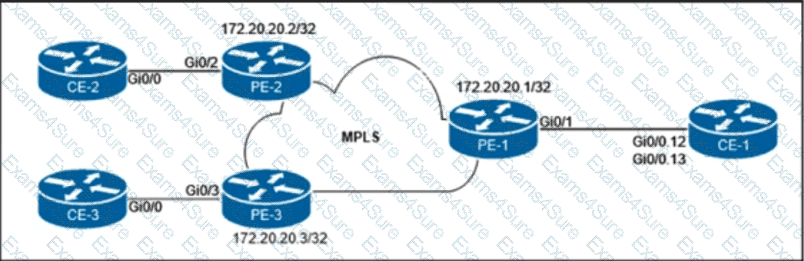
Refer to the exhibit.

Question # 50

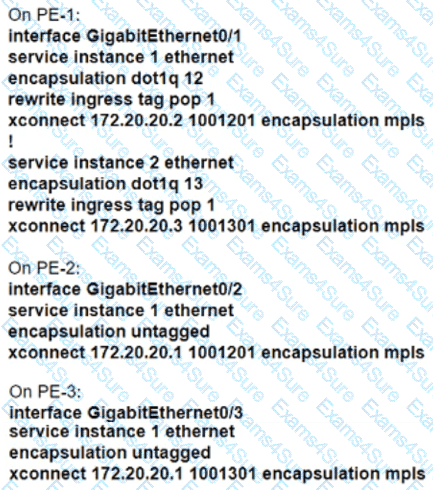
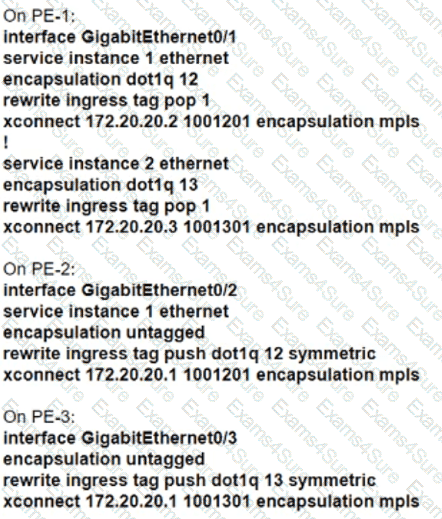
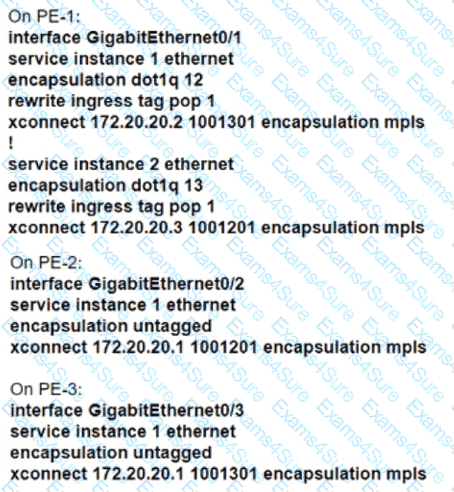
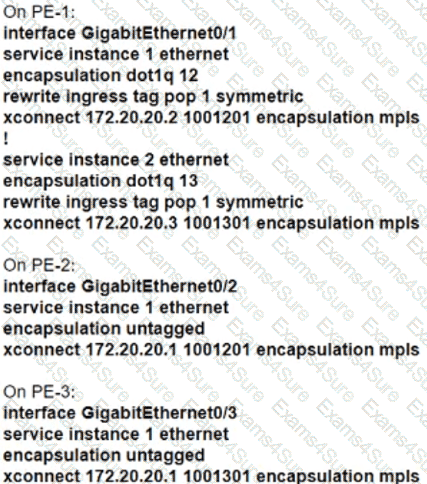
The customer that owns the CE-1, CE-2, and CE-3 routers purchased point-to-point E-Line services from the Carrier Ethernet provider. The service provider is delivering multiplexed UNI at the customer HQ location on PE-1 and untagged UNIs at the PE-2 and PE-3 locations. Additionally, the customer provided these VLAN to EVC mapping requirements:

• EVC 1 between CE-1 and CE-2 must be provisioned with C-VLAN 12 at the HQ location.

• EVC 2 between CE-1 and CE-3 must be provisioned with C-VLAN 13 at the HQ location.

Which configuration must the network engineer implement on the PE routers to provide end-to-end Carrier Ethernet service to the customer?

Options:

A.  
B.  
C.  
D.  
Discussion 0
Question # 51

What is the primary purpose of the flexible algorithm in a segment-routing environment?

Options:

A.  

to distribute designated-path information for certain traffic classes to maintain routing information in accordance with current network-performance indicators

B.  

to integrate with legacy routing protocols to ensure backward compatibility and a smooth transition in mixed network environments

C.  

to determine and assign labels for specific types of traffic, ensuring that routes maintain a valid backup path as network conditions change

D.  

to support adaptive path selection, optimizing network performance based on real-time network metrics

Discussion 0
Question # 52

Which technology enables the addition of new wavelengths in a fiber-optic network?

Options:

A.  

IPoDWDM

B.  

CWDM

C.  

DWDM

D.  

ROADM

Discussion 0
Question # 53

Why do packet loops occur during the configuration of BlDlR-PIM?

Options:

A.  

The network does not support BIDIR-PIM

B.  

The network is partially upgraded to support BIDlR-PIM

C.  

No interface for carrying traffic for multicast groups has been configured

D.  

The router has not been configured to advertise itself

Discussion 0
Question # 54

Which OoS model allows hosts to report their QoS needs to the network?

Options:

A.  

DiffServ

B.  

CB-WFQ

C.  

IntServ

D.  

MQC

Discussion 0
Question # 55

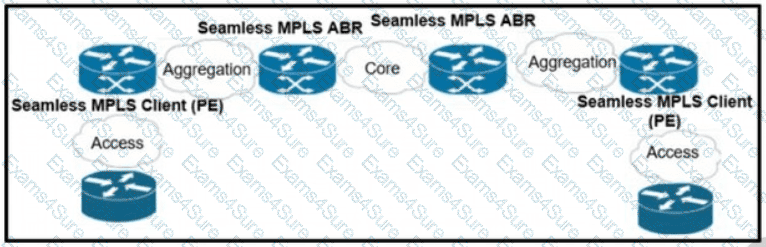
Refer to the exhibit.

Question # 55

A network operator working for a telecommunication company with an employee 3994:37:650 is implementing a cisco Unified MPLS solution. What is the effect of this implementation?

Options:

A.  

EIGRP is deployed between the PEs and ABRs with RFC 3107.

B.  

OSPF is deployed between the PEs and ABRs with RFC 3107.

C.  

IS-IS is deployed between the PEs and ABRs with RFC 3107.

D.  

BGP is deployed between the PEs and ABRs with RFC 3107.

Discussion 0
Question # 56

Refer to the exhibit:

Question # 56

A network engineer is implementing a BGP routing policy.

Which effect of this configuration is true?

Options:

A.  

All traffic that matches acl10 is allowed without any change to its local-preference

B.  

All traffic that matches acl10 is dropped without any change to its local-preference

C.  

If traffic matches acl10, it is allowed and its local-preference is set to 300

D.  

All traffic is assigned a local-preference of 30O regardless of its destination

Discussion 0
Question # 57

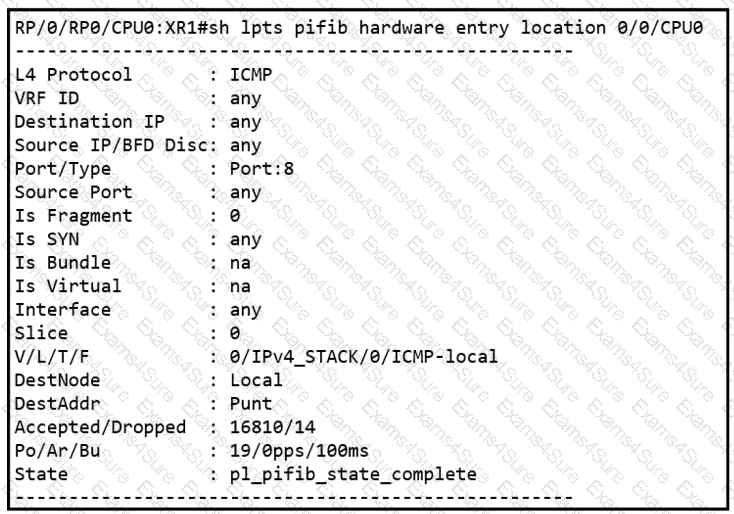
Refer to the exhibit.

Question # 57

While troubleshooting the network, a network operator with an employee id: 3812:12:993 is trying to ping XR1. Which result should the operator expect when trying to ping to an XR1 local address?

Options:

A.  

ICMP traffic works at a policed rate of 19 bytes per second every 100 ms

B.  

All ICMP traffic responds successfully.

C.  

All ICMP traffic is dropped.

D.  

ICMP traffic works at a policed rate of 19 packets every 100 ms.

Discussion 0
Question # 58

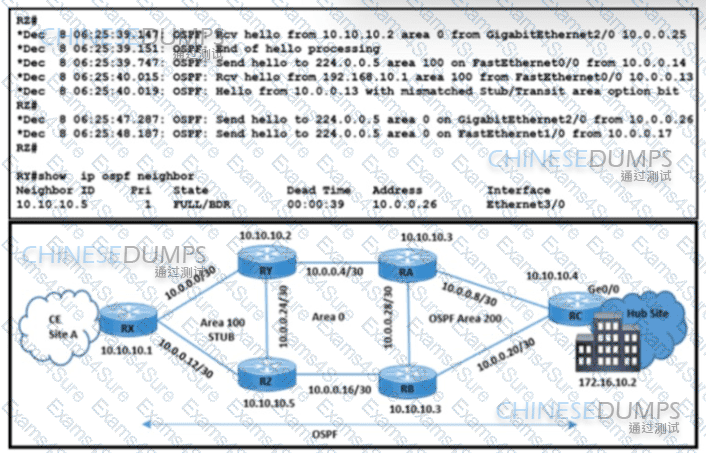
Refer to the exhibit.

Question # 58

A network administrator implemented MPLS LDP changes on PE-A LSR device. The engineer must ensure there are no LDP peer are fully operational. Which LDP feature must the engineer apply to the existing configuration to eliminate the problem?
Options:

A.  

Configure MPLS LDP IGP synchronization on the network.

B.  

Configure MPLS LDP NSR for all LDP sessions.

C.  

Enable LDP session protection under the routing protocol.

D.  

Disable IP CEF on routers running LDP and enable LDP.

Discussion 0
Question # 59

Question # 59

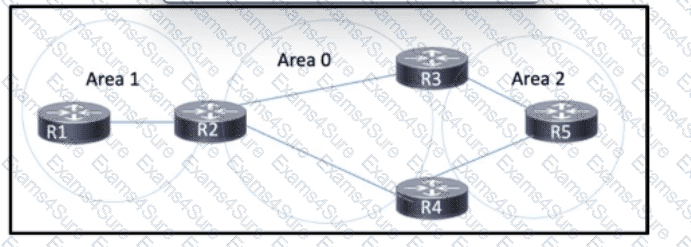
Refer to the exhibit. A network engineer received a complaint about these problems in OSPF stub area 100:

    The Ethernet link is down between routers RX and RY because the fiber was cut.

    CE site A traffic to the hub site is being dropped.

Which action resolves these issues?
Options:

A.  

Set the OSPF authentication type to MD5 between RX and RY DUMPS

B.  

Change the OSPF area 100 type to stub on RZ.

C.  

Change the OSPF priority to 100 on the interfaces that connect RX and RY.

D.  

DUMPS Set the OSPF MTU to 1500 on the link between RX and RZ.

Discussion 0
Question # 60

Question # 60

Refer to the exhibit. OSPF is running in the network, which is segmented into three areas. MPLS is enabled on all routers to support Layer 3 VPN. The network architect is concerned about potential packet loss when new OSPF adjacencies form. Which two tasks should the architect perform to implement MPLS LDP synchronization? (Choose two.)


Options:

A.  

Enable MPLS functionality on all interfaces that are involved in MPLS.

B.  

Configure OSPF to use the same router ID for each router that is involved in MPLS.

C.  

Enable LDP sync under the OSPF process.

D.  

Establish MPLS targeted sessions for connected LDP neighbors only.

E.  

Establish a virtual link between the areas to support LDP sync between segments.

Discussion 0
Get 350-501 dumps and pass your exam in 24 hours!

Free Exams Sample Questions