Spring Sale Limited Time 65% Discount Offer - Ends in 0d 00h 00m 00s - Coupon code: 65pass65

350-501 Implementing and Operating Cisco Service Provider Network Core Technologies (350-501 SPCOR) is now Stable and With Pass Result | Test Your Knowledge for Free

Exams4sure Dumps

350-501 Practice Questions

Implementing and Operating Cisco Service Provider Network Core Technologies (350-501 SPCOR)

Last Update 3 days ago
Total Questions : 547

Dive into our fully updated and stable 350-501 practice test platform, featuring all the latest CCNP Service Provider exam questions added this week. Our preparation tool is more than just a Cisco study aid; it's a strategic advantage.

Our free CCNP Service Provider practice questions crafted to reflect the domains and difficulty of the actual exam. The detailed rationales explain the 'why' behind each answer, reinforcing key concepts about 350-501. Use this test to pinpoint which areas you need to focus your study on.

350-501 PDF

350-501 PDF (Printable)
$48.3
$137.99

350-501 Testing Engine

350-501 PDF (Printable)
$52.5
$149.99

350-501 PDF + Testing Engine

350-501 PDF (Printable)
$65.45
$186.99
Question # 76

Question # 76

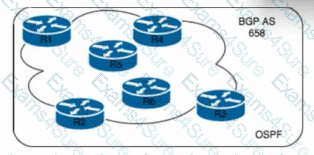
Refer to the exhibit. An ISP is providing online registration services for a new social program. OSPF is being used as an interior routing protocol with TE capabilities. A network engineer with an employee ID: 5209:82:636 must provide faster MPLS-enabled convergence in case of failure. The ip cef distributed command has already been configured on all MPLS-enabled routers, and connectivity between the core routers has been verified following IETF RFC 4379. Which additional task must the engineer perform to complete the implementation?

Options:

A.  

Implement LDP session protection on all PE routers.

B.  

Implement MPLS TE fast reroute node protection on all MPLS-enabled routers.

C.  

Implement MPLS TE fast reroute link protection on routers R2 and R3.

D.  

Implement OSPF loop-free alternate fast reroute on core routers only.

Discussion 0
Question # 77

An engineer working for a telecommunication company with an employee ID: 4460:35:466 must configure an OSPF router in a multivendor network so that it performs NSF in the event of a route processor switchover. Which configuration must the engineer apply?

Options:

A.  

router ospf 1 nsf Cisco

B.  

router ospf 1 nsf ietf

C.  

router ospf 1 nsf ietf helper

D.  

router ospf 1 nsf Cisco helper

Discussion 0
Question # 78

Question # 78

Refer to the exhibit. R1 and R3 have a pseudowire connection between them, which allows R2 and R4 to communicate via Layer 2. R2 uses VLAN 10. R4 also uses VLAN 10, but with a different subnet associated.

Which configuration should the engineer apply to R3 to rewrite the VLAN on traffic from R2 to VLAN 15?

Options:

A.  

interface TenGigE0/0/0/0.1 I2transport

 encapsulation dot1q 10

 rewrite ingress tag translate 1-to-2 dot1q 15 second-dot1q 20

B.  

interface TenGigE0/0/0/0.2 I2transport

 encapsulation dot1q 15

C.  

interface TenGigE0/0/0/0.1 I2transport

 encapsulation dot1q 10

 rewrite ingress tag pop 1

D.  

interface TenGigE0/0/0/0.2 12transport

 encapsulation dot1q 10

 rewrite ingress tag push dot1q 15 symmetric

Discussion 0
Question # 79

Which type of attack is an application attack?

Options:

A.  

ping of death

B.  

ICMP (ping) flood

C.  

HTTP flood

D.  

SYN flood

Discussion 0
Question # 80

Exhibit:

Question # 80

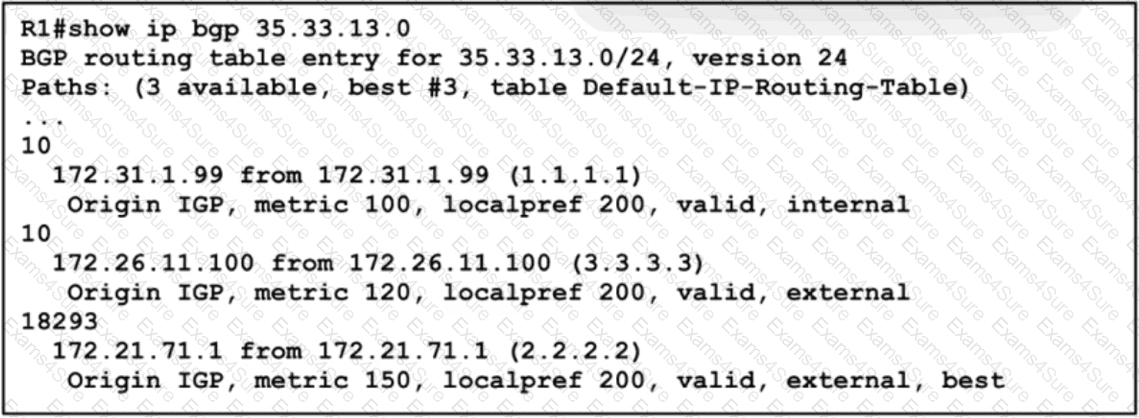
A network engineer must update the routing toward the web server with IP address 35.22.13.1. The primary path must be configured via the neighbor router with ID 1.1.1.1. However, local-preference configuration is not permitted on R1. Which task must the engineer perform on R1 to complete the implementation?
Options:

A.  

Configure the device to choose the best MED from the same AS.

B.  

Set the device to ignore the conditional MED if the route originated in a different autonomous system.

C.  

Enable MED comparison between routes from neighbors in different AS.

D.  

Implement deterministic MED to choose the best route from the different AS.

Discussion 0
Question # 81

What is the main purpose of EVPN?

Options:

A.  

to provide simplified and flexible underlay connectivity for private VPN services

B.  

to provide scalable, interoperable multitenancy in data center and cloud networks

C.  

to provide advanced security features for IoT devices

D.  

to provide application-aware networking capabilities in a cloud environment

Discussion 0
Question # 82

Question # 82

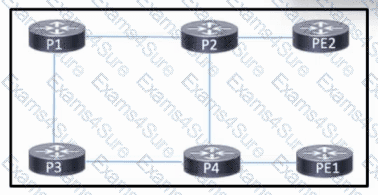
Refer to the exhibit. The network is configured with OSP

F.  

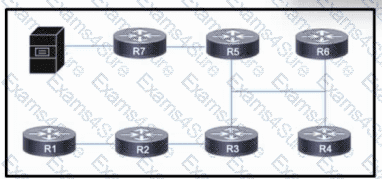
A networking team just connected a streaming multicast server to router R7, and they now must enable access for users throughout the network to stream video from the server.

Which action must the team take so that users can stream video without overloading the network?
Options:

A.  

Implement PIM-DM on the link between the server and R7.

B.  

Implement PIM-SM on the LAN network connecting R5, R6, R3, and R4.

C.  

Implement PIM-SM on all routers and connected links.

D.  

Implement PIM-DM on all interfaces in the network except the LAN connection between R5, R6, R3, and R4.

Discussion 0
Question # 83

Question # 83

Refer to the exhibit. A service provider is running MPLS in the core to support Layer 3 VPN. OSPF is configured to support dynamic routing, and BGP is enabled throughout the network. A network engineer is adding a new P router to the infrastructure and is connecting it to P1 and P3.

Which task must the engineer perform on the new router to allow it to participate in the Layer 3 VPN?

Options:

A.  

Enable LDP sync under the OSPF routing process.

B.  

Establish an LDP neighbor relationship with P1 and P3.

C.  

Configure OSPF and BGP to support MPLS.

D.  

Enable LDP and establish an OSPF adjacency in a new area.

Discussion 0
Question # 84

Drag and drop the functions from the left onto the correct Path Computation Element Protocol roles on the right
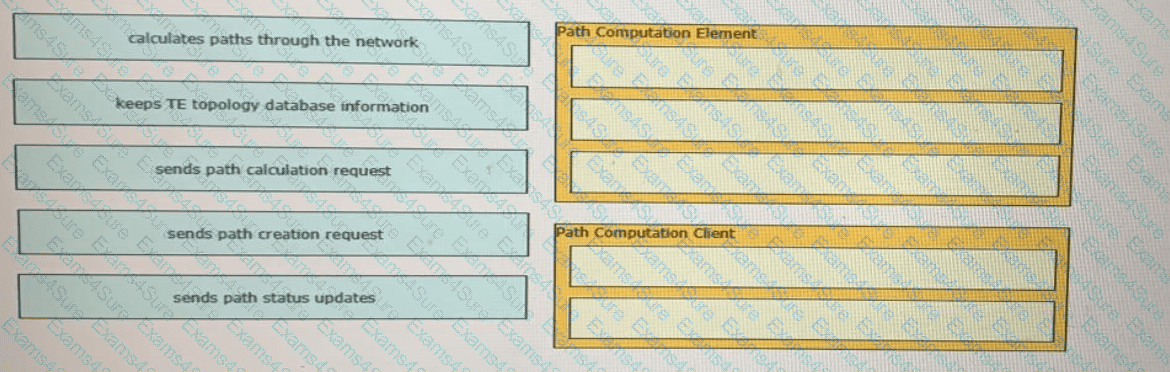
Question # 84

Options:

Discussion 0
Question # 85

How is a telemetry session established for data analytics?

Options:

A.  

A router initiates a session using the dial-out to a destination.

B.  

A destination initiate a session to a router.

C.  

The destination initiate a session using the dial-out more to the router.

D.  

A router requests the data using Teinet.

Discussion 0
Question # 86

Drag and drop the NAT64 descriptions from the left onto the correct NAT64 types on the right.
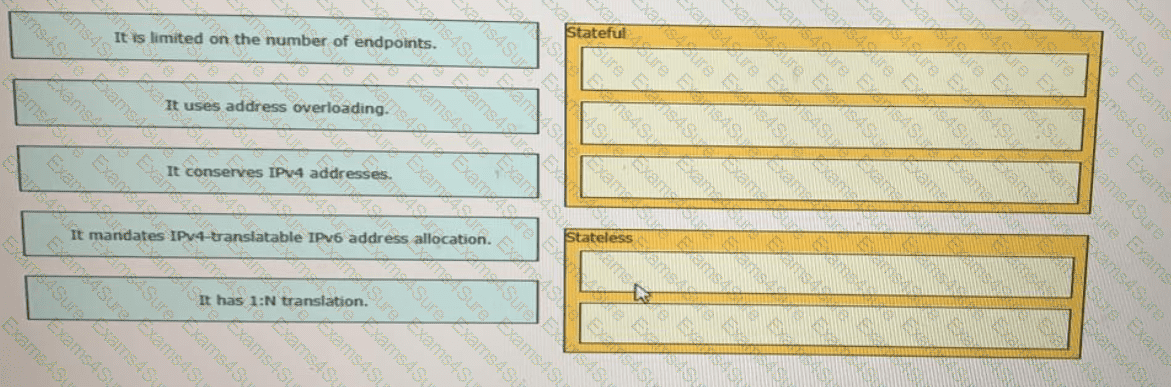
Question # 86

Options:

Discussion 0
Question # 87

The networking team must create a golden configuration to monitor and discover network devices, and also support the capability to configure network devices in the future. Not all devices on the network are capable of gRPC or REST-API calls. The solution should use a username and password, and data in transit should be highly secured. The modern NMS system has been configured with IP address 172.14.15.1, and the snmp-server view iso included command has already been added to the template. Which two commands should the team add to the configuration template to enable SNMPv3 on network devices? (Choose two.)
Options:

A.  

snmp-server user Cisco group v3 auth md5 Cisco123 authpriv aes 192 Cisco1234

B.  

snmp-server group v3 authnopriv ro

C.  

snmp-server user Cisco group v3 auth sha Cisco123 priv aes 256 Cisco1234

D.  

snmp-server user Cisco group v3 auth she-aes Cisco123 authnopriv aes 128 Cisco1234

E.  

snmp-server group v3 priv read view

Discussion 0
Question # 88

What is the primary purpose of Terraform in the network?

Options:

A.  

to manage the Cisco network infrastructure as code to ensure consistent configuration and scalability

B.  

to facilitate the integration of Cisco networking solutions with cloud platforms to improve scalability

C.  

to schedule and manage maintenance tasks on Cisco network devices to minimize errors and downtime

D.  

to enable the seamless migration of Cisco network configurations between diverse network environments

Discussion 0
Question # 89

Question # 89

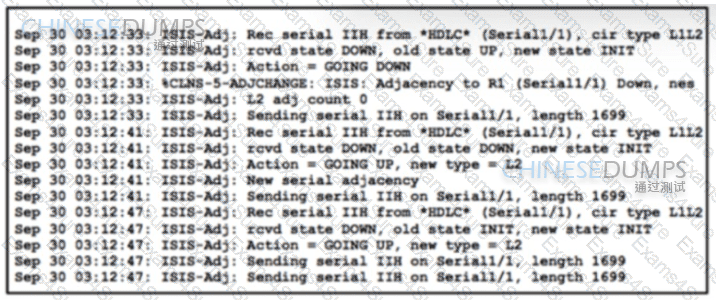
Refer to the exhibit Routers R1 and R2 are connected via a señal link and use the IS-IS routing protocol for route exchange After a configuration change on R2. IS-IS connectivity is interrupted A network engineer confirmed that the interfaces are in the UP state and connectivity exists between the two routers. Which two actions must the engineer perform to resolve the problem? (Choose two.)

Options:

A.  

Disable padding for hello packets under the serial interface on R2 DUMPS

B.  

Change the hello interface timer to 10 seconds on R1.

C.  

Change the MTU to 1500 bytes on R2.

D.  

Enable hello packet padding globally on R1.

E.  

Change R2 to an IS-IS Level 1 router.

Discussion 0
Question # 90

A network engineer must configure a router for Flexible NetFlow IPFIX export. The IP address of the destination server is 172.17.12.1. The source address must be set to the Loopback0 IPv4 address and exported packets must be set to DSCP CS3. The TTL must be 64 and the transport protocol must be set to UDP with destination port 4739. Which configuration must the engineer apply to the router?


Options:

A.  

configure terminal

flow exporter EXPORTER-1

destination 172.17.12.1

source Loopback0

dscp 3

ttl 64

export-protocol netflow-v9

transport udp 4739

end

B.  

configure terminal

flow exporter EXPORTER-1

destination 172.17.12.1

source Loopback0

dscp 24

ttl 64

export-protocol ipfix

end

C.  

configure terminal

flow exporter EXPORTER-1

destination 172.17.12.1

source Loopback0

dscp 24

ttl 64

export-protocol netflow-v9

transport udp 4739

end

D.  

configure terminal

flow exporter EXPORTER-1

destination 172.17.12.1

source Loopback0

dscp 3

ttl 64

export-protocol ipfix

end

Discussion 0
Get 350-501 dumps and pass your exam in 24 hours!

Free Exams Sample Questions