
Spring Sale Limited Time 65% Discount Offer - Ends in 0d 00h 00m 00s - Coupon code: 65pass65

350-501 Implementing and Operating Cisco Service Provider Network Core Technologies (350-501 SPCOR) is now Stable and With Pass Result | Test Your Knowledge for Free

Exams4sure Dumps

350-501 Practice Questions

Implementing and Operating Cisco Service Provider Network Core Technologies (350-501 SPCOR)

Last Update 4 days ago
Total Questions : 547

Dive into our fully updated and stable 350-501 practice test platform, featuring all the latest CCNP Service Provider exam questions added this week. Our preparation tool is more than just a Cisco study aid; it's a strategic advantage.

Our free CCNP Service Provider practice questions crafted to reflect the domains and difficulty of the actual exam. The detailed rationales explain the 'why' behind each answer, reinforcing key concepts about 350-501. Use this test to pinpoint which areas you need to focus your study on.

350-501 PDF

350-501 PDF (Printable)
$48.3
$137.99

350-501 Testing Engine

350-501 PDF (Printable)
$52.5
$149.99

350-501 PDF + Testing Engine

350-501 PDF (Printable)
$65.45
$186.99
Question # 91

Refer to the exhibit.

Question # 91

What does the number 2 mean in the configuration?

Options:

A.  

It dictates the number of sessions that will be open with the SNMP manager

B.  

It represents the version of SNMP running.

C.  

It indicates two SNMP managers are able to read and write with the agent using community string ciscotest.

D.  

It is the numeric name of the ACL that contains the list of SNMP managers with access to the agent.

Discussion 0
Question # 92

The NOC engineer in a service provider network must configure an SNMP community on switch SW with these security attributes:

* Event messages must be authenticated with the MD5 algorithm and encrypted.

* The remote user name for the SNMP server at 172.16.10.1 is AuthNocUser.

Which configuration must the engineer apply to the switch?

Options:

A.  

SW(config)# snmp-server group group2 v3 auth

SW(config)# snmp-server user AuthNocUser group2 remote 172.16.10.1 v3 auth md5 password1

B.  

SW(config)# snmp-server group group3 v3 priv

SW(config)# snmp-server user AuthNocUser group3 remote 172.16.10.1 v3 auth md5 Cisco@123 priv des 56

C.  

SW(config)# snmp-server group group1 v3 noauth

SW(config)# snmp-server user AuthNocUser group1 remote 172.16.10.1

SW(config)# snmp-server host 172.16.10.1 informs version 3 noauth remoteuser config

D.  

SW(config)# snmp-server community comaccess ro 4

SW(config)# snmp-server enable traps snmp authentication

SW(config)# snmp-server host cisco.com version 2c public

Discussion 0
Question # 93

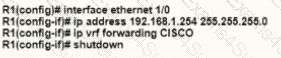
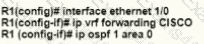
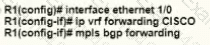
A network engineer is deploying VRF on ASBR router R1. The interface must have connectivity over an MPLS VPN inter-AS Option AB network. Which configuration must the engineer apply on the router to accomplish this task?

A)

Question # 93

B)

Question # 93

C)

Question # 93

D)

Question # 93

Options:

A.  

Option A

B.  

Option B

C.  

Option C

D.  

Option D

Discussion 0
Question # 94

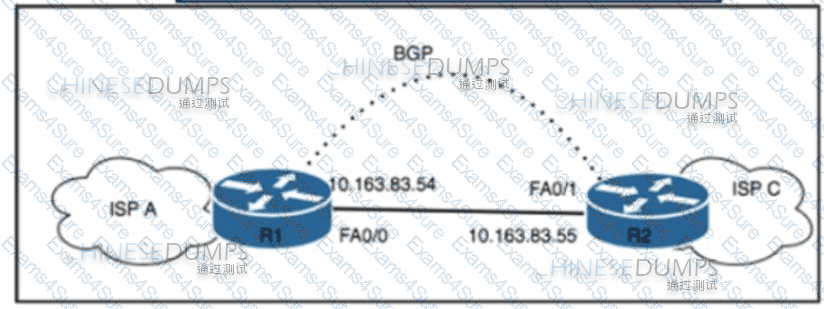
Question # 94Question # 94

Refer to the exhbit. ISP A has a BGP peering with ISP C with the maximum-prefix 150 configuration on R1. After a recent security breach on the ISP A network, a network engineer has been asked to enable a lightweight security mechanism to protect the R1 CPU and BGP membership from spoofing attacks. Which solution must ISP A implement?

Options:

A.  

Configure bgp maxas-limit 1 in the IPv4 address family urateUhe global BGP configuration.

B.  

Configure neighbor 10.163.83.54 enable-connected-check under the BGP IPv4 address family.

C.  

Configure neighbor 10.163.83.55 password Cisco under the global BGP IPv4 address family.

D.  

Configure neighbor 10.163.83.55 ttl-stcurity hops 2 under the global BGP configuration.

Discussion 0
Question # 95

What happens when a segment-routing TE tunnel loses the link and there is no secondary path in place?
Options:

A.  

The headend router generates a new path to the tail-end router using bandwidth to determine the best path.

B.  

The tail-end router sends an alert to the syslog server that the tunnel and the secondary route are inaccessible.

C.  

The headend router starts the invalidation timer to bring the tunnel down.

D.  

The headend and tail-end routers revalidate SID hops to determine the proper label stack to reroute the traffic.

Discussion 0
Question # 96

Question # 96

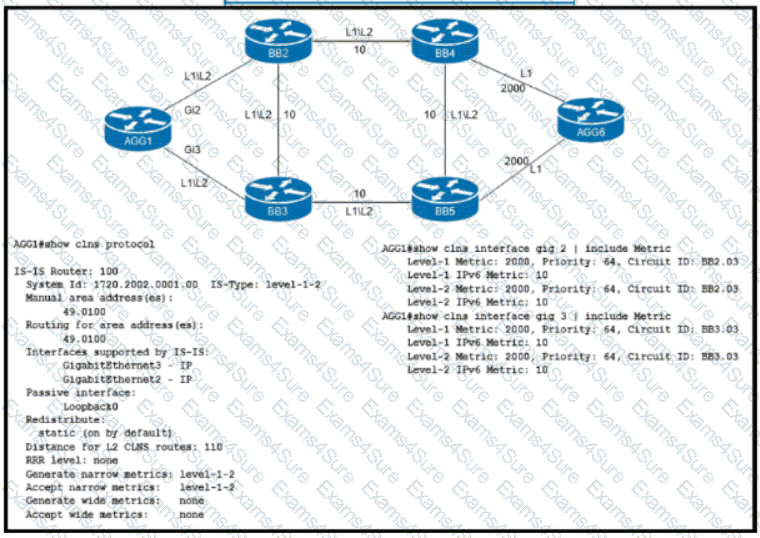
Refer to the exhibit. An engineer is configuring IS-IS on ISP network. Which IS-IS configuration must an engineer implement on router AGG1 so that it establishes connectivity to router AGG6 via the BB3 core router?
Options:

A.  

router isis 100

metric-style narrow

interface GigabitEthernet 3

isis metric 10 level-2

B.  

router isis 100

metric-style wide

interface GigabitEthernet 3

isis metric 1500 level-2

C.  

router isis 100

metric-style narrow

interface GigabitEthernet 3

isis metric 10 level-1

D.  

router isis 100

metric-style wide

interface GigabitEthernet 3

isis metric 1500 level-1

Discussion 0
Question # 97

Question # 97

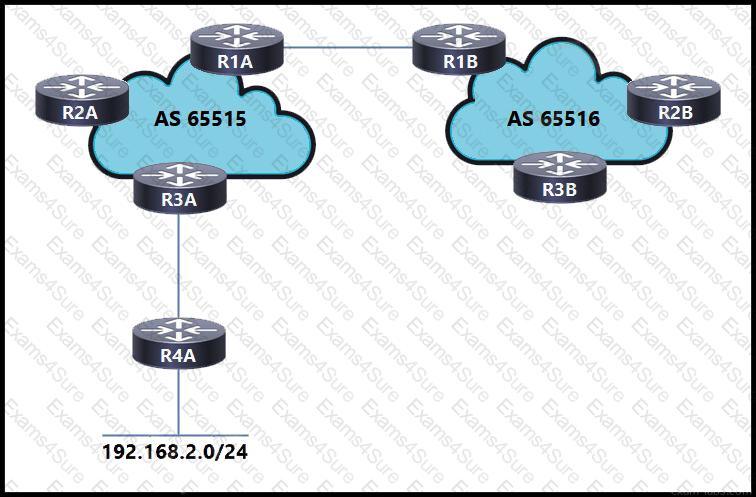
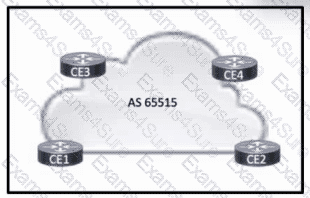
Refer to the exhibit. An engineer working for a private telecommunication company with an employee id: 3414:81:713 is implementing this network, in which:

Routers R1A and R1B are eBGP neighbors.

iBGP is configured within AS 65515 and AS 65516.

Network 192.168.2.0/24 is shared with AS 65516.

Router R3A has an iBGP relationship with router R2A only.

Router R2A has an iBGP relationship with routers R1A and R3

A.  

Which additional task must the engineer perform to complete the configuration?
Options:

A.  

Configure router R2A to use the next-hop-self attribute when advertising the learned route to router R1

A.  

B.  

Configure router R3A to redistribute route 192.168.2.0/24 into the configured IGP to advertise the prefix to router R1

A.  

C.  

Configure router R2A as a route reflector to advertise the iBGP learned prefix from router R3A to R1

A.  

D.  

Configure router R1A with a static route to 192.168.2.0/24 that is redistributed into BGP.

Discussion 0
Question # 98

Which two features describe TI-LFA? (Choose two.)

Options:

A.  

TI-LFA uses PQ or P and Q nodes on the post-convergence path to compute the backup path.

B.  

Post-convergence, TI-LFA considers the next-hop neighbor to calculate the backup repair path.

C.  

TI-LFA works with point of local repair when the PQ node supports only LDP capability.

D.  

Unlike RLFA, TI-LFA works without the PQ node and provides double segment failure protection.

E.  

TI-LFA leverages the post-convergence path that carries data traffic after a failure.

Discussion 0
Question # 99

Question # 99

Refer to the exhibit. The enterprise is running BGP between sites to provide connectivity to users across the company's geographic regions. A network engineer must update the configuration so that the operations team can confirm that BGP prefixes that are received on each router originated from the correct autonomous system.

Which configuration must the engineer apply?
Options:

A.  

bgp bestpath prefix-validate disable

B.  

bgp rpki server tcp 192.168.1.2 port 1029 refresh 500

C.  

bgp bestpath prefix-validate allow-invalid

D.  

bgp synchronization

Discussion 0
Question # 100

Question # 100

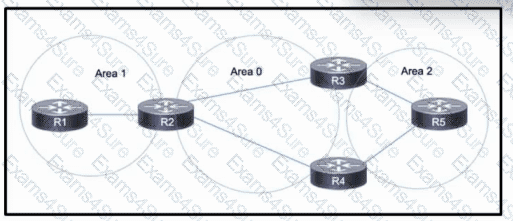
Refer to the exhibit. OSPF is running in the given network. R1 was previously running EIGRP on a standalone network, and a network engineer just migrated it to OSP

F.  

The R1 peering with R2 has come up.

Which additional action must the engineer take so that R2 receives routes from Area 1 and Area 0 but is prevented from receiving routes from Area 2?

Options:

A.  

Implement a route map that matches R2's interface to R3 and R4, and then attach the route map to an inbound distribute list on R2.

B.  

Implement a route map that matches the routes in an ACL from Area 2, and then attach the route map to an inbound distribute list on R2.

C.  

Implement a route map that matches the routes from Area 2 in a prefix list, and then attach the route map to an outbound distribute list on R2.

D.  

Implement a route map that matches R1's next-hop address, and then attach the route map to an outbound distribute list on R2.

Discussion 0
Question # 101

Which additional feature does MPLS DiffServ tunneling support?

Options:

A.  

matching EXP and DSCP values

B.  

interaction between MPLS and IGP

C.  

using GRE tunnels to hide markings

D.  

PHB layer management

Discussion 0
Question # 102

Refer to the exhibit.

Question # 102

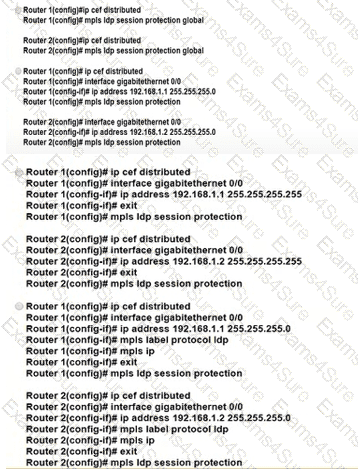
Router 1 and router 2 are running OSPF Area 0. The router logs on both routers show that the LDP link has flapped. Which configuration must the engineer apply to the two routers to implement session protection on the link?
Question # 102

Options:

A.  

Option A

B.  

Option B

C.  

Option C

D.  

Option D

Discussion 0
Question # 103

Question # 103

router(config)# route-map blackhole-trigger

router(config-route-map)# match tag 777

router(config-route-map)# set ip next-hop 10.0.1.1

router(config-route-map)# set origin igp

router{config-route-map)# set community no-export

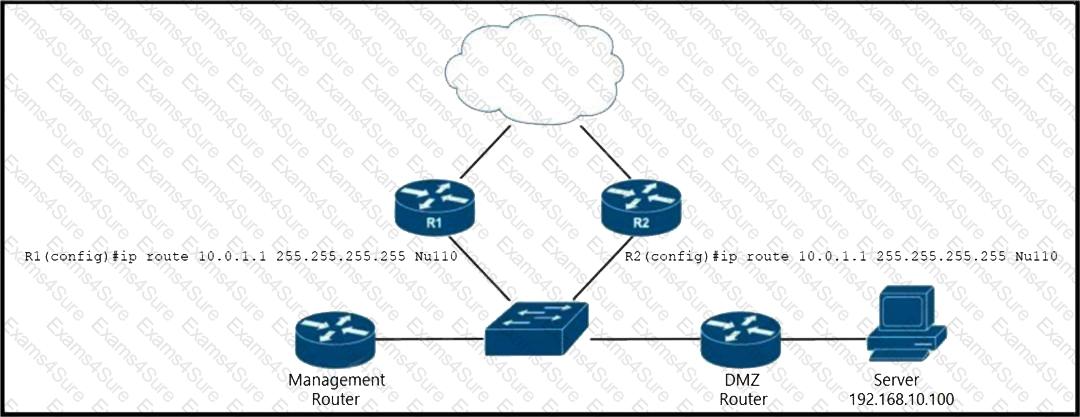
Refer to the exhibit. EIGRP is running across the core to exchange internal routes, and each router maintains iBGP adjacency with the other routers on the network. An operator has configured static routes on the edge routers R1 and R2 for IP address 10.0.1.1, which is used as a black hole route as shown. Which configuration should the operator implement to the management router to create a route map that will redistribute tagged static routes into BGP and create a static route to blackhole traffic with tag 777 that is destined to the server at 192.168.10.100?

Options:

A.  

router(config)# router bgp 55100

router(config-router)# redistribute static route-map blackhole-trigger

router(config)# ip route 10.0.1.1 255.255.255.255 Null0 tag 777

B.  

router(config)# router bgp 55100

router(config-router)# redistribute static route-map blackhole-trigger

router(config)# ip route 192.168.10.100 255.255.255.255 Null0 tag 777

C.  

router(config)# router bgp 55100

router(config-router)# redistribute connected

router(config)# ip route 192.168.10.100 255.255.255.255 tag 777

D.  

router(config)# router bgp 55100

router(config-router)# redistribute connected route-map blackhole-trigger

router(config)# ip route 192.168.10.100 255.255.255.255 Null0 tag 777

Discussion 0
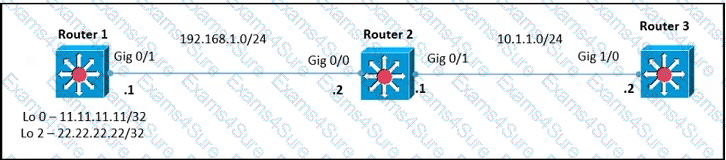
Question # 104

Refer to the exhibit.

Question # 104

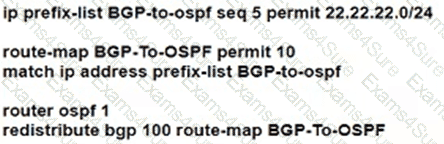
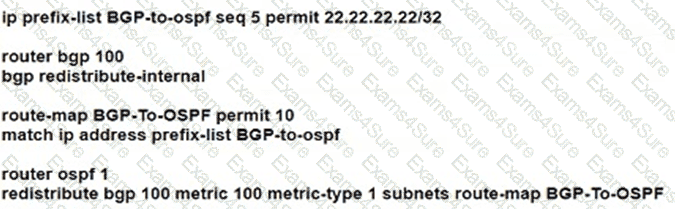
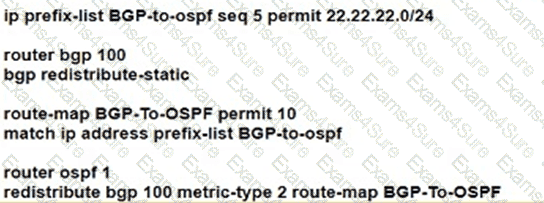
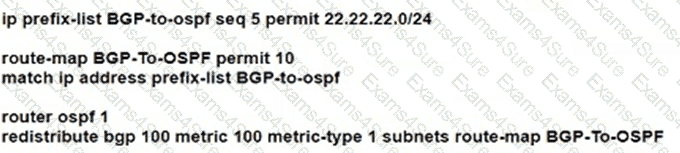
Router 1 and router 2 are running IBGP. and router 2 and router 3 are running OSPF Area 0. Router 1 is advertising loopback interlaces Lo0 and Lo2 and router 2 is redistributing BGP into OSPF Area 0. Which configuration must an administrator apply so that router 2 uses a route map to redistribute only the internal route from Lo 2?

A)
Question # 104

B)

Question # 104

C)

Question # 104

D)

Question # 104

Options:

A.  

Option A

B.  

Option B

C.  

Option C

D.  

Option D

Discussion 0
Question # 105

Question # 105

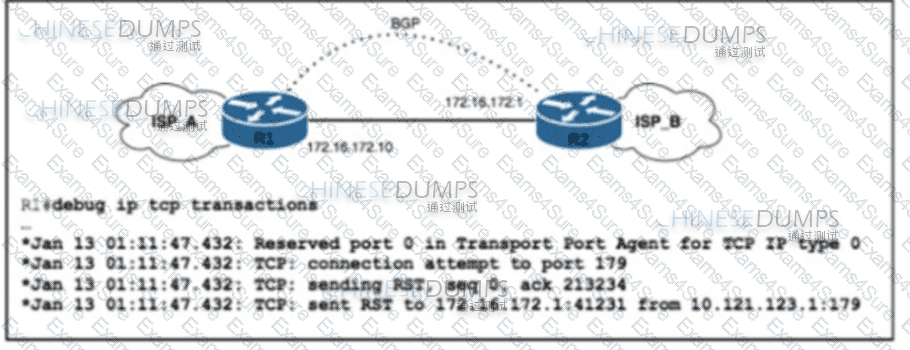
Refer to the exhibit. ISP_A and ISP_B use AS numbers 38321 and 16213 respectively. After a network engineer reloaded router R1, the BGP session with R2 failed to establish. The engineer confirmed BGP next-hop availability with a connectivity test between the router loopback addresses 10.121.123.2 and 10.121.123.1, as well as between interfaces Gi1/1 and Gi1/2. EBGP multihop has been configured on both routers. Which action must the engineer take to resolve the issue?


Options:

A.  

Configure transport connection-mod© passive on R2.

B.  

Configure neighbor 172.16.172.1 authentication on R1

C.  

Configure neighbor update-source lo0 on R2

D.  

Configure remote-as 16213 on R1.

Discussion 0
Get 350-501 dumps and pass your exam in 24 hours!

Free Exams Sample Questions