Spring Sale Limited Time 65% Discount Offer - Ends in 0d 00h 00m 00s - Coupon code: 65pass65

350-501 Implementing and Operating Cisco Service Provider Network Core Technologies (350-501 SPCOR) is now Stable and With Pass Result | Test Your Knowledge for Free

Exams4sure Dumps

350-501 Practice Questions

Implementing and Operating Cisco Service Provider Network Core Technologies (350-501 SPCOR)

Last Update 3 days ago
Total Questions : 547

Dive into our fully updated and stable 350-501 practice test platform, featuring all the latest CCNP Service Provider exam questions added this week. Our preparation tool is more than just a Cisco study aid; it's a strategic advantage.

Our free CCNP Service Provider practice questions crafted to reflect the domains and difficulty of the actual exam. The detailed rationales explain the 'why' behind each answer, reinforcing key concepts about 350-501. Use this test to pinpoint which areas you need to focus your study on.

350-501 PDF

350-501 PDF (Printable)
$48.3
$137.99

350-501 Testing Engine

350-501 PDF (Printable)
$52.5
$149.99

350-501 PDF + Testing Engine

350-501 PDF (Printable)
$65.45
$186.99
Question # 136

What is one of the main functions of 6RD?

Options:

A.  

It provides stateful session translation with the 2002::/16 prefix.

B.  

It translates RFC 1918 IP addresses into public IP addresses.

C.  

It provides native reachability between IPv4-only hosts and 6RD-enabled IPv6 hosts.

D.  

It allows customers IPv6 traffic to be tunneled over IPv4 network infrastructure.

Discussion 0
Question # 137

Question # 137

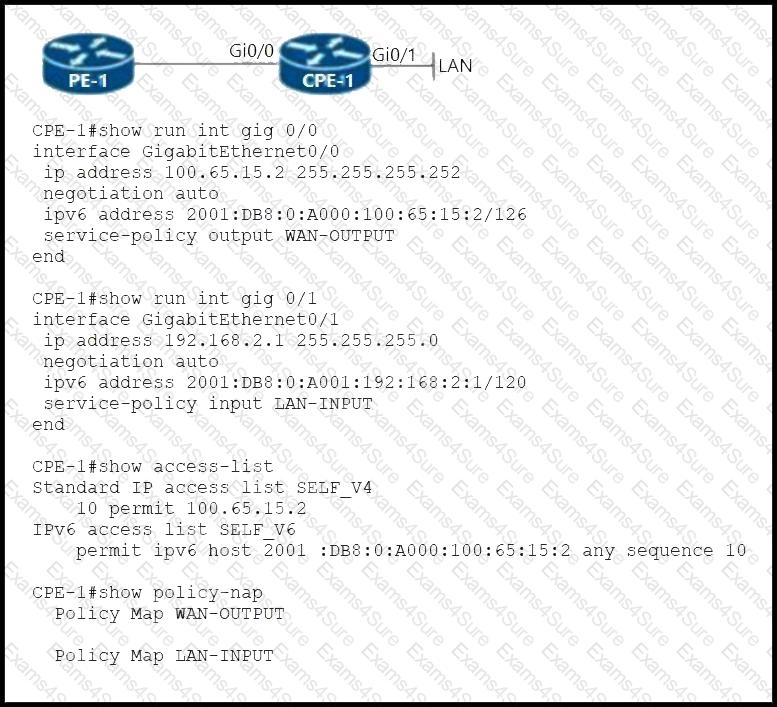
Refer to the exhibit. A network engineer configures CPE-1 for QoS with these requirements:

IPv4 and IPv6 traffic originated by the CPE-1 WAN IP address must be marked with DSCP CS3.

IPv4 LAN traffic must be marked with DSCP CS1.

IPv6 LAN traffic must be marked with DSCP default.

Which configuration must the engineer implement on CPE-1?

Options:

A.  

class-map match-any SELF_TRAFFIC

match access-group name SELF_V4

match access-group name SELF_V6

class-map match-all V4_ TRAFFIC

match protocol ip

class-map match-all V6_TRAFFIC

match protocol ipv6

class-map match-all QG_4

match qos-group 4

class-map match-all QG_6

match qos-group 6

!

policy-map LAN-INPUT

class V4_TRAFFIC

set qos-group 4

class V

B.  

class-map match-all SELF_TRAFFIC

match access-group name SELF_V4

match access-group name SELF_V6

class-map match-all V4_ TRAFFIC

match protocol ip

class-map match-all V6_TRAFFIC

match protocol ipv6

class-map match-all QG_4

match qos-group 4

class-map match-all QG_6

match qos-group 6

!

policy-map LAN-INPUT

class V4_TRAFFIC

set qos-group 4

class V

C.  

class-map match-all SELF_TRAFFIC

match access-group name SELF_V4

match access-group name SELF_V6

class-map match-all V4_ TRAFFIC

match protocol ip

class-map match-all V6_TRAFFIC

match protocol ipv6

class-map match-all QG_4

match qos-group 4

class-map match-all QG_6

match qos-group 6

!

policy-map LAN-INPUT

class V4_TRAFFIC

set qos-group 4

class V

D.  

class-map match-any SELF_TRAFFIC

match access-group name SELF_V4

match access-group name SELF_V6

class-map match-all V4_ TRAFFIC

match protocol ip

class-map match-all V6_TRAFFIC

match protocol ipv6

class-map match-all QG_4

match qos-group 4

class-map match-all QG_6

match qos-group 6

!

policy-map LAN-INPUT

class V4_TRAFFIC

set qos-group 4

class V

Discussion 0
Question # 138

Refer to the exhibit.

Question # 138

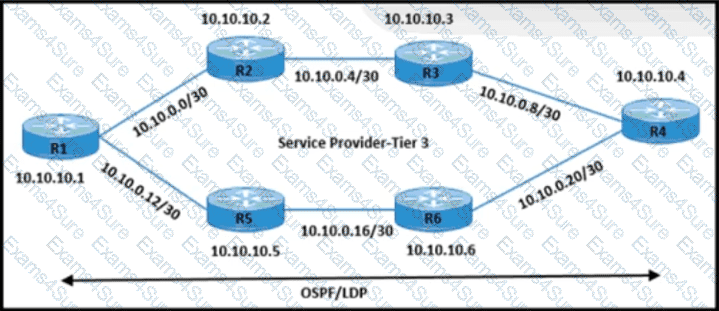
The network engineer is performing end-to-end MPLS path testing with these conditions:

• Users must perform MPLS OAM for all available same-cost paths from R1 to R4.

• Traceroute operations must return all of the next-hop IP details.

Which configuration meets these requirements?

Options:

A.  

traceroute mpls ipv4 10.10.10.4 255.255.255.255 verbose

B.  

traceroute mpls multipath ipv4 10.10.10.4 255.255.255.255

C.  

traceroute mpls multipath ipv4 10.10.10.4 255.255.255.255 verbose

D.  

traceroute mpls ipv4 10.10.10.4 255.255.255.255 source 10.10.10.1

Discussion 0
Question # 139

Refer to the exhibit.

Question # 139

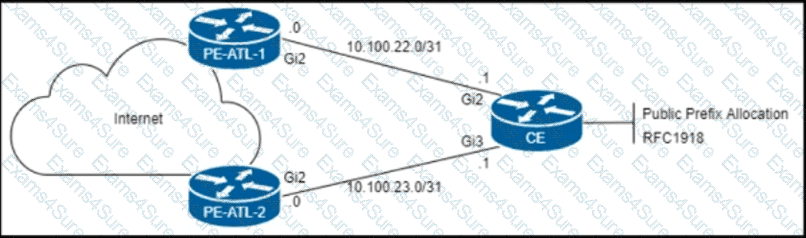
The CE router is peering with both PE routers and advertising a public prefix to the internet. Routing to and from this prefix will be asymmetric under certain network conditions, but packets must not be discarded. Which configuration must an engineer apply to the two PE routers so that they validate reverse packet forwarding for packets entering their Gi2 interfaces and drop traffic from the RFC1918 space?

Options:

A.  

ip verify unicast source reachable-via rx allow-default

B.  

interface GigabitEthernet 2

ip verify unicast source reachable-via rx

C.  

ip verify unicast source reachable-via any allow-default

interface GigabitEthernet 2

D.  

ip verify unicast source reachable-via any

Discussion 0
Question # 140

A network architect must implement CSC VPN services for a new backbone carrier. Which two benefits does the architecture provide? (Choose two.)

Options:

A.  

It maintains.a single backbone, which simplifies the VPN implementation to customers.

B.  

It eliminates the need to maintain a centralized network-maintenance and operations strategy.

C.  

It leverages IPsec to establish connections within the backbone. which eliminates the need for BGP to distribute routes.

D.  

It supports a scalable growth strategy that services multiple customers efficiently

E.  

It relies on IP communications, which simplifies the network design.

Discussion 0
Question # 141

An engineer must implement QoS to prioritize traffic that requires better service throughout the network. The engineer started by configuring a class map to identify the high-priority traffic. Which additional tasks must the engineer perform to implement the new QoS policy?

Options:

A.  

Attach the class map to a policy map that sets the minimum bandwidth allocated to the classified traffic and designates the action to be taken on the traffic.

B.  

Attach the class map to a policy map that designates the action to be taken on the classified traffic and then attach the policy map to an interface using a service policy.

C.  

Attach the class map to a policy map within a VRF to segregate the high-priority traffic and then attach the policy map to an interface in another VR

F.  

D.  

Create a route map to manipulate the routes that are entered into the routing table and then attach the route map to an interface using a service policy.

Discussion 0
Question # 142

Which statement describes the advantage of a Multi-Layer control plane?

Options:

A.  

It automatically provisions monitors, and manages traffic across Layer 0 to Layer 3

B.  

It minimizes human error configuring converged networks

C.  

It supports dynamic wavelength restoration in Layer 0

D.  

It provides multivendor configuration capabilities for Layer 3 to Layer 1

Discussion 0
Question # 143

The NOC team must update the BGP forwarding configuration on the network with these requirements:

BGP peers must establish a neighborship with NSF capability and restart the session for the capability to be exchanged after 120 seconds.

BGP peers must delete routes after 360 seconds of inactivity.

Which action meets these requirements?

Options:

A.  

Set the BGP restart-time to 120 seconds and the BGP ha-mode sso to 360 seconds.

B.  

Set the stalepath-time to 120 seconds and the BGP restart-time to 360 seconds.

C.  

Set the BGP ha-mode sso to 120 seconds and the BGP restart-time to 360 seconds.

D.  

Set the BGP restart-time to 120 seconds and the stalepath-time to 360 seconds.

Discussion 0
Question # 144

Refer to the exhibit:

Question # 144

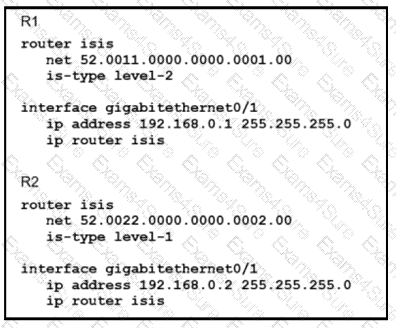
Which statement about the status of the neighbor relationship between R1 and R2 is true?

Options:

A.  

The neighbor relationship is down because the two routers are configured with different area types

B.  

The neighbor relationship is down because the two routers are in the same subnet.

C.  

The neighbor relationship is up because R2 is level 1 and level 2 router.

D.  

The neighbor relationship is down because R2 is operating as a Level 1 router and the two routers are in different area

Discussion 0
Question # 145

An engineer is implementing MPLS to monitor within the MPLS domain. Which must the engineer perform to prevent packets from being forwarded beyond the service provider domain when the LSP is down?
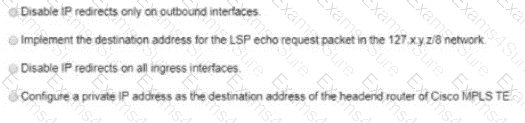
Question # 145

Options:

A.  

Option A

B.  

Option B

C.  

Option C

D.  

Option D

Discussion 0
Question # 146

An organization with big data requirements is implementing NETCONF as part of its migration to a new cloud-based environment. The organization has multiple offices across widespread geography. A network engineer is configuring NETCONF on one of the border routers. Which configuration must the engineer apply to save the running configuration?

Options:

A.  

B.  

C.  

snmp-server community public RW

snmp-server trap link left

snmp-server enable traps snmp authentication linkdown linkup

snmp-server enable traps syslog

snmp-server manager

D.  

logging history debugging

logging snmp-trap emergencies

logging snmp-trap alerts

logging snmp-trap critical

logging snmp-trap errors

logging snmp-trap warnings

logging snmp-trap notifications

logging snmp-trap information

logging snmp-trap debugging

Discussion 0
Question # 147

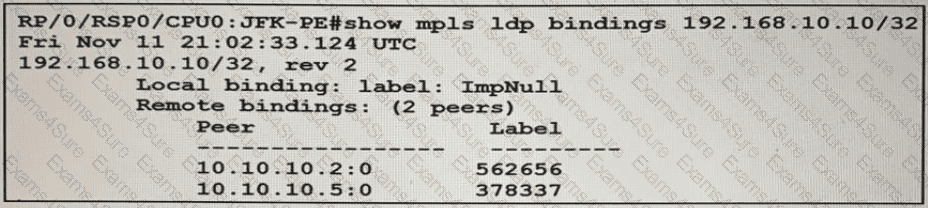
Refer to the exhibit:

Question # 147

After implementing a new design for the network, a technician reviews the pictured CLI output as part of the MOP.

Which two statements describe what the technician can ascertain from the ImpNull output? (Choose two.)
Options:

A.  

Label 0 is used for the prefix displayed but will not be part of the MPLS label stack for packets destined for 192 168.10.10.

B.  

Ultimate Hop Popping is in use for the prefix displayed.

C.  

Label 0 is used for the prefix displayed and will be part of the MPLS label stack for packets destined for 192.168.10.10

D.  

Penultimate Hop Popping is in use for the prefix displayed

E.  

Label 3 is in use for the prefix displayed and will be part of the MPLS label stack for packets destined for 192.168.10.10

Discussion 0
Question # 148

What is a feature of model-driven telemetry?

Options:

A.  

It occasionally streams to multiple servers in the network.

B.  

It is less secure because it uses community strings.

C.  

It uses the pull model to send requested data to a client when polled.

D.  

It uses the push model to stream data to desired destinations.

Discussion 0
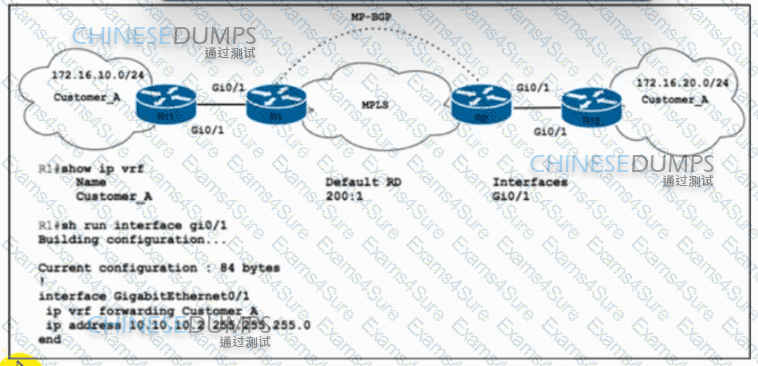
Question # 149

Question # 149

Refer to the exhibit. Customer_A asked ISP_A to connect two offices via an MPLS L3 VPN. Customer_A is currently using only the default route toward ISP_

A.  

The engineer at ISP_A already configured the ip route vrf Customer_A 172.16.10.0 255.255.255.0 10.10.10.1 command on R1. Which action completes the configuration?

Options:

A.  

Configure the network 172.16.10.0 and redistribute-internal static commands under the BGP address family for Customer_A in the global BGP configuration on R1.

B.  

Enable the bgp default route-target filter and default-Information originate commands under the global BGP configuration on R2.

C.  

Configure the route-target both 200:1 and route-replicate vrf Customer_A commands under the lp vrf configuration on R2.

D.  

Configure the redistribute static and redistribute connected commands on R1.

Discussion 0
Question # 150

The network team is planning to implement IPv6 on the company’s existing IPv4 network infrastructure. The network currently uses IS-IS to share routes between peers. Which task must the team perform so that IS-IS will run in multitopology mode on the updated IPv6 network?


Options:

A.  

Configure the links between the network routers as point-to-point.

B.  

Configure the network routers to use metric-style wide.

C.  

Configure the network routers as Level 2 routers.

D.  

Configure the IS-IS IPv6 metric on the dual-stack links.

Discussion 0
Get 350-501 dumps and pass your exam in 24 hours!

Free Exams Sample Questions