Spring Sale Limited Time 65% Discount Offer - Ends in 0d 00h 00m 00s - Coupon code: 65pass65

350-501 Implementing and Operating Cisco Service Provider Network Core Technologies (350-501 SPCOR) is now Stable and With Pass Result | Test Your Knowledge for Free

Exams4sure Dumps

350-501 Practice Questions

Implementing and Operating Cisco Service Provider Network Core Technologies (350-501 SPCOR)

Last Update 4 days ago
Total Questions : 547

Dive into our fully updated and stable 350-501 practice test platform, featuring all the latest CCNP Service Provider exam questions added this week. Our preparation tool is more than just a Cisco study aid; it's a strategic advantage.

Our free CCNP Service Provider practice questions crafted to reflect the domains and difficulty of the actual exam. The detailed rationales explain the 'why' behind each answer, reinforcing key concepts about 350-501. Use this test to pinpoint which areas you need to focus your study on.

350-501 PDF

350-501 PDF (Printable)
$48.3
$137.99

350-501 Testing Engine

350-501 PDF (Printable)
$52.5
$149.99

350-501 PDF + Testing Engine

350-501 PDF (Printable)
$65.45
$186.99
Question # 151

Refer to the exhibit.

Question # 151

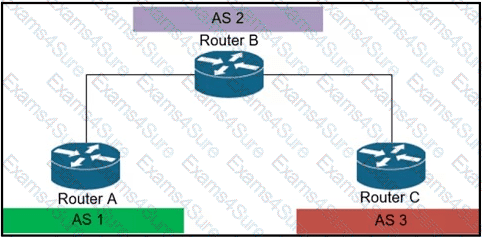
An engineer working for private Service Provider with employee id: 3948:11:613 is configuring the BGPsec framework. Which two conditions must the engineer take into account? (Choose two.)
Options:

A.  

BGPsec uses IPsec tunnel for security.

B.  

The BGPsec framework secures the AS path.

C.  

In BGPsec. all route advertisements are given an expiry time by the originator of the route.

D.  

Private keys are part of the router key pair used to sign route updates.

E.  

In BGPsec. route advertisements are not given an expiration time by the originator of the route.

Discussion 0
Question # 152

Question # 152

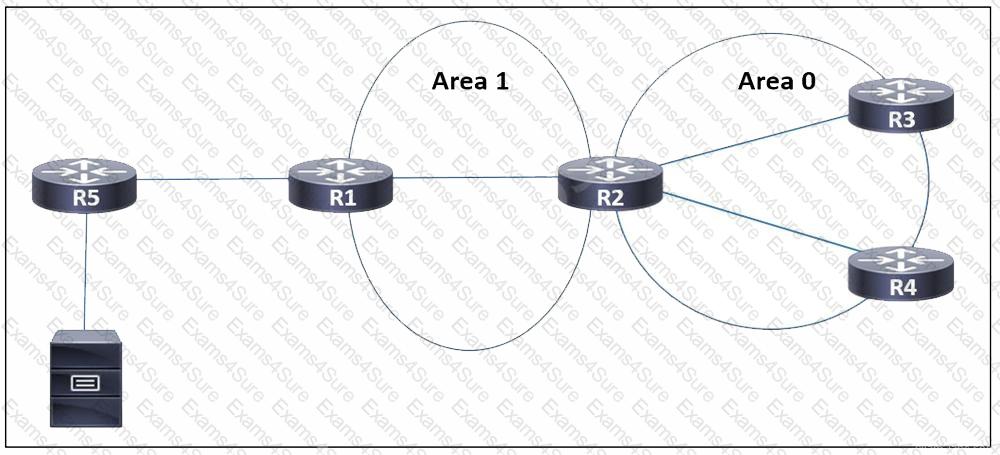
Refer to the exhibit. EIGRP is running between routers R5 and R1, and OSPF is used in the rest of the network. Users in a network attached to router R3 need to access a server connected to R5. Which task must the engineer perform so that only the users attached to R3 are able to access the server, but no other network is shared to OSPF?

Options:

A.  

Configure redistribution using route maps to filter the routes that are shared

B.  

Configure redistribution using an offset list to filter the routes that are shared.

C.  

Configure an OSPF virtual link between R1 and R3 to route traffic between the two areas.

D.  

Configure R1 as a stub router for EIGRP and OSPF so that only the default route is shared

Discussion 0
Question # 153

After you analyze your network environment, you decide to implement a full separation model for Internet access and MPLS L3VPN services For which reason do you make this decision?

Options:

A.  

It enables you to choose whether to separate or centralize each individual service.

B.  

It is easier to manage a system in which services are mixed

C.  

It requires only one edge router

D.  

It enables EGP and IGP to operate independently

Discussion 0
Question # 154

A network engineer must enable the helper router to terminate the OSPF graceful restart process if it detects any changes in the LS

A.  

Which command enables this feature?

Options:

A.  

nsf ietf helper disable

B.  

nsf cisco enforce global

C.  

nsf ietf helper strict-lsa-checking

D.  

nsf Cisco helper disable

Discussion 0
Question # 155

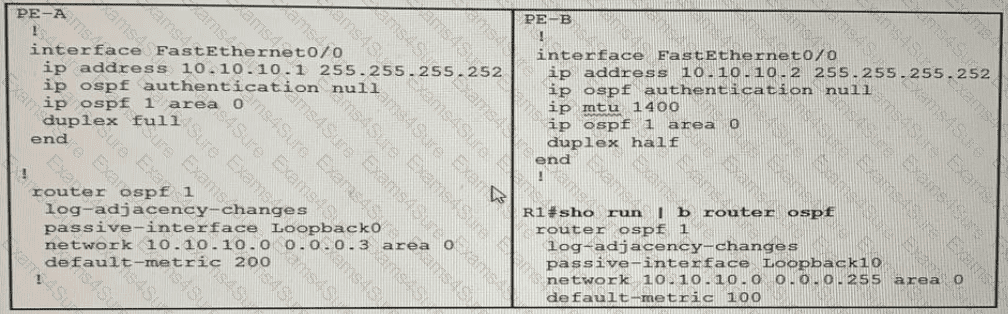
Refer to the exhibit:

Question # 155

Which configuration prevents the OSPF neighbor from establishing?

Options:

A.  

mtu

B.  

duplex

C.  

network statement

D.  

default-metric

Discussion 0
Question # 156

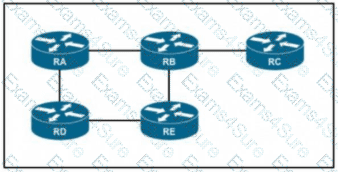
Refer to the exhibit.

Question # 156

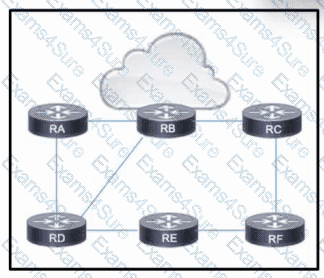
If RC is a stub router, which entry must be injected so that it will send traffic outside the OSPF domain?

Options:

A.  

virtual link between RB and RC

B.  

sham link

C.  

more specific route

D.  

default route

Discussion 0
Question # 157

FRR is configured on a network. What occurs when the headend router on the path is alerted to a link failure over IGP?
Options:

A.  

LSP attempts fast switching on the backup path until the primary path returns to the active state.

B.  

The headend router uses a presignaled LSP to bypass the failure point.

C.  

A new backup tunnel is established past the PLR to pass through the protected nodes

D.  

Backup tunnel is established and intersects with the primary tunnel at the headend.

Discussion 0
Question # 158

Question # 158

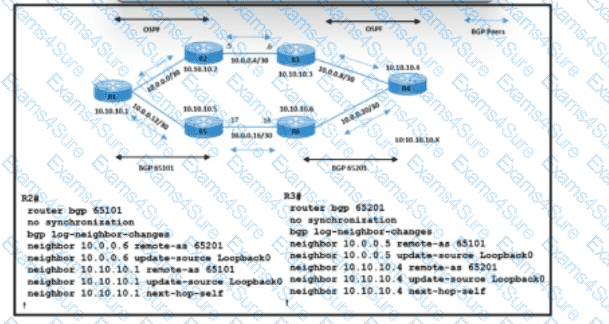
Refer to the exhibit. A network operations team is implementing eBGP on the service provider network. Data traffic between routers R1 and R4 must use the R2-R3 link, which connects AS 65101 and AS65201. iBGP sessions with adjacent routers are up on 10.10.10.1 and 10.10.10.4. The team is now updating the configuration for eBGP peers on routers R2 and R3. Which action must be taken to meet the requirements?

Options:

A.  

Add the soft-reconfiguration command.

B.  

Add the ebgp-multihop command.

C.  

Remove the update-source command.

D.  

Remove the next-hop-self command.

Discussion 0
Question # 159

Refer to the exhibit:

Question # 159

An engineer wants to authenticate the OSPF neighbor between PEA and PE-B using MD5.

Which command on PE-B successfully completes the configuration?

A)

Question # 159

B)

Question # 159

C)

Question # 159

D)

Question # 159

Options:

A.  

Option A

B.  

Option B

C.  

Option C

D.  

Option D

Discussion 0
Question # 160

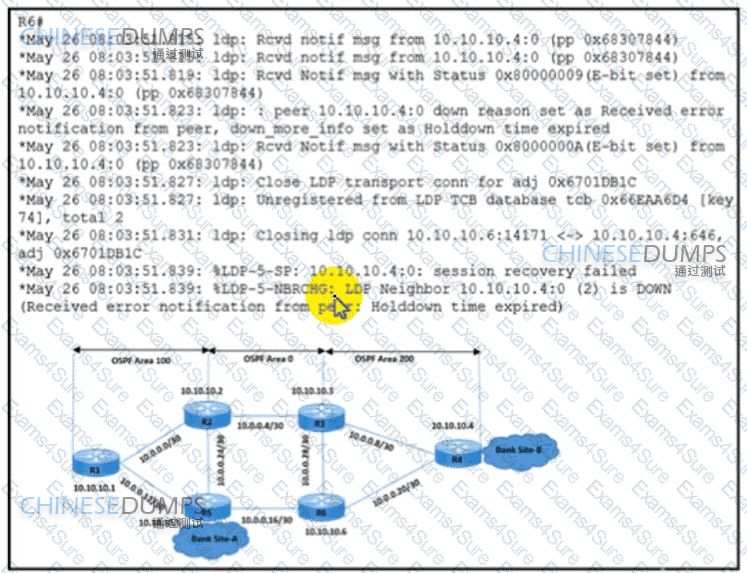
Refer to the exhibit.

Question # 160

A network engineer is implementing an LDP-based MPLS solution to enable packet flow between the two bank sites The engineer was given two requirements

·LDP peering must stay up when there is a link failure between R3 and R6

·LDP peering must not flap when there is a link failure between R5 and R6

Which action meets these requirements?
Options:

A.  

Enable Link LDP on R4 and R6

B.  

Reset the LDP session between R4 and R6

C.  

Configure LDP Session Protection on R4

D.  

Implement an LDP targeted session with R4 on R6

Discussion 0
Question # 161

Question # 161

Refer to the exhibit. The network is running OSPF, and access to the internet is provided through router R

B.  

Router RA connects to several servers that provide services to users connected to RC and R

F.  

User traffic is growing, and the engineering team wants to mitigate the future potential for congestion when the servers are experiencing heavy use.

Which action must the team take to maintain better network performance?

Options:

A.  

Implement MPLS and install a Cisco MPLS TE tunnel to route high-priority traffic via a preferred path.

B.  

Implement ACLs to manage traffic flowing over individual links.

C.  

Implement class maps to categorize traffic and apply them to policies to manage traffic flow.

D.  

Implement OSPF point-to-point links to eliminate the need for DR election and the associated traffic.

Discussion 0
Question # 162

The service provider is serving hosts with two different multicast streams from source X and source Y. Source X is multicast group 224.0.0.0/8, and source Y is multicast group 226.0.0.0/8. Multicast source X should send its stream through bidirectional RP address 10.20.1.1, and multicast source Y should send its stream through RP address 10.20.2.1. Which configuration meets these requirements?

Options:

A.  

Enable ip pim ssm default on RA and R

B.  

B.  

Add ip pim bidir-enable in global mode on R

B.  

C.  

Permit the source X and source Y IP addresses in the access list on R

B.  

D.  

Set PIM sparse mode with a static RP address of 10.20.2.1 on RA and R

C.  

Discussion 0
Question # 163

A company is expanding its existing office space to a new floor of the building, and the networking team is installing a new set of switches. The new switches are running IGMPv2, and the engineers configured them for VLAN10 only. The rest of the existing network includes numerous Layer 2 switches in multiple other VLANs, all running IGMPv3. Which additional task must the team perform when deploying the new switches so that traffic is switched correctly through the entire network?

Options:

A.  

Configure the new switches to use IGMPv3 on all VLANs on the network.

B.  

Configure all switches on the network to support IGMPv2 and IGMPv3 on all VLANs on the network.

C.  

Configure the new switches to use IGMPv3 on VLAN10 only.

D.  

Configure all switches on the network to support IGMPv2 and IGMPv3 on VLAN10 only.

Discussion 0
Question # 164

Question # 164

Refer to the exhibit. An engineer started to configure a router for OSP

F.  

Which configuration must the engineer perform on the router without changing any interface configuration so that the router establishes an OSPF neighbor relationship with its peer?



Options:

A.  

router(config)# router ospf 11router(config-if)# no passive-interface ethernet 1/1

B.  

router(config)# interface ethernet 1/1router(config-if)# no shutdown

C.  

router(config)# interface ethernet 1/1router(config-if)# ip ospf hello-interval

D.  

router(config)# interface ethernet 1/1router(config-if)# ip ospf priority 0

Discussion 0
Get 350-501 dumps and pass your exam in 24 hours!

Free Exams Sample Questions