
Which two of the following are examples of audit methods that 'do' involve human interaction?
An organisation has ISO/IEC 27001 Information Security Management System (ISMS) certification from a third-party certification body. Which one of the following represents an advantage of having accredited certification?
Which two of the following phrases would apply to "act" in relation to the Plan-Do-Check-Act cycle for a business process?
Scenario 7: Webvue. headquartered in Japan, is a technology company specializing in the development, support, and maintenance of computer software. Webvue provides solutions across various technology fields and business sectors. Its flagship service is CloudWebvue, a comprehensive cloud computing platform offering storage, networking, and virtual computing services. Designed for both businesses and individual users. CloudWebvue is known for its flexibility, scalability, and reliability.
Webvue has decided to only include CloudWebvue in its ISO/IEC 27001 certification scope. Thus, the stage 1 and 2 audits were performed simultaneously Webvue takes pride in its strictness regarding asset confidentiality They protect the information stored in CloudWebvue by using appropriate cryptographic controls. Every piece of information of any classification level, whether for internal use. restricted, or confidential, is first encrypted with a unique corresponding hash and then stored in the cloud
The audit team comprised five persons Keith. Sean. Layla, Sam. and Tina. Keith, the most experienced auditor on the IT and information security auditing team, was the audit team leader. His responsibilities included planning the audit and managing the audit team. Sean and Layla were experienced in project planning, business analysis, and IT systems (hardware and application) Their tasks included audit planning according to Webvue’s internal systems and processes Sam and Tina, on the other hand, who had recently completed their education, were responsible for completing the day-to-day tasks while developing their audit skills
While verifying conformity to control 8.24 Use of cryptography of ISO/IEC 27001 Annex A through interviews with the relevant staff, the audit team found out that the cryptographic keys have been initially generated based on random bit generator (RBG) and other best practices for the generation of the cryptographic keys. After checking Webvue's cryptography policy, they concluded that the information obtained by the interviews was true. However, the cryptographic keys are still in use because the policy does not address the use and lifetime of cryptographic keys.
As later agreed upon between Webvue and the certification body, the audit team opted to conduct a virtual audit specifically focused on verifying conformity to control 8.11 Data Masking of ISO/IEC 27001 within Webvue, aligning with the certification scope and audit objectives. They examined the processes involved in protecting data within CloudWebvue. focusing on how the company adhered to its policies and regulatory standards. As part of this process. Keith, the audit team leader, took screenshot copies of relevant documents and cryptographic key management procedures to document and analyze the effectiveness of Webvue's practices.
Webvue uses generated test data for testing purposes. However, as determined by both the interview with the manager of the QA Department and the procedures used by this department, sometimes live system data are used. In such scenarios, large amounts of data are generated while producing more accurate results. The test data is protected and controlled, as verified by the simulation of the encryption process performed by Webvue's personnel during the audit
While interviewing the manager of the QA Department, Keith observed that employees in the Security Training Department were not following proper procedures, even though this department fell outside the audit scope. Despite the exclusion in the audit scope, the non conformity in the Security Training Department has potential implications for the processes within the audit scope, specifically impacting data security and cryptographic practices in CloudWebvue. Therefore, Keith incorporated this finding into the audit report and accordingly informed the auditee.
Based on the scenario above, answer the following question:
Question:
Based on Scenario 7, the audit team checked Webvue’s cryptography policy to obtain reasonable assurance of the information obtained during interviews. Which type of audit procedure has been used?
Scenario 3
NightCore, a multinational technology enterprise headquartered in the United States, specializes in e-commerce, cloud computing, digital streaming, and artificial intelligence (AI). After having an information security management system (ISMS) implemented for over a year, NightCore contracted a certification body to perform an audit for ISO/IEC 27001 certification.
The certification body formed a team of five auditors, with Jack as a team leader. Jack is renowned for his extensive auditing experience in risk management, information security controls, and incident management. His skill set aligns well with the requirements of auditing principles and processes, enabling him to effectively comprehend the audit scope and apply relevant criteria effectively. Jack also demonstrates a solid understanding of NightCore’s organizational structure, purpose, and management practices and the statutory and regulatory requirements applicable to its activities.
The audit carried out by the audit team followed a rational method to reach reliable and reproducible conclusions systematically. The audit team recognized that only information capable of being verified to some extent should be considered valid evidence. In some rare instances during the audit where the verification of certain information posed challenges and where its degree of verifiability was low, the auditors exercised their professional judgment to assess the reliability and determine the level of reliance that could be placed on such evidence.
During the audit, the auditors documented their observations and inspection notes regarding the operational planning and control of NightCore’s ISMS operations. They also recorded observations of NightCore’s inventory of information and associated assets. Additionally, the auditors reviewed the configuration of firewalls implemented to secure connections to network services.
As the audit approached its final stages, NightCore’s commitment to upholding the highest levels of information security became evident. With ISO/IEC 27001 certification within reach, NightCore is well-positioned to achieve ISO/IEC 27001 certification, enhancing its reputation in the technology sector.
Question
Based on Scenario 3, what approach or method did the audit team employ to reach conclusions in NightCore’s audit process?
You are an experienced ISMS Audit Team Leader, talking to an Auditor in training who has been assigned to your audit team. You want to ensure that they understand the importance of the Check stage of the Plan-
Do-Check-Act cycle in respect of the operation of the information security management system.
You do this by asking him to select the answer which best describes the purpose of the check activity 'management review.
The purpose of the management review is to: Select 1
Scenario 3
NightCore, a multinational technology enterprise headquartered in the United States, specializes in e-commerce, cloud computing, digital streaming, and artificial intelligence (AI). After having an information security management system (ISMS) implemented for over a year, NightCore contracted a certification body to perform an audit for ISO/IEC 27001 certification.
The certification body formed a team of five auditors, with Jack as a team leader. Jack is renowned for his extensive auditing experience in risk management, information security controls, and incident management. His skill set aligns well with the requirements of auditing principles and processes, enabling him to effectively comprehend the audit scope and apply relevant criteria effectively. Jack also demonstrates a solid understanding of NightCore’s organizational structure, purpose, and management practices and the statutory and regulatory requirements applicable to its activities.
The audit carried out by the audit team followed a rational method to reach reliable and reproducible conclusions systematically. The audit team recognized that only information capable of being verified to some extent should be considered valid evidence. In some rare instances during the audit where the verification of certain information posed challenges and where its degree of verifiability was low, the auditors exercised their professional judgment to assess the reliability and determine the level of reliance that could be placed on such evidence.
During the audit, the auditors documented their observations and inspection notes regarding the operational planning and control of NightCore’s ISMS operations. They also recorded observations of NightCore’s inventory of information and associated assets. Additionally, the auditors reviewed the configuration of firewalls implemented to secure connections to network services.
As the audit approached its final stages, NightCore’s commitment to upholding the highest levels of information security became evident. With ISO/IEC 27001 certification within reach, NightCore is well-positioned to achieve ISO/IEC 27001 certification, enhancing its reputation in the technology sector.
Question
During the audit at NightCore, the auditors focused on key areas of ISMS operations, including operational planning, asset inventory, and firewall configurations. What type of evidence did the auditors collect during the audit conducted at NightCore?
The auditor discovered that two out of 15 employees of the IT Department have not received adequate information security training. What does this represent?
Which two activities align with the “Check’’ stage of the Plan-Do-Check-Act cycle when applied to the process of managing an internal audit program as described in ISO 19011?
You are the audit team leader conducting a third-party audit of an online insurance organisation. During Stage 1, you found that the organisation took a very cautious risk approach and included all the information security controls in ISO/IEC 27001:2022 Appendix A in their Statement of Applicability.
During the Stage 2 audit, your audit team found that there was no evidence of the implementation of the three controls (5.3 Segregation of duties, 6.1 Screening, 7.12 Cabling security) shown in the extract from the Statement of Applicability. No risk treatment plan was found.
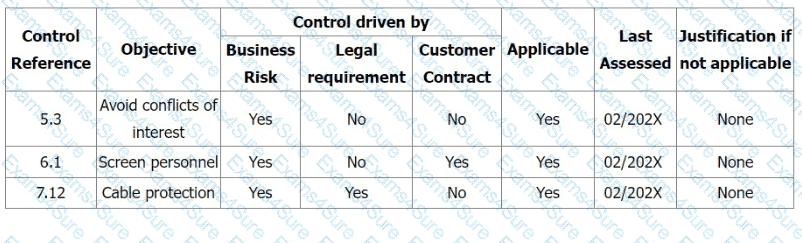
Select three options for the actions you would expect the auditee to take in response to a
nonconformity against clause 6.1.3.e of ISO/IEC 27001:2022.