Integrated reporting is designed to make visible the capitals on which the organisation depends, and how the organisation uses those capitals to create value in the short, medium and long term
Which THREE of the following capitals are specifically identified in the Integrated Reporting
Company Y plans to diversify into an activity where Company X has an equity beta of 1.6, a debt beta of zero and gearing of 50% (debt/debt plus equity).
The risk-free rate of return is 5% and the market portfolio is expected to return 10%.
The rate of corporate income tax is 30%.
What would be the risk-adjusted cost of equity if Company Y has 60% equity and 40% debt?
A company's dividend policy is to pay out 50% of its earnings.
Its most recent earnings per share was $0.50, and it has just paid a dividend per share of $0.25.
Currently, dividends are forecast to grow at 2% each year in perpetuity and the cost of equity is 10.5%.
In order to grow its earnings and dividends, the company is considering undertaking a new investment funded entirely by debt finance. If the investment is undertaken:
• Its cost of equity will immediately increase to 12% due to the increased finance risk.
• Its earnings and dividends will immediately commence growing at 4% each year in perpetuity.
Which of the following is the expected percentage change in the share price if the new investment is undertaken?
A large, quoted company that is all-equity financed is planning to acquire a smaller unquoted company that is also all-equity financed.
The acquiring company's directors are using the dividend valuation model to value the target company before making an offer.
Relevant data for the target company:
• Dividends paid in the last financial year $2 million
• Book value of net assets $15 million
• Shares in issue 1 million
The acquiring company's cost of capital is 10%.
Its directors believe they can improve the target company's performance in the long term.
They estimate there will be no growth in the first year of the acquisition but from year 2 onwards there will be a 4% growth each year in perpetuity.
What is the maximum price the acquiring company should offer for each of the shares in the target company?
F Co. is a large private company, the founder holds 60% of the company's share capital and her 2 children each hold 20% of the share capital.
The company requires a large amount of long-term finance to pursue expansion opportunities, the finance is required within the next 3 months. The family has agreed that an Initial Public Offering (IPO) should not be pursued at this time, because it would take up to 12 months to arrange.
The existing shareholders are currently considering raising the required finance from an established Venture Capitalist in the form of debt and equity. The Venture Capitalist has agreed to provide the required finance provided it can earn a return on investment of 25% per year. In addition, the Venture Capitalist requires 60% of the equity capital, a directorship in the company and a veto on all expenditure of a capital or revenue nature above a specified limit.
From the perspective of the family, which of the following are advantages of raising the required finance from the Venture Capitalist?
Select all that apply.
Company X plans to acquire Company Y.
Pre-acquisition information:
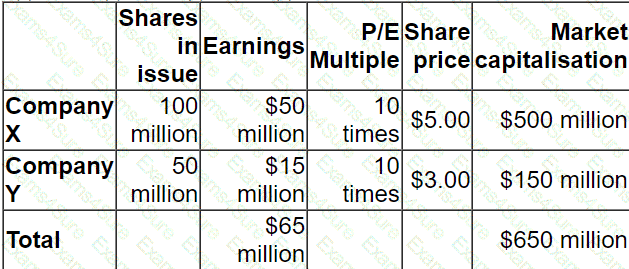
Post-acquisition information:
Total combined earnings are expected to increase by 10%
Total combined P/E multiple will remain at 10 times
Which of the following share-for-share exchanges will result in an increase of 10% in Company X's share price post-acquisition?
Three companies are quoted on the New York Stock Exchange. The following data applies:
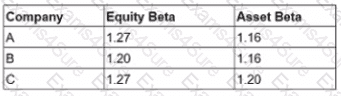
Which of the following statements is TRUE?
Company A has just announced a takeover bid for Company
B.
The two companies are large companies in the same industry_ The bid is considered to be hostile.Company B's Board of Directors intends to try to prevent the takeover as they do not consider it to be in the best interests of shareholders
Which THREE of the following are considered to be legitimate post-offer defences?
A company with a market capitalisation of S50million is considering raising $1 million debt to fund a new 10-year capital investment protect
The value of this issue is considered to be small in comparison to the company's market capitalisation
The company is considering whether to raise the debt finance by either a "bond private placing' or a 'public bond issue.
Which THREE of the following statements are correct?
A company's directors plan to increase gearing to come in line with the industry average of 40%. They need to know what the effect will be on the company's WAC
C.
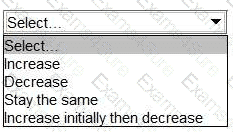
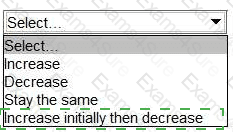
According to traditional theory of gearing the WACC is most likely to: