
A company is planning to repurchase some of its shares. Relevant details are as follows:
• 100 million shares in issue
• Current share price $5
• 5 million shares to be repurchased
• 10% repurchase premium
• Repurchased shares to be cancelled
What would you expect the share price after the repurchase to be?
Give your answer to two decimal places.
$ ?
The table below shows the forecast for a company's next financial year:
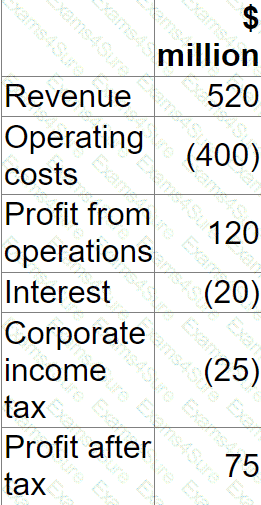
The forecast incorporates the following assumptions:
• 25% of operating costs are variable
• Debt finance comprises a $400 million fixed rate loan at 5%
• Corporate income tax is paid at 25%
The company plans to do the following next year from the forecast earnings on the assumption that earnings will be equivalent to free cash flow:
• Pay a total dividend of $20 million
• Invest $40 million in new projects
What is the maximum % reduction in operating activity that could occur next year before the company's dividend and investment plans are affected?
Give your answer to the nearest 0.1%.
A company has announced a rights issue of 1 new share for every 4 existing shares.
Relevant data:
• The current market price per share is $10.00.
• Rights are to be issued at a 20% discount to the current price.
• The rate of return on the new funds raised is expected to be 10%.
• The rate of return on existing funds is 5%.
What is the yield-adjusted theoretical ex-rights price?
Give your answer to two decimal places.
$ ?
Company ABC is planning to bid for company DDD, an unlisted company in an unrelated industry sector to AB
C.
The directors of ABC are considering a number of different valuation methods for DDD before making a bid.
Which of the following is the MOST appropriate method for ABC to use to value DDD?
An all equity financed company reported earnings for the year ending 31 December 20X1 of $8 million.
One of its financial objectives is to increase earnings by 5% each year.
In the year ending 31 December 20X2 it financed a project by issuing a bond with a $1 million nominal value and a coupon rate of 4%.
The company pays corporate income tax at 20%.
If the company is to achieve its earnings target for the year ending 31 December 20X2, what is the minimum operating profit (profit before interest and tax) that it must achieve?
A major energy company, GDE, generates and distributes electricity in country
A.
The government of country A is concerned about rising inflation and has imposed price controls on GDE, limiting the price it can charge per unit of electricity sold to both domestic and commercial customers. It is likely that price controls will continue for the foreseeable future.
The introduction of price controls is likely to reduce the profit for the current year from $3 billion to $1 billion.
The company has:
• Distributable reserves of $2 billion.
• Surplus cash at the start of the year of $1 billion.
• Plans to pay a total dividend of $1.5 billion in respect of the current year, representing a small annual increase as in previous years. However, no dividends have yet been announced.
Which THREE of the following responses would be MOST appropriate for GDE following the imposition of price controls?
Which THREE of the following statements are true of a money market hedge?
A company proposes to value itself based on the net present value of estimated future cash flows.
Relevant data:
• The cash flow for the next three years is expected to be £100 million each year
• The cash flow after year 3 will grow at 2% to perpetuity
• The cost of capital is 12%
The value of the company to the nearest $ million is:
A company is planning a share repurchase programme with the following details:
• Repurchased shares will be immediately cancelled.
• The shares will be purchased at a premium to the market share price.
The current market share price is greater than the nominal value of the shares.
Which of the following statements about the impact of the share repurchase programme on the company's financial statements is correct?
A company is currently all-equity financed with a cost of equity of 9%.
It plans to raise debt with a pre-tax cost of 3% in order to buy back equity shares.
After the buy-back, the debt-to-equity ratio at market values will be 1 to 2.
The corporate income tax rate is 25%.
Which of the following represents the company's cost of equity after the buy-back according to Modigliani and Miller's Theory of Capital Structure with taxes?