
Company P is a large unlisted food-processing company.
Its current profit before interest and taxation is $4 million, which it expects to be maintainable in the future.
It has a $10 million long-term loan on which it pays interest of 10%.
Corporate tax is paid at the rate of 20%.
The following information on P/E multiples is available:
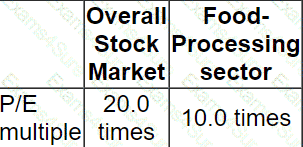
Which of the following is the best indication of the equity value of Company P?
WX, an advertising agency, has just completed the all-cash acquisition of a competitor, YZ. This was seen by the market as a positive strategic move byWX.
Which THREE of the following will WX's shareholders expect the company's directors to prioritise following the acquisition?
The financial assistant of a geared company has prepared the following calculation of the company's equity value:


Useful information;
• Tax rate - 20%
• Cost of equity = 12%
• Weighted average cost of capital (WACC)« 10%
" Debt finance of the company comprises a $6 million 7% undated bond trading at par Valuation workings.
Which of the following errors has been made by the financial assistant?
Which THREE of the following would be of most interest to lenders deciding whether to provide long-term debt to a company?
Company M is a listed company in a highly technical service industry.
The directors are considering making a cash offer for the shares in Company Q, an unquoted company in the same industry.
Relevant data about Company Q:
• The company has seen consistent growth in earnings each year since it was founded 10 years ago.
• It has relatively few non-current assets.
• Many of the employees are leading experts in their field. A recent exercise suggested that the value of the company's human capital exceeded the value of its tangible assets.
The directors and major shareholders of Company Q have indicated willingness to sell the company.
Before negotiations become too advanced, the directors of Company M are considering the benefits to their company that would follow the acquisition.
Which THREE of the following are the most likely benefits of the acquisition to Company M's shareholders?
A venture capitalist is considering investing in a management buy-out that would be financed as follows:
• Equity from managers
• Equity from a venture capitalist
• Mezzanine debt finance from a venture capitalist
• Senior debt from a bank
The venture capitalist is planning to work with the management to grow the business in anticipation of an initial public offering within five years.
However, the cash forecast shows a potential shortage of funds in the first year and the venture capitalist is evaluating the potential impact of cash being generated in the first year being significantly lower than forecast.
The most important risk that a shortage of cash would create for the management buyout is that the new company has insufficient funds to:
A company is considering taking out $10.000,000 of floating rate bank borrowings to finance a new project. The current rate available to the company on floating rate barrowings is 8%. The borrowings contain a covenant based on an interested cover of 5 times.
The project is expected to generate the following results:
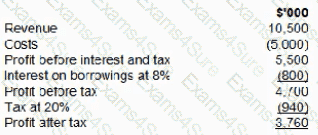
At what interest rate on the floating rate borrowings is the bank covenant first breached?
A listed company has recently announced a profit warning.
The company's share price fell 20% on the day of the announcement but had been fairly static in the weeks leading up to the announcement.
Which form of efficient market is most likely to be indicated by this share price movement?
A company has a financial objective of maintaining a gearing ratio of between 30% and 40%, where gearing is defined as debt/equity at market values.
The company has been affected by a recent economic downturn leading to a shortage of liquidity and a fall in the share price during 20X1.
On 31 December 20X1 the company was funded by:
• Share capital of 4 million $1 shares trading at $4.0 per share.
• Debt of $7 million floating rate borrowings.
The directors plan to raise $2 million additional borrowings in order to improve liquidity.
They expect this to reassure investors about the company's liquidity position and result in a rise in the share price to $4.2 per share.
Is the planned increase in borrowings expected to help the company meet its gearing objective?
A private company manufactures goods for export, the goods are priced in foreign currency B$.
The company is partly owned by members of the founding family and partly by a venture capitalist who is helping to grow the business rapidly in preparation for a planned listing in three years' time.
The company therefore has significant long term exposure to the B$.
This exposure is hedged up to 24 months into the future based on highly probable forecast future revenue streams.
The company does not apply hedge accounting and this has led to high volatility in reported earnings.
Which of the following best explains why external consultants have recently advised the company to apply hedge accounting?