
Company A is a large well-established listed entertainment company and Company B is a small unlisted company specializing in providing online media streaming.
Company A has a gearing ratio of 60% (using book values) and interest cover of 2.
Company A is considering making an offer for Company B, either a cash offer financial by raising additional debt finance or a share-for-share exchange.
Which of the following is most likely to occur if Company A offers a share-for exchange rather than offering cash finance by raising debt?
Which of the following statements are true with regard to interest rate swaps?
Select ALL that apply.
Company ABE is an unlisted company that has been trading for 10 years. During this period, it has seen substantial growth in revenue and earnings. For the company to continue its growth it needs to raise new finance The directors are considering an initial public offering (IPO).
The following information is relevant to Company ABE:
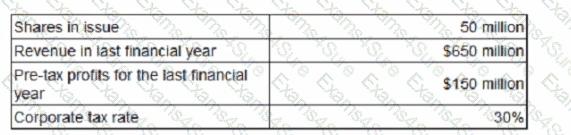
A listed company of similar size and in the same industry as Company ABE had earnings per share in the last financial year of $1 80 Its shares are currently trading at a price / earnings ratio of 12.
The directors of Company ABE have asked for advice on what price they might expect if the company is listed on the stock exchange by means of an IPO.
Using the information provided what is an estimated issue price for each share in Company ABE?

Give your answer to 2 decimal places.
The primary objective of a public sector entity is to ensure value for money is generated.
Value for money is defined as performing an activity so as to simultaneously achieve economy, efficiency and effectiveness
Efficiency is defined as:
A company is valuing its equity prior to an initial public offering (IPO).
Relevant data:
• Earnings per share $1.00
• WACC is 8% and the cost of equity is 12%
• Dividend payout ratio 40%
• Dividend growth rate 2% in perpetuity
The current share price using the Dividend Valuation Model is closest to:
The ex div share price of Company A’s shares is $.3.50
An investor in Company A currently holds 2,000 shares.
Company A plans to issue a script divided of 1 new shares for every 10 shares currently held.
After the scrip divided, what will be the total wealth of the shareholder?
Give your answer to the nearest whole $.
A project requires an initial outlay of $2 million which can be financed with either a bank loan or finance lease.
The company will be responsible for annual maintenance under either option.
The tax regime is:
• Tax depreciation allowances can be claimed on purchased assets.
• If leased using a finance lease, tax relief can be claimed on the interest element of the lease payments and also on the accounting depreciation charge.
The trainee management accountant has begun evaluating the lease versus buy decision and has produced the following data. He is not confident that all this information is relevant to this decision.
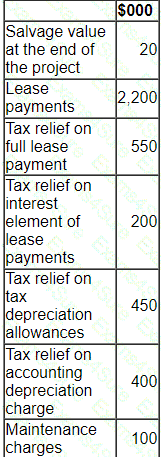
Using only the relevant data, which of the following is correct?




