A manufacturing company is based in Country L whose currency is the L$.
One of the company's products is exported to Country M, a rapidly growing economy, whose currency is the M$.
In the most recent financial year:
• 100,000 units of the product were sold to customers in country M
• The unit selling price was M$12
The spot rate today is L$1 = M$5
The company has an objective of growth in total sales value in L$ of 10% a year.
If the L$ strengthens by 5% next year against the M$, what volume of sales of this product is needed next year to achieve the objective?
SUP is a large supermarket chain. It produces many 'own brand' goods in Country S where the parent company is located. These goods are sold in SUP's supermarkets in Country S as well as being sold at a 'transfer price' to SUP companies located in foreign countries for sale in the SUP supermarkets located in that country.
Which of the following factors is the most important for SUP from a lax planning and compliance viewpoint when setting prices for the 'own brand' goods sold to other group companies'?
The following information relates to Company ZZA's current capital structure:
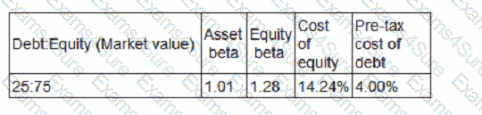
Company ZZA is considering a change in the capital structure that will increase gearing to 35:65 (Debt Equity).
The risk-free rate is 4% and the return on the market portfolio is expected to be 12%.
The rate of corporate tax is 25%
Using the Capital Asset Pricing Model, calculate the cost of equity resulting from the proposed change to the capital structure.
Company C is a listed company. It is currently considering the acquisition of Company
D.
The original founder of Company C currently owns 52% of the shares.Alternative forms of consideration for Company D being considered are as follows:
• Cash payment, financed by new borrowing
• issue of new shares in Company C
Which of the following is an advantage of a cash offer over a share-for exchange from the viewpoint of the original founder of Company C?
Company A is planning to acquire Company B at a price of $ 65 million by means of a cash bid.
Company A is confident that the merged entity can achieve the same price earnings ratio as that of Company
A.
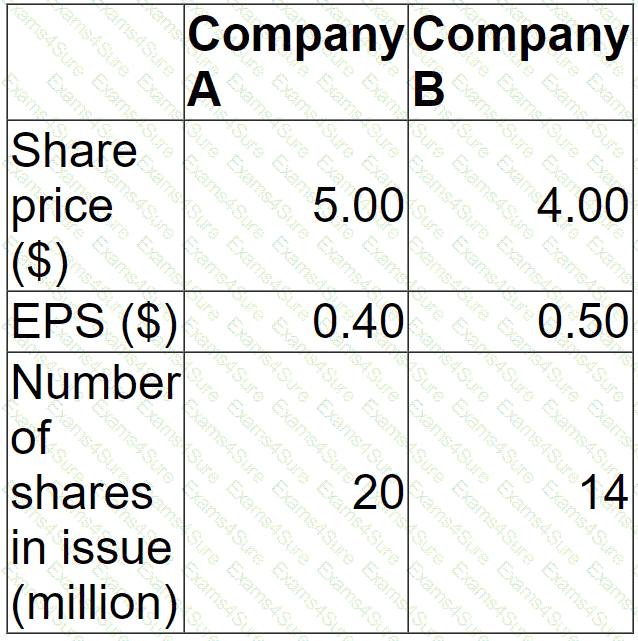
What does Company A expect the value of the merged entity to be post acquisition?
A company raised fixed rate bank finance together with an interest rate swap for the same term and same principal value to pay floating receive fixed rate interest on an annual basis.
Which THREE of the following statements are correct?
An all equity financed company reported earnings for the year ending 31 December 20X1 of $5 million.
One of its financial objectives is to increase earnings by 5% each year.
In the year ending 31 December 20X2 it financed a project by issuing a bond with a $1 million nominal value and a coupon rate of 7%.
The company pays corporate income tax at 30%.
If the company is to achieve its earnings target for the year ending 31 December 20X2, what is the minimum operating profit (profit before interest and tax) that it must achieve?
A company is in the process of issuing a 10 year $100 million bond and is considering using an interest rate swap to change the interest profile on some or all of the $100 million new finance.
The company has a target fixed versus floating rate debt profile of 1:1. Before issuing the bond its debt profile was as follows:
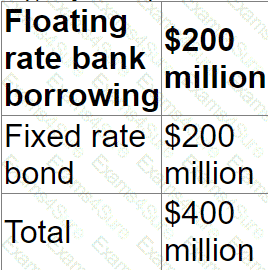
Which of the following is the most appropriate interest rate swap structure for the company?
A company is considering a divestment via either a management buyout (MBO) or sale to a private equity purchaser. Which of the following is an argument in favour of the MBO from the viewpoint of the original company?
A company is based in Country Y whose functional currency is Y$. It has an investment in Country Z whose functional currency is Z$.
This year the company expects to generate Z$ 10 million profit after tax.
Tax Regime:
• Corporate income tax rate in country Y is 50%
• Corporate income tax rate in country Z is 20%
• Full double tax relief is available
Assume an exchange rate of Y$ 1 = Z$ 5.
What is the expected profit after tax in Y$ if the Z$ profit is remitted to Country Y?