
On the network shown in the figure, the DHCP server function is enabled on GEO/0/0 of R2, and the address pool is an interface address pool. When GEO/0/0 and GEO/0/1 of R1 function as DHCP clients, only one interface can obtain an IP address by default.

The configuration of an interface on a switch is shown below. Which of the following average rates of broadcast packets received by the interface trigger the storm control action?

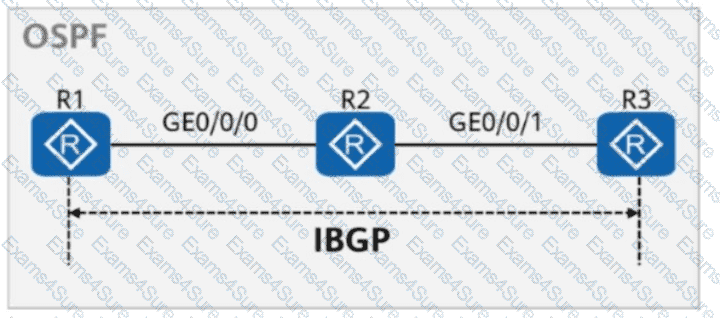
On the network shown in the figure, OSPF runs on R1, R2, and R3, and OSPF BFD is enabled. R1 and R3 use loopback interfaces to establish an iBGP peer relationship. If GE0/0/1 of R2 is shut down, which of the following is the longest period after which the BGP peer relationship of R1 will change from Up to Down?
As shown in the figure, CE1 sends traffic of VPN1 to PE1. After receiving the traffic, PE1 forwards the traffic. Which of the following statements are true?

MPLS supports nesting of multiple labels. After receiving an MPLS packet, a device first processes the label next to the Layer 2 header, that is, the top MPLS label.
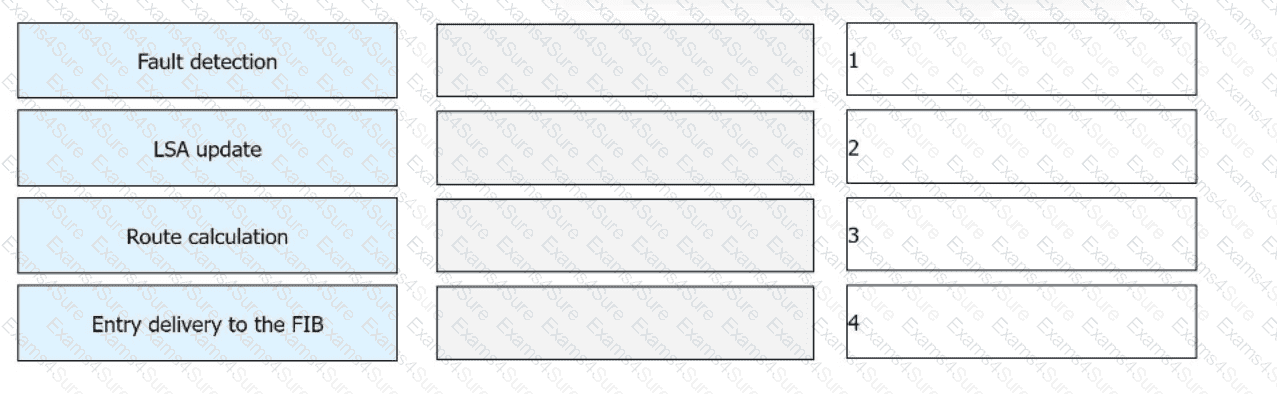
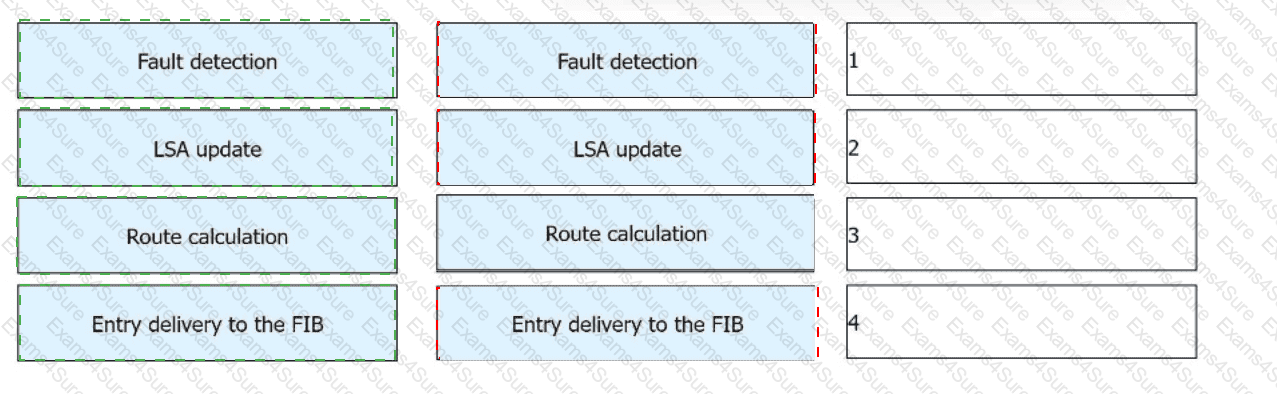
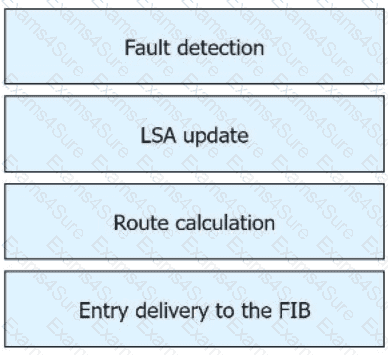
When a fault occurs on an OSPF network, traffic can be switched to another path only after several phases. Sort these phases in the correct sequence.
To protect a device against the attacks of forged BGP messages, you can configure GTSM to check whether the TTL value in the IP message header is within the specified range. If the peer x.x.x.x valid-ttl-hops 100 command is configured on a device, the valid TTL value range of the detected message is [155, 255].
On the network shown in the figure, the DHCP server function is enabled on GE0/0/0 of R2, and the address pool is an interface address pool.
When GE0/0/0 and GE0/0/1 of R1 function as DHCP clients, only one interface can obtain an IP address by default.

Options:
The figure shows an MPLS packet with multiple labels.
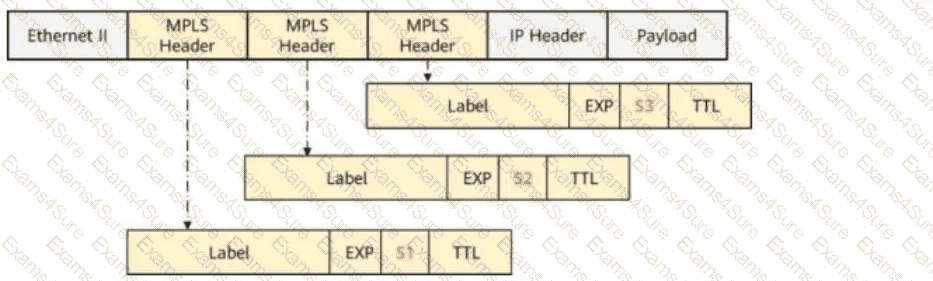
Which of the following values for the S field is correct?
On a stable network that requires fast route convergence, you can change the value of the interval at which OSPF LSAs are updated to 0 so that topology or route changes can be immediately advertised on the network through LSAs, which speeds up route convergence.