
A network engineer provides a troubleshooting report after rectifying a fault. The actual network is simplified into the one shown in the figure, where R1 and R2 both have OSPF enabled, and function as the gateways of PCI and PC2, respectively. Given this, which of the following statements is false?
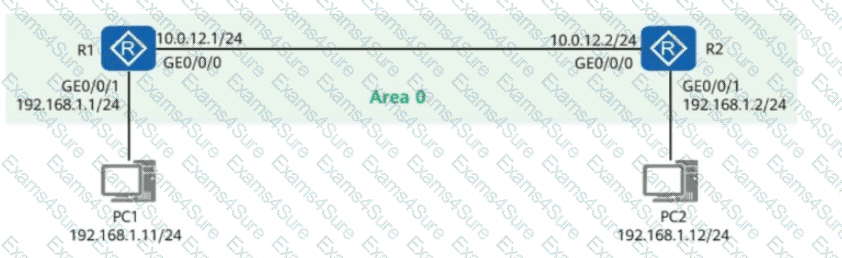
OSPF supports equal-cost load balancing. When the number of equal-cost routes on the network is greater than the number specified in the maximum load-balancing command, and the interface priorities and interface indexes are the same, the routes with smaller next-hop IP addresses are selected for load balancing.
On the OSPFv3 network shown in the figure, the LSDB of R2 contains ____ Router-LSAs. (Enter only digits.)
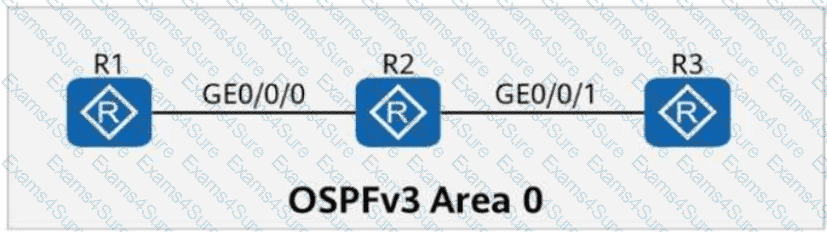
Based on the local LSDB, a device that runs OSPF uses the SPF algorithm to calculate the SPT with itself as the root, and determines the next hop to the destination network according to the SPT. If the network changes frequently, you can set the maximum interval for SPF calculation to 0 ms to speed up route convergence.
On an MPLS network, after an LSR receives a Hello message from a peer, the LSR establishes an LDP adjacency with the peer. The Hello message is sent in multicast or unicast mode.
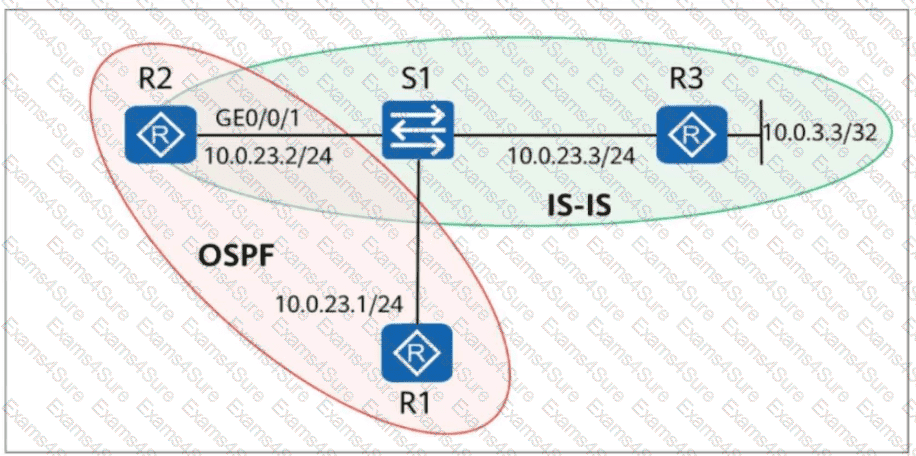
On the network shown in the figure, OSPF is deployed on R1 and R2. IS-IS is deployed on R2 and R3. To enable R1 to obtain the route to 10.0.3.3/32, ISIS routes are imported into OSPF on R2. In this case, the next hop address to 10.0.3.3/32 in the routing table of R1 is_____.
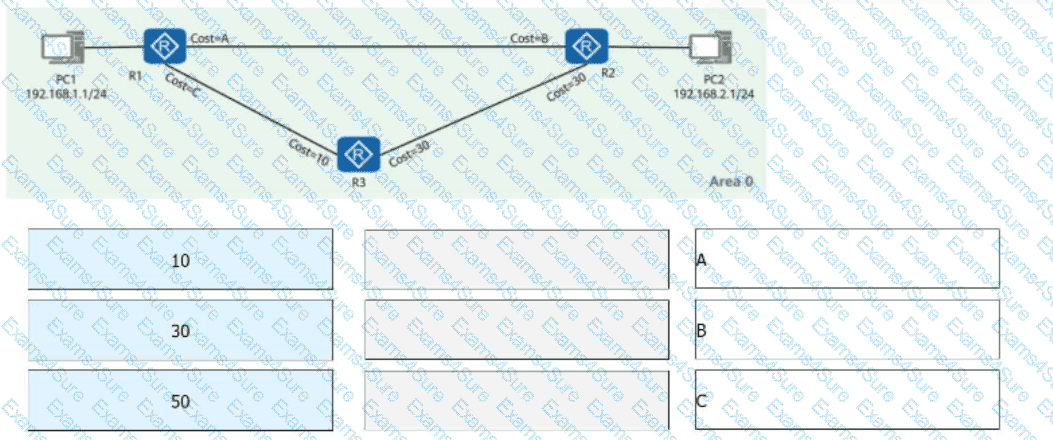
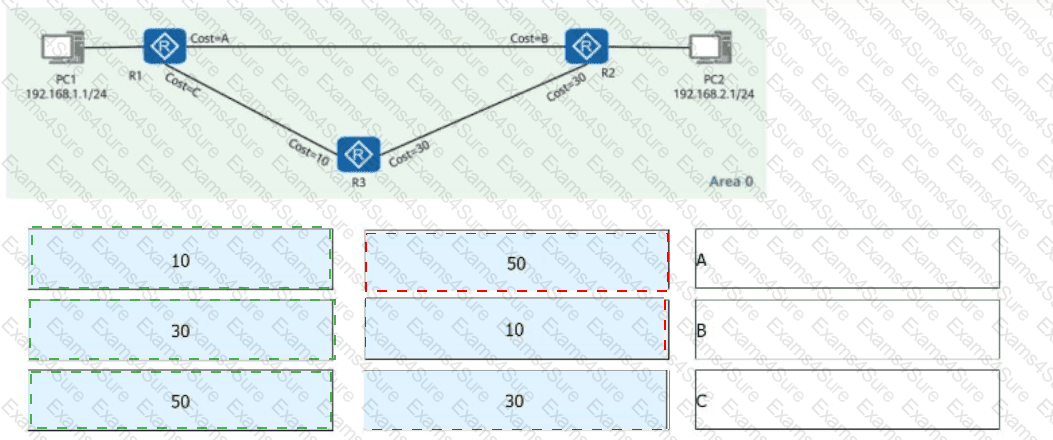
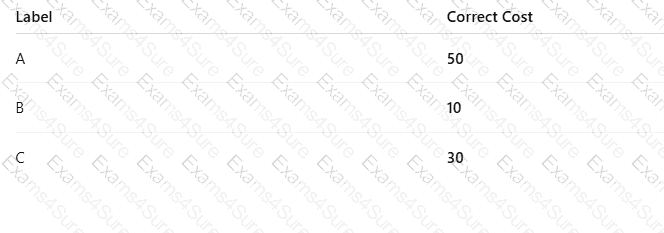
On the OSPF network shown in the figure, drag the values on the left to the correct positions so that the traffic from PC1 to PC2 is sent along the path PC1 → R1 → R3 → R2 → PC2, and the traffic from PC2 to PC1 is sent along the path PC2 → R2 → R1 → PC1.
On the network shown in the figure, IS-IS runs on R1, R2, R4, and R5, and the area ID is 49.0001. IS-IS runs on R3 and R6, and the area ID is 49.0002. The import-route isis level-2 into level-1 command is configured on R2.
In AS 65000, R1, R3, R4, and R6 each establish iBGP peer relationships with R2 and R5. R2 and R5 are Route Reflectors (RRs), and R1, R4, R3, and R6 are clients.
An iBGP peer relationship is established between R2 and R5, and the same cluster ID is configured. The iBGP peer relationships are established using Loopback0. The IP address of Loopback0 on each router is 10.0.X.X/32, where X is the router number.
R1 and R4 import the external route 192.168.1.0/24 to BGP through the import-route command, and R3 and R6 import the external route 192.168.2.0/24 to BGP through the import-route command.
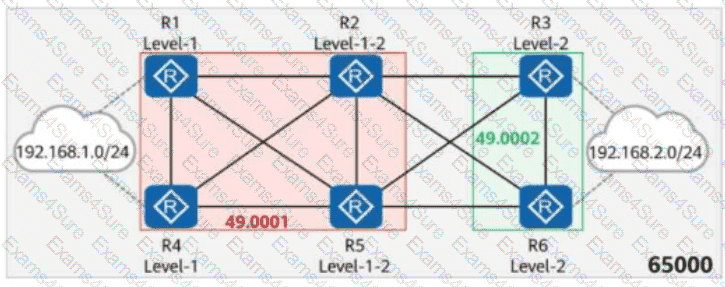
Which of the following statements are true?
OSPFv3 packets are encapsulated in IPv6 packets. Which of the following is the value of the Next Header field in the IPv6 packet header?
Options:
On the network shown in the figure, IS-IS runs on R1, R2, R4, and R5, and the area ID is 49.0001. IS-IS runs on R3 and R6, and the area ID is 49.0002. The import-route isis level-2 into level-1 command is configured on R2.
In AS 65000, R1, R3, R4, and R6 each establish iBGP peer relationships with R2 and R5. R2 and R5 are Route Reflectors (RRs), and R1, R4, R3, and R6 are clients.
The iBGP peer relationships are established using Loopback0. The IP address of Loopback0 on each router is 10.0.X.X/32, and the router ID is 10.0.X.X, where X is the number of the router.
R1 and R4 import the external route 192.168.1.0/24 to BGP through the import-route command, and R3 and R6 import the external route 192.168.2.0/24 to BGP through the import-route command.
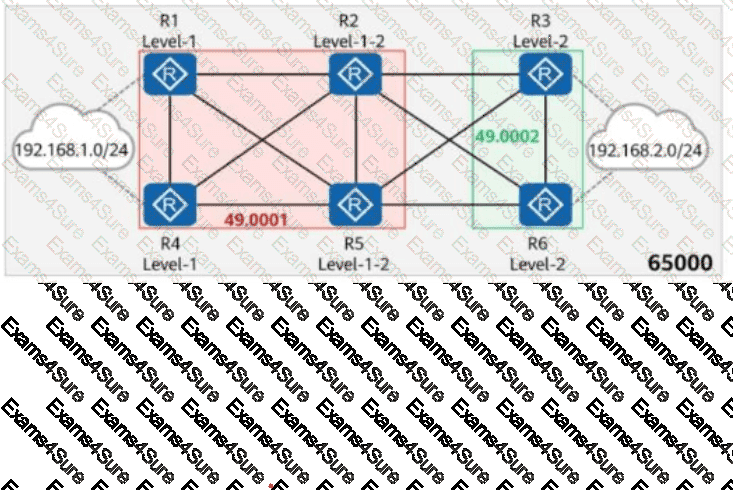
Which of the following statements are true?