
You are conducting an Information Security Management System audit in the despatch department of an international
logistics organisation that provides shipping services to large organisations including local hospitals and government offices.
Parcels typically contain pharmaceutical products, biological samples and documents such as passports and driving licences.
You note that the company records show a very large number of returned items with causes including misaddressed labels
and, in 15% of cases, two or more labels for different addresses for the one package. You are interviewing the Shipping
Manager (SM).
You: Are items checked before being dispatched?
SM: Any obviously damaged items are removed by the duty staff before being dispatched, but the small profit margin makes
it uneconomic to implement a formal checking process.
You: What action is taken when items are returned?
SM: Most of these contracts are relatively low value, therefore it has been decided that it is easier and more convenient to
simply reprint the label and re-send individual parcels than it is to implement an investigation.
You raise a non-conformity against clause 8.1 of ISO 27001:2022.
Which one option below that best describes the non-conformity you have identified?
A data processing tool crashed when a user added more data in the buffer than its storage capacity allows. The incident was caused by the tool's inability to bound check arrays. What kind of vulnerability is this?
Scenario 8: Tessa. Malik, and Michael are an audit team of independent and qualified experts in the field of security, compliance, and business planning and strategies. They are assigned to conduct a certification audit in Clastus, a large web design company. They have previously shown excellent work ethics, including impartiality and objectiveness, while conducting audits. This time, Clastus is positive that they will be one step ahead if they get certified against ISO/IEC 27001.
Tessa, the audit team leader, has expertise in auditing and a very successful background in IT-related issues, compliance, and governance. Malik has an organizational planning and risk management background. His expertise relies on the level of synthesis and analysis of an organization's security controls and its risk tolerance in accurately characterizing the risk level within an organization On the other hand, Michael is an expert in the practical security of controls assessment by following rigorous standardized programs.
After performing the required auditing activities, Tessa initiated an audit team meeting They analyzed one of Michael s findings to decide on the issue objectively and accurately. The issue Michael had encountered was a minor nonconformity in the organization's daily operations, which he believed was caused by one of the organization's IT technicians As such, Tessa met with the top management and told them who was responsible for the nonconformity after they inquired about the names of the persons responsible
To facilitate clarity and understanding, Tessa conducted the closing meeting on the last day of the audit. During this meeting, she presented the identified nonconformities to the Clastus management. However, Tessa received advice to avoid providing unnecessary evidence in the audit report for the Clastus certification audit, ensuring that the report remains concise and focused on the critical findings.
Based on the evidence examined, the audit team drafted the audit conclusions and decided that two areas of the organization must be audited before the certification can be granted. These decisions were later presented to the auditee, who did not accept the findings and proposed to provide additional information. Despite the auditee's comments, the auditors, having already decided on the certification recommendation, did not accept the additional information. The auditee's top management insisted that the audit conclusions did not represent reality, but the audit team remained firm in their decision.
Based on the scenario above, answer the following question:
Question:
After analyzing the audit conclusions, Company X accepted the risk related to a detected nonconformity and decided not to take corrective action. However, their decision was not documented. Is this acceptable?
Scenario 5: Cobt. an insurance company in London, offers various commercial, industrial, and life insurance solutions. In recent years, the number of Cobt's clients has increased enormously. Having a huge amount of data to process, the company decided that certifying against ISO/IEC 27001 would bring many benefits to securing information and show its commitment to continual improvement. While the company was well-versed in conducting regular risk assessments, implementing an ISMS brought major changes to its daily operations. During the risk assessment process, a risk was identified where significant defects occurred without being detected or prevented by the organizations internal control mechanisms.
The company followed a methodology to implement the ISMS and had an operational ISMS in place after only a few months After successfully implementing the ISMS, Cobt applied for ISO/IEC 27001 certification Sarah, an experienced auditor, was assigned to the audit Upon thoroughly analyzing the audit offer, Sarah accepted her responsibilities as an audit team leader and immediately started to obtain general information about Cobt She established the audit criteria and objective, planned the audit, and assigned the audit team members' responsibilities.
Sarah acknowledged that although Cobt has expanded significantly by offering diverse commercial and insurance solutions, it still relies on some manual processes Therefore, her initial focus was to gather information on how the company manages its information security risks Sarah contacted Cobt's representatives to request access to information related to risk management for the off-site review, as initially agreed upon for part of the audit However, Cobt later refused, claiming that such information is too sensitive to be accessed outside of the company This refusal raised concerns about the audit's feasibility, particularly regarding the availability and cooperation of the auditee and access to evidence Moreover, Cobt raised concerns about the audit schedule, stating that it does not properly reflect the recent changes the company made It pointed out that the actions to be performed during the audit apply only to the initial scope and do not encompass the latest changes made in the audit scope
Sarah also evaluated the materiality of the situation, considering the significance of the information denied for the audit objectives. In this case, the refusal by Cobt raised questions about the completeness of the audit and its ability to provide reasonable assurance. Following these situations, Sarah decided to withdraw from the audit before a certification agreement was signed and communicated her decision to Cobt and the certification body. This decision was made to ensure adherence to audit principles and maintain transparency, highlighting her commitment to consistently upholding these principles.
Based on the scenario above, answer the following question:
Question:
Based on the information provided in Scenario 5, Cobt refused to provide the auditors with information on risk management. How would you, as an auditor, resolve such a situation?
You are an experienced ISMS audit team leader providing instruction to a class of auditors in training. The subject of today's lesson is the management of information security risk in accordance with the requirements of ISO/IEC 27001:2022.
You provide the class with a series of activities. You then ask the class to sort these activities into the order in which they appear in the standard.
What is the correct sequence they should report back to you?
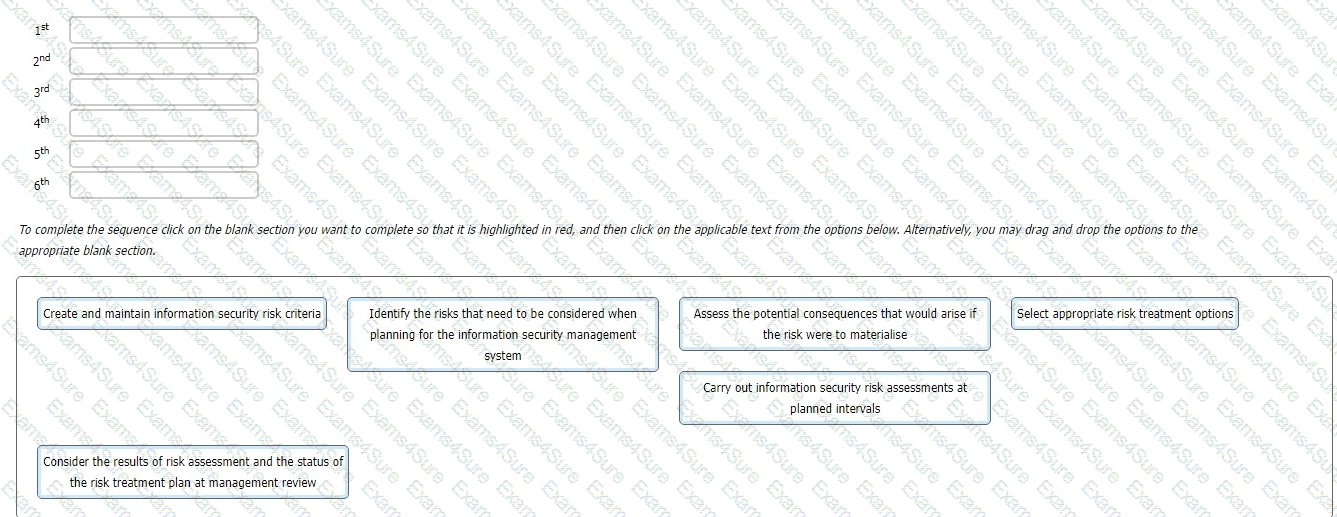
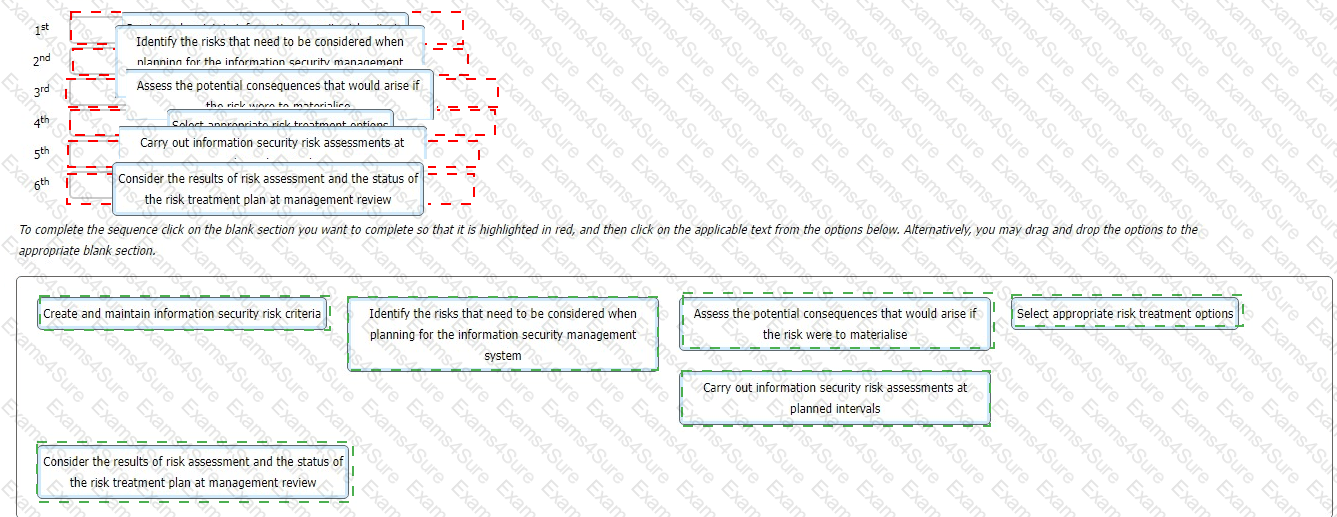
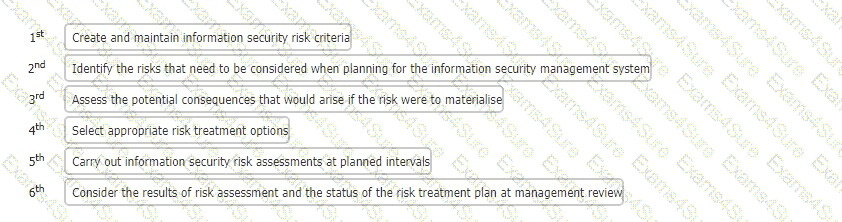
Question:
How does predictive analytics help auditors in identifying potential risks?
Scenario 6: Cyber ACrypt is a cybersecurity company that provides endpoint protection by offering anti-malware and device security, asset life cycle management, and device encryption. To validate its ISMS against ISO/IEC 27001 and demonstrate its commitment to cybersecurity excellence, the company underwent a meticulous audit process led by John, the appointed audit team leader.
Upon accepting the audit mandate, John promptly organized a meeting to outline the audit plan and team roles This phase was crucial for aligning the team with the audit's objectives and scope However, the initial presentation to Cyber ACrypt’s staff revealed a significant gap in understanding the audit's scope and objectives, indicating potential readiness challenges within the company
As the stage 1 audit commenced, the team prepared for on-site activities. They reviewed Cyber ACrypt's documented information, including the information security policy and operational procedures ensuring each piece conformed to and was standardized in format with author identification, production date, version number, and approval date Additionally, the audit team ensured that each document contained the information required by the respective clause of the standard This phase revealed that a detailed audit of the documentation describing task execution was unnecessary, streamlining the process and focusing the team's efforts on critical areas During the phase of conducting on-site activities, the team evaluated management responsibility for the Cyber Acrypt's policies This thorough examination aimed to ascertain continual improvement and adherence to ISMS requirements Subsequently, in the document, the stage 1 audit outputs phase, the audit team meticulously documented their findings, underscoring their conclusions regarding the fulfillment of the stage 1 objectives. This documentation was vital for the audit team and Cyber ACrypt to understand the preliminary audit outcomes and areas requiring attention.
The audit team also decided to conduct interviews with key interested parties. This decision was motivated by the objective of collecting robust audit evidence to validate the management system’s compliance with ISO/IEC 27001 requirements. Engaging with interested parties across various levels of Cyber ACrypt provided the audit team with invaluable perspectives and an understanding of the ISMS's implementation and effectiveness.
The stage 1 audit report unveiled critical areas of concern. The Statement of Applicability (SoA) and the ISMS policy were found to be lacking in several respects, including insufficient risk assessment, inadequate access controls, and lack of regular policy reviews. This prompted Cyber ACrypt to take immediate action to address these shortcomings. Their prompt response and modifications to the strategic documents reflected a strong commitment to achieving compliance.
The technical expertise introduced to bridge the audit team's cybersecurity knowledge gap played a pivotal role in identifying shortcomings in the risk assessment methodology and reviewing network architecture. This included evaluating firewalls, intrusion detection and prevention systems, and other network security measures, as well as assessing how Cyber ACrypt detects, responds to, and recovers from external and internal threats. Under John's supervision, the technical expert communicated the audit findings to the representatives of Cyber ACrypt. However, the audit team observed that the expert s objectivity might have been compromised due to receiving consultancy fees from the auditee. Considering the behavior of the technical expert during the audit, the audit team leader decided to discuss this concern with the certification body.
Based on the scenario above, answer the following question:
Question:
Based on Scenario 6, is the audit team leader’s decision regarding the technical expert’s behavior acceptable?
You are performing an ISMS audit at a residential nursing home that provides healthcare services. The next step in your audit
plan is to verify the information security of the business continuity management process. During the audit, you learned that
the organisation activated one of the business continuity plans (BCPs) to make sure the nursing service continued during the
recent pandemic. You ask the Service Manager to explain how the organization manages information security during the
business continuity management process.
The Service Manager presented the nursing service continuity plan for a pandemic and summarised the process as follows:
Stop the admission of any NEW residents.
70% of administration staff and 30% of medical staff will work from home.
Regular staff self-testing, including submitting a negative test report 1 day BEFORE they come to the office.
Install ABC's healthcare mobile app, tracking their footprint and presenting a GREEN Health Status QR-Code for checking on the spot.
You ask the Service Manager how to prevent non-relevant family members or interested parties from accessing residents' personal data when staff work from home. The Service Manager cannot answer and suggests the IT Security Manager should help with that.
You would like to further investigate other areas to collect more audit evidence. Select three options that will not be in your audit trail.
Scenario 4: SendPay is a financial company that provides its services through a network of agents and financial institutions. One of their main services is transferring money worldwide. SendPay, as a new company, seeks to offer top quality services to its clients. Since the company offers international transactions, it requires from their clients to provide personal information, such as their identity, the reason for the transactions, and other details that might be needed to complete the transaction. Therefore, SendPay has implemented security measures to protect their clients' information, including detecting, investigating, and responding to any information security threats that may emerge. Their commitment to offering secure services was also reflected during the ISMS implementation where the company invested a lot of time and resources.
Last year, SendPay unveiled their digital platform that allows money transactions through electronic devices, such as smartphones or laptops, without requiring an additional fee. Through this platform, SendPay's clients can send and receive money from anywhere and at any time. The digital platform helped SendPay to simplify the company's operations and further expand its business. At the time, SendPay was outsourcing its software operations, hence the project was completed by the software development team of the outsourced company. The same team was also responsible for maintaining the technology infrastructure of SendPay.
Recently, the company applied for ISO/IEC 27001 certification after having an ISMS in place for almost a year. They contracted a certification body that fit their criteria. Soon after, the certification body appointed a team of four auditors to audit SendPay's ISMS.
During the audit, among others, the following situations were observed:
1.The outsourced software company had terminated the contract with SendPay without prior notice. As a result, SendPay was unable to immediately bring the services back in-house and its operations were disrupted for five days. The auditors requested from SendPay's representatives to provide evidence that they have a plan to follow in cases of contract terminations. The representatives did not provide any documentary evidence but during an interview, they told the auditors that the top management of SendPay had identified two other software development companies that could provide services immediately if similar situations happen again.
2.There was no evidence available regarding the monitoring of the activities that were outsourced to the software development company. Once again, the representatives of SendPay told the auditors that they regularly communicate with the software development company and that they are appropriately informed for any possible change that might occur.
3.There was no nonconformity found during the firewall testing. The auditors tested the firewall configuration in order to determine the level of security provided by
these services. They used a packet analyzer to test the firewall policies which enabled them to check the packets sent or received in real-time.
Based on this scenario, answer the following question:
Based on scenario 4, the auditors requested documentary evidence regarding the monitoring process of outsourced operations. What does this indicate?
Finnco, a subsidiary of a certification body, provided ISMS consultancy services to an organization. Considering this scenario, when can the certification body certify the organization?

Exam style questions across every ISO-IEC-27001-Lead-Auditor domain
Last Update 4 days ago
Total Questions : 418
Start with our free ISO-IEC-27001-Lead-Auditor practice questions, carefully crafted to mirror the domains, phrasing, and difficulty of the real ISO 27001 exam. Each ISO-IEC-27001-Lead-Auditor exam question comes with a detailed rationale that explains not just which answer is correct but why the others fall short. That's how concepts stick. Use the free set to benchmark yourself: identify your PECB weak domains, see where you're losing marks, and build a focused study plan in minutes.