
Pre-Summer Sale Limited Time 65% Discount Offer - Ends in 0d 00h 00m 00s - Coupon code: 65pass65

L4M5 Commercial Negotiation is now Stable and With Pass Result | Test Your Knowledge for Free

Exams4sure Dumps

L4M5 Practice Questions

Commercial Negotiation

Last Update 4 days ago
Total Questions : 395

Dive into our fully updated and stable L4M5 practice test platform, featuring all the latest CIPS Level 4 Diploma in Procurement and Supply exam questions added this week. Our preparation tool is more than just a CIPS study aid; it's a strategic advantage.

Our free CIPS Level 4 Diploma in Procurement and Supply practice questions crafted to reflect the domains and difficulty of the actual exam. The detailed rationales explain the 'why' behind each answer, reinforcing key concepts about L4M5. Use this test to pinpoint which areas you need to focus your study on.

L4M5 PDF

L4M5 PDF (Printable)
$43.75
$124.99

L4M5 Testing Engine

L4M5 PDF (Printable)
$50.75
$144.99

L4M5 PDF + Testing Engine

L4M5 PDF (Printable)
$63.7
$181.99
Question # 41

Which of the following will shift the supply curve to the right?

Options:

A.  

Changes in customer taste

B.  

New disruptive technology

C.  

Decreased market price of substitute products

D.  

Increased customers' disposable income

Discussion 0
Question # 42

Which of the following types of questions are likely to be the most effective to check facts in negotiations?

Options:

A.  

Hypothetical

B.  

Open

C.  

Leading

D.  

Closed

Discussion 0
Question # 43

Effective listening is important in integrative negotiations. Is this statement correct?

Options:

A.  

Yes, as it allows issues to be shared and understood between all parties

B.  

Yes, as it means the supplier's attempts at negotiation can be stopped quickly with reasoning

C.  

No, as what the other party has to say is not important

D.  

No, as effective listening is important only in a distributive negotiation

Discussion 0
Question # 44

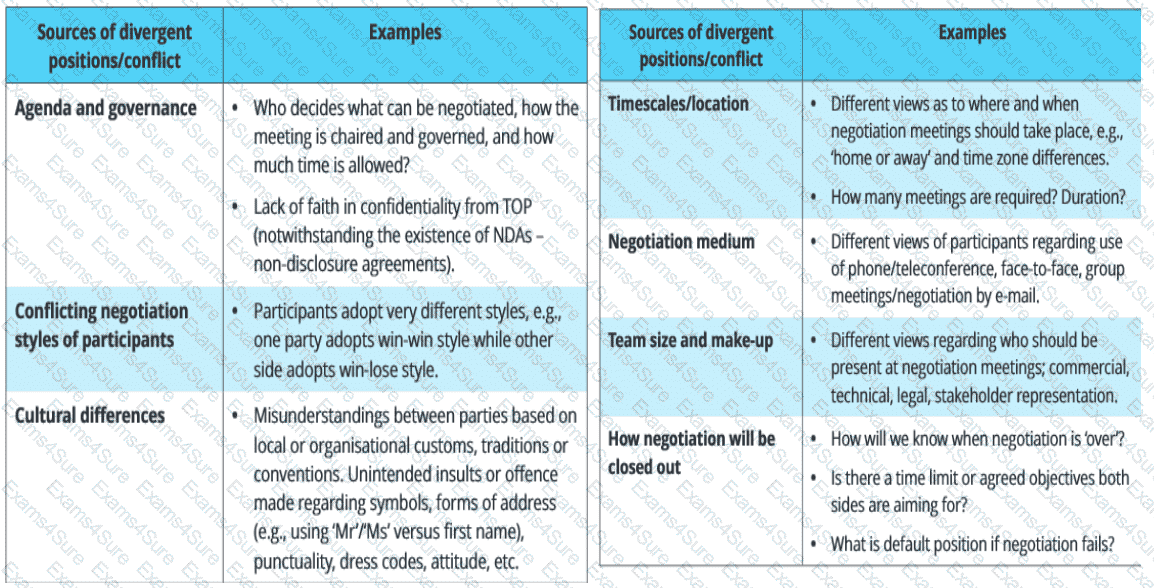
Which of the following are most likely to be sources of conflict that can emerge from the process of commercial negotiations? Select TWO that apply.
Options:

A.  

Differences in conflict management style

B.  

Differences in culture

C.  

Types of purchase

D.  

Standard terms and conditions

E.  

Line of the best fits

Discussion 0
Question # 45

A negotiation process ends once the negotiating meeting has finished. Is this statement true?

Options:

A.  

Yes, provided that the meeting results in a win-win for both parties

B.  

Yes, because both parties have all of the emotional intelligence they need to proceed

C.  

No, best practice would include a period of reflection after the meeting as part of the process

D.  

No, the negotiation of terms should always continue after the meeting and until signed by the supplier only

Discussion 0
Question # 46

Buyers should have the ability to analyse the costs of their purchases not only for determining their impact to their organisation’s cost but also for the purpose of reducing them during commercial negotiations to contribute to the profitability of their organisation. One way ofanalysing costs is to classify them into direct and indirect costs. Which ONE of the following is an explanation of ‘direct costs’?

Options:

A.  

Costs that are only related to manufacturing firms where raw materials are directly converted into specific product units

B.  

Costs of materials, labour, and other expenses that are directly identified with manufactured units of a product

C.  

Costs that are connected with materials and labour, excluding expenses used directly in manufacturing products

D.  

Costs of labour and expenses incurred directly whether or not the production fluctuates owing to demand or downtime

Discussion 0
Question # 47

Telephone is most likely to be used for which of the following negotiations?

Options:

A.  

High value contract

B.  

Contract for purchasing a specialised product

C.  

Routine transactions

D.  

Complex one-off purchase

Discussion 0
Question # 48

A competitive win-lose distributive approach to a negotiation is seeking to:

Options:

A.  

Foster collaboration and trust between the parties to enable joint problem solving

B.  

Obtain the largest possible share of resources or benefits at the expense of the other party

C.  

Maximise joint gains for both parties so that resources and benefits are equally shared

D.  

Compromise and split the difference so that both parties do not get what they want

Discussion 0
Question # 49

A procurement officer for a manufacturing organisation is negotiating with a supplier over the provision of components. The supplier has indicated that they have to raise their prices due to their fixed costs increasing. Which TWO of the following are types of fixed costs?

Options:

A.  

Staff salaries

B.  

Building rents

C.  

Raw materials

D.  

Temporary labour

E.  

Warehouse logistics

Discussion 0
Question # 50

Where a market consists of a large producer of a product with high market power, it is known as:

Options:

A.  

A monopolistic structure

B.  

An oligopoly structure

C.  

A monopoly structure

D.  

A monopsony structure

Discussion 0
Get L4M5 dumps and pass your exam in 24 hours!

Free Exams Sample Questions