Pre-Summer Sale Limited Time 65% Discount Offer - Ends in 0d 00h 00m 00s - Coupon code: 65pass65

MLA-C01 AWS Certified Machine Learning Engineer - Associate is now Stable and With Pass Result | Test Your Knowledge for Free

Exams4sure Dumps

MLA-C01 Practice Questions

AWS Certified Machine Learning Engineer - Associate

Last Update 4 days ago
Total Questions : 241

Dive into our fully updated and stable MLA-C01 practice test platform, featuring all the latest AWS Certified Associate exam questions added this week. Our preparation tool is more than just a Amazon Web Services study aid; it's a strategic advantage.

Our free AWS Certified Associate practice questions crafted to reflect the domains and difficulty of the actual exam. The detailed rationales explain the 'why' behind each answer, reinforcing key concepts about MLA-C01. Use this test to pinpoint which areas you need to focus your study on.

MLA-C01 PDF

MLA-C01 PDF (Printable)
$43.75
$124.99

MLA-C01 Testing Engine

MLA-C01 PDF (Printable)
$50.75
$144.99

MLA-C01 PDF + Testing Engine

MLA-C01 PDF (Printable)
$63.7
$181.99
Question # 31

An ML engineer is designing an AI-powered traffic management system. The system must use near real-time inference to predict congestion and prevent collisions.

The system must also use batch processing to perform historical analysis of predictions over several hours to improve the model. The inference endpoints must scale automatically to meet demand.

Which combination of solutions will meet these requirements? (Select TWO.)

Options:

A.  

Use Amazon SageMaker real-time inference endpoints with automatic scaling based on ConcurrentInvocationsPerInstance.

B.  

Use AWS Lambda with reserved concurrency and SnapStart to connect to SageMaker endpoints.

C.  

Use an Amazon SageMaker Processing job for batch historical analysis. Schedule the job with Amazon EventBridge.

D.  

Use Amazon EC2 Auto Scaling to host containers for batch analysis.

E.  

Use AWS Lambda for historical analysis.

Discussion 0
Question # 32

A company is planning to create several ML prediction models. The training data is stored in Amazon S3. The entire dataset is more than 5 ТВ in size and consists of CSV, JSON, Apache Parquet, and simple text files.

The data must be processed in several consecutive steps. The steps include complex manipulations that can take hours to finish running. Some of the processing involves natural language processing (NLP) transformations. The entire process must be automated.

Which solution will meet these requirements?

Options:

A.  

Process data at each step by using Amazon SageMaker Data Wrangler. Automate the process by using Data Wrangler jobs.

B.  

Use Amazon SageMaker notebooks for each data processing step. Automate the process by using Amazon EventBridge.

C.  

Process data at each step by using AWS Lambda functions. Automate the process by using AWS Step Functions and Amazon EventBridge.

D.  

Use Amazon SageMaker Pipelines to create a pipeline of data processing steps. Automate the pipeline by using Amazon EventBridge.

Discussion 0
Question # 33

A company wants to use large language models (LLMs) that are supported by Amazon Bedrock to develop a chat interface for the company ' s internal technical documentation. The company stores the documentation as dozens of text files that are several megabytes in total size. The company updates the text files often.

Which solution will meet these requirements MOST cost-effectively?

Options:

A.  

Create a new LLM on Amazon Bedrock. Train the new LLM on the original dataset and the company documentation. Make the new model available in Bedrock for calls from the chat interface.

B.  

Integrate the company documentation with Amazon Bedrock guardrails. Invoke the guardrails for all Amazon Bedrock calls from the chat interface.

C.  

Use all the text files to fine tune a model in Amazon Bedrock. Use the fine-tuned model to process user prompts.

D.  

Upload all the text files to an Amazon Bedrock knowledge base. Use the knowledge base to provide context when the chat interface makes calls to Amazon Bedrock.

Discussion 0
Question # 34

An ML engineer is developing a classification model. The ML engineer needs to use custom libraries in processing jobs, training jobs, and pipelines in Amazon SageMaker AI.

Which solution will provide this functionality with the LEAST implementation effort?

Options:

A.  

Manually install the libraries in the SageMaker AI containers.

B.  

Build a custom Docker container that includes the required libraries. Host the container in Amazon Elastic Container Registry (Amazon ECR). Use the ECR image in the SageMaker AI jobs and pipelines.

C.  

Use a SageMaker AI notebook instance and install libraries at startup.

D.  

Run code externally on Amazon EC2 and import results into SageMaker AI.

Discussion 0
Question # 35

A company uses an Amazon SageMaker AI model for real-time inference with auto scaling enabled. During peak usage, new instances launch before existing instances are fully ready, causing inefficiencies and delays.

Which solution will optimize the scaling process without affecting response times?

Options:

A.  

Change to a multi-model endpoint configuration.

B.  

Integrate Amazon API Gateway and AWS Lambda to manage invocations.

C.  

Decrease the scale-in cooldown period and increase the maximum instance count.

D.  

Increase the cooldown period after scale-out activities.

Discussion 0
Question # 36

A company has developed a new ML model. The company requires online model validation on 10% of the traffic before the company fully releases the model in production. The company uses an Amazon SageMaker endpoint behind an Application Load Balancer (ALB) to serve the model.

Which solution will set up the required online validation with the LEAST operational overhead?

Options:

A.  

Use production variants to add the new model to the existing SageMaker endpoint. Set the variant weight to 0.1 for the new model. Monitor the number of invocations by using Amazon CloudWatch.

B.  

Use production variants to add the new model to the existing SageMaker endpoint. Set the variant weight to 1 for the new model. Monitor the number of invocations by using Amazon CloudWatch.

C.  

Create a new SageMaker endpoint. Use production variants to add the new model to the new endpoint. Monitor the number of invocations by using Amazon CloudWatch.

D.  

Configure the ALB to route 10% of the traffic to the new model at the existing SageMaker endpoint. Monitor the number of invocations by using AWS CloudTrail.

Discussion 0
Question # 37

A company wants to use large language models (LLMs) supported by Amazon Bedrock to develop a chat interface for internal technical documentation.

The documentation consists of dozens of text files totaling several megabytes and is updated frequently.

Which solution will meet these requirements MOST cost-effectively?

Options:

A.  

Train a new LLM in Amazon Bedrock using the documentation.

B.  

Use Amazon Bedrock guardrails to integrate documentation.

C.  

Fine-tune an LLM in Amazon Bedrock with the documentation.

D.  

Upload the documentation to an Amazon Bedrock knowledge base and use it as context during inference.

Discussion 0
Question # 38

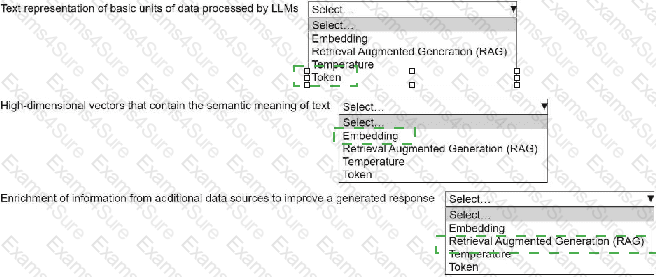
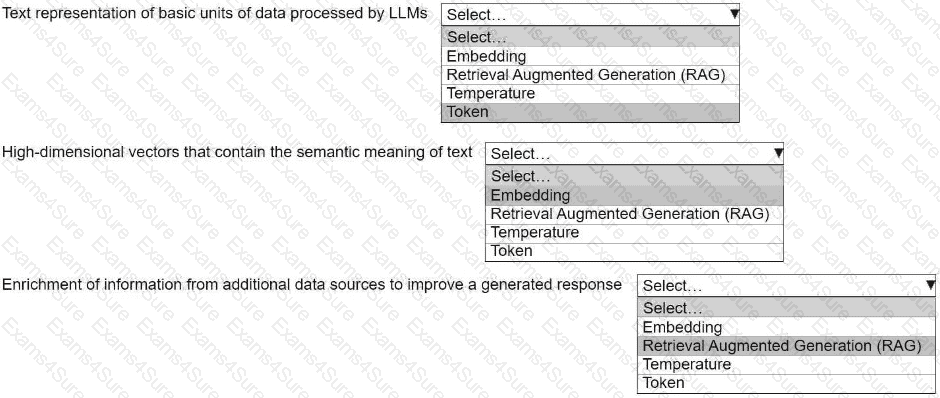
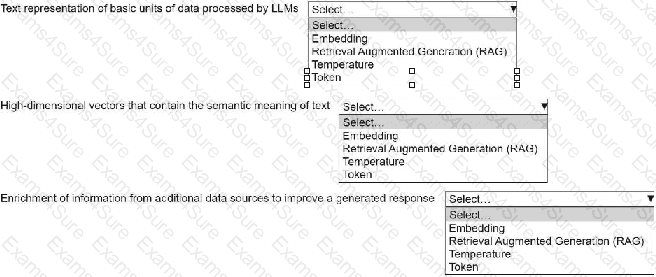
An ML engineer is building a generative AI application on Amazon Bedrock by using large language models (LLMs).

Select the correct generative AI term from the following list for each description. Each term should be selected one time or not at all. (Select three.)

• Embedding

• Retrieval Augmented Generation (RAG)

• Temperature

• Token
Question # 38

Options:

Discussion 0
Question # 39

A company runs an ML model on Amazon SageMaker AI. The company uses an automatic process that makes API calls to create training jobs for the model. The company has new compliance rules that prohibit the collection of aggregated metadata from training jobs.

Which solution will prevent SageMaker AI from collecting metadata from the training jobs?

Options:

A.  

Opt out of metadata tracking for any training job that is submitted.

B.  

Ensure that training jobs are running in a private subnet in a custom VP

C.  

C.  

Encrypt the training data with an AWS Key Management Service (AWS KMS) customer managed key.

D.  

Reconfigure the training jobs to use only AWS Nitro instances.

Discussion 0
Question # 40

An ML engineer is analyzing a classification dataset before training a model in Amazon SageMaker AI. The ML engineer suspects that the dataset has a significant imbalance between class labels that could lead to biased model predictions. To confirm class imbalance, the ML engineer needs to select an appropriate pre-training bias metric.

Which metric will meet this requirement?

Options:

A.  

Mean squared error (MSE)

B.  

Difference in proportions of labels (DPL)

C.  

Silhouette score

D.  

Structural similarity index measure (SSIM)

Discussion 0
Get MLA-C01 dumps and pass your exam in 24 hours!

Free Exams Sample Questions