Pre-Summer Sale Limited Time 65% Discount Offer - Ends in 0d 00h 00m 00s - Coupon code: 65pass65

200-201 Understanding Cisco Cybersecurity Operations Fundamentals (CBROPS) is now Stable and With Pass Result | Test Your Knowledge for Free

Exams4sure Dumps

200-201 Practice Questions

Understanding Cisco Cybersecurity Operations Fundamentals (CBROPS)

Last Update 1 day ago
Total Questions : 476

Dive into our fully updated and stable 200-201 practice test platform, featuring all the latest CyberOps Associate exam questions added this week. Our preparation tool is more than just a Cisco study aid; it's a strategic advantage.

Our free CyberOps Associate practice questions crafted to reflect the domains and difficulty of the actual exam. The detailed rationales explain the 'why' behind each answer, reinforcing key concepts about 200-201. Use this test to pinpoint which areas you need to focus your study on.

200-201 PDF

200-201 PDF (Printable)
$48.3
$137.99

200-201 Testing Engine

200-201 PDF (Printable)
$52.5
$149.99

200-201 PDF + Testing Engine

200-201 PDF (Printable)
$65.45
$186.99
Question # 111

What is a difference between rule-based and role-based access control mechanisms?

Options:

A.  

Rule-based are simple and easy to execute, and role-based are well-defined.

B.  

Role-based are an appropriate choice in geographically diverse workgroups, and rule-based are for simply structured workgroups.

C.  

Rule-based are less granular, and role-based have time constraints.

D.  

Role-based are efficient in small workgroups, and rule-based are preferred in time-defined workgroups.

Discussion 0
Question # 112

How does an attack surface differ from an attack vector?

Options:

A.  

An attack vector recognizes the potential outcomes of an attack, and the attack surface is choosing a method of an attack.

B.  

An attack surface identifies vulnerable parts for an attack, and an attack vector specifies which attacks are feasible to those parts.

C.  

An attack surface mitigates external vulnerabilities, and an attack vector identifies mitigation techniques and possible workarounds.

D.  

An attack vector matches components that can be exploited, and an attack surface classifies the potential path for exploitation

Discussion 0
Question # 113

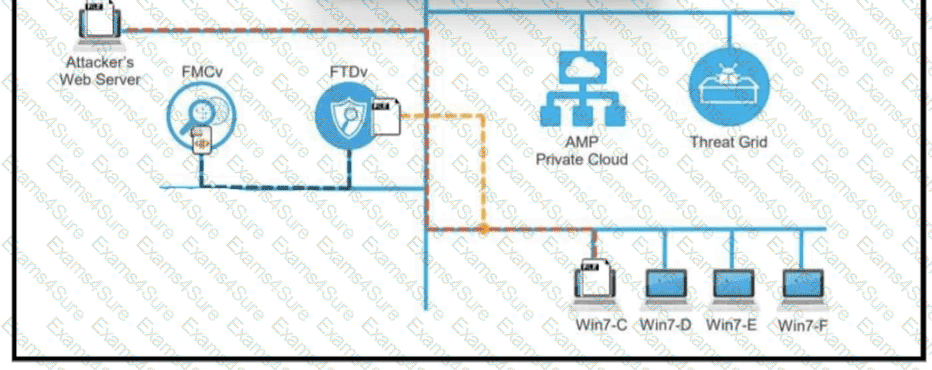
Refer to the exhibit.

Question # 113

A workstation downloads a malicious docx file from the Internet and a copy is sent to FTDv. The FTDv sends the file hash to FMC and the tile event is recorded what would have occurred with stronger data visibility.

Options:

A.  

The traffic would have been monitored at any segment in the network.

B.  

Malicious traffic would have been blocked on multiple devices

C.  

An extra level of security would have been in place

D.  

Detailed information about the data in real time would have been provided

Discussion 0
Question # 114

What are two social engineering techniques? (Choose two.)

Options:

A.  

privilege escalation

B.  

DDoS attack

C.  

phishing

D.  

man-in-the-middle

E.  

pharming

Discussion 0
Question # 115

What is the difference between a vulnerability and an attack surface?

Options:

A.  

A vulnerability is the risk of exploiting a weakness in the application, and the target application itself is the attack surface

B.  

The attack surface is the SQL injection targeted on the database, and the database is the vulnerability that might be exploited.

C.  

The attack surface is a sum of measured risks for a particular asset, and the vulnerability is an unmeasured exploitable risk

D.  

A vulnerability is unsanitized user input sent to exploit a web application and the browser is the attack surface for the web application

Discussion 0
Question # 116

Which artifact is used to uniquely identify a detected file?

Options:

A.  

file timestamp

B.  

file extension

C.  

file size

D.  

file hash

Discussion 0
Question # 117

Which filter allows an engineer to filter traffic in Wireshark to further analyze the PCAP file by only showing the traffic for LAN 10.11.x.x, between workstations and servers without the Internet?

Options:

A.  

src=10.11.0.0/16 and dst=10.11.0.0/16

B.  

ip.src==10.11.0.0/16 and ip.dst==10.11.0.0/16

C.  

ip.src=10.11.0.0/16 and ip.dst=10.11.0.0/16

D.  

src==10.11.0.0/16 and dst==10.11.0.0/16

Discussion 0
Question # 118

Which event is a vishing attack?

Options:

A.  

obtaining disposed documents from an organization

B.  

using a vulnerability scanner on a corporate network

C.  

setting up a rogue access point near a public hotspot

D.  

impersonating a tech support agent during a phone call

Discussion 0
Question # 119

A network engineer discovers that a foreign government hacked one of the defense contractors in their home country and stole intellectual property. What is the threat agent in this situation?

Options:

A.  

the intellectual property that was stolen

B.  

the defense contractor who stored the intellectual property

C.  

the method used to conduct the attack

D.  

the foreign government that conducted the attack

Discussion 0
Question # 120

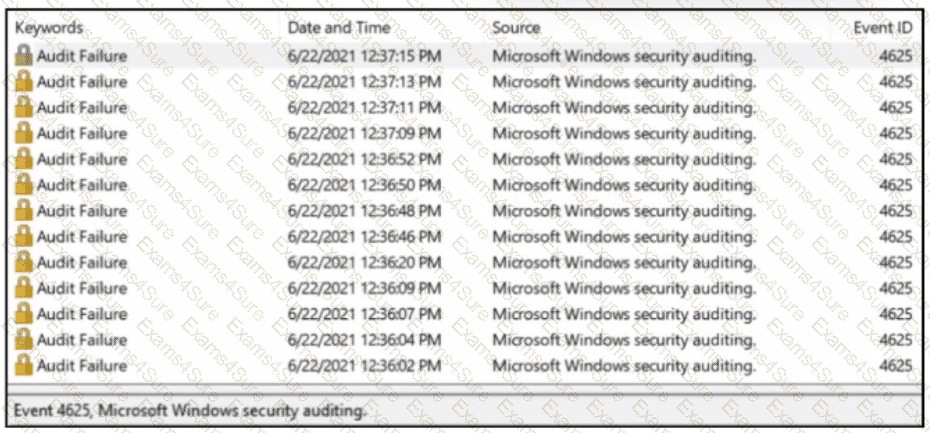
Refer to the exhibit.

Question # 120

A SOC analyst received a message from SIEM about abnormal activity on the Windows server The analyst checked the Windows event log and saw numerous Audit Failures logs. What is occurring?


Options:

A.  

Windows failed to audit the logs

B.  

regular Windows log

C.  

brute-force attack

D.  

DoS attack

Discussion 0
Get 200-201 dumps and pass your exam in 24 hours!

Free Exams Sample Questions