Pre-Summer Sale Limited Time 65% Discount Offer - Ends in 0d 00h 00m 00s - Coupon code: 65pass65

200-201 Understanding Cisco Cybersecurity Operations Fundamentals (CBROPS) is now Stable and With Pass Result | Test Your Knowledge for Free

Exams4sure Dumps

200-201 Practice Questions

Understanding Cisco Cybersecurity Operations Fundamentals (CBROPS)

Last Update 1 day ago
Total Questions : 476

Dive into our fully updated and stable 200-201 practice test platform, featuring all the latest CyberOps Associate exam questions added this week. Our preparation tool is more than just a Cisco study aid; it's a strategic advantage.

Our free CyberOps Associate practice questions crafted to reflect the domains and difficulty of the actual exam. The detailed rationales explain the 'why' behind each answer, reinforcing key concepts about 200-201. Use this test to pinpoint which areas you need to focus your study on.

200-201 PDF

200-201 PDF (Printable)
$48.3
$137.99

200-201 Testing Engine

200-201 PDF (Printable)
$52.5
$149.99

200-201 PDF + Testing Engine

200-201 PDF (Printable)
$65.45
$186.99
Question # 51

What is the impact of false positive alerts on business compared to true positive?

Options:

A.  

True positives affect security as no alarm is raised when an attack has taken place, resulting in a potential breach.

B.  

True positive alerts are blocked by mistake as potential attacks affecting application availability.

C.  

False positives affect security as no alarm is raised when an attack has taken place, resulting in a potential breach.

D.  

False positive alerts are blocked by mistake as potential attacks affecting application availability.

Discussion 0
Question # 52

How low does rule-based detection differ from behavioral detection?

Options:

A.  

Behavioral systems find sequences that match particular attach behaviors, and rule-based systems identify potential zero-day attacks.

B.  

Rule-based systems search for patterns linked to specific types of attacks, and behavioral systems Identify attacks per signature.

C.  

Behavioral systems have patterns are for complex environments, and rule-based systems can be used on low-mid-sized businesses.

D.  

Rule-based systems have predefined patterns, and behavioral systems learn the patterns that are specific to the environment.

Discussion 0
Question # 53

Which of these is a defense-in-depth strategy principle?

Options:

A.  

identify the minimum resource required per employee.

B.  

Assign the least network privileges to segment network permissions.

C.  

Provide the minimum permissions needed to perform Job functions.

D.  

Disable administrative accounts to avoid unauthorized changes.

Discussion 0
Question # 54

An analyst received a ticket regarding a degraded processing capability for one of the HR department's servers. On the same day, an engineer noticed a disabled antivirus software and was not able to determine when or why it occurred. According to the NIST Incident Handling Guide, what is the next phase of this investigation?

Options:

A.  

Recovery

B.  

Detection

C.  

Eradication

D.  

Analysis

Discussion 0
Question # 55

What is the difference between statistical detection and rule-based detection models?

Options:

A.  

Rule-based detection involves the collection of data in relation to the behavior of legitimate users over a period of time

B.  

Statistical detection defines legitimate data of users over a period of time and rule-based detection defines it on an IF/THEN basis

C.  

Statistical detection involves the evaluation of an object on its intended actions before it executes that behavior

D.  

Rule-based detection defines legitimate data of users over a period of time and statistical detection defines it on an IF/THEN basis

Discussion 0
Question # 56

Which principle is being followed when an analyst gathers information relevant to a security incident to determine the appropriate course of action?

Options:

A.  

decision making

B.  

rapid response

C.  

data mining

D.  

due diligence

Discussion 0
Question # 57

Which evasion technique is a function of ransomware?

Options:

A.  

extended sleep calls

B.  

encryption

C.  

resource exhaustion

D.  

encoding

Discussion 0
Question # 58

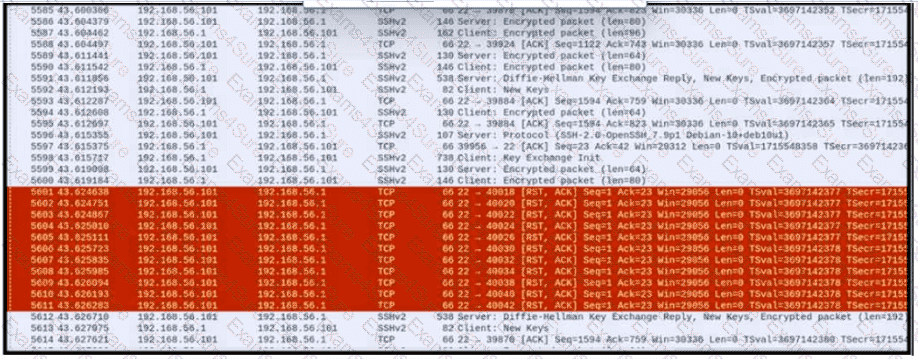
Refer to the exhibit.

Question # 58

An engineer is analyzing a PCAP file after a recent breach An engineer identified that the attacker used an aggressive ARP scan to scan the hosts and found web and SSH servers. Further analysis showed several SSH Server Banner and Key Exchange Initiations. The engineer cannot see the exact data being transmitted over an encrypted channel and cannot identify how the attacker gained access How did the attacker gain access?

Options:

A.  

by using the buffer overflow in the URL catcher feature for SSH

B.  

by using an SSH Tectia Server vulnerability to enable host-based authentication

C.  

by using an SSH vulnerability to silently redirect connections to the local host

D.  

by using brute force on the SSH service to gain access

Discussion 0
Question # 59

An employee of a company receives an email with an attachment. They notice that this email is from a suspicious source, and they decide not to open the attached file. After further investigation, a security analyst concludes that this file is malware. To which category of the Cyber Kill Chain model does this event belong?

Options:

A.  

Weaponization

B.  

Installation

C.  

Exploitation

D.  

Delivery

Discussion 0
Question # 60

Which technology on a host is used to isolate a running application from other applications?

Options:

A.  

sandbox

B.  

application allow list

C.  

application block list

D.  

host-based firewall

Discussion 0
Get 200-201 dumps and pass your exam in 24 hours!

Free Exams Sample Questions