Weekend Sale Limited Time 70% Discount Offer - Ends in 0d 00h 00m 00s - Coupon code: merry71

Free Understanding Cisco Cybersecurity Operations Fundamentals (CBROPS) Practice Questions

Exams4sure Dumps

Exam style questions across every 200-201 domain

Last Update 3 days ago
Total Questions : 476

Start with our free 200-201 practice questions, carefully crafted to mirror the domains, phrasing, and difficulty of the real CyberOps Associate exam. Each 200-201 exam question comes with a detailed rationale that explains not just which answer is correct but why the others fall short. That's how concepts stick. Use the free set to benchmark yourself: identify your Cisco weak domains, see where you're losing marks, and build a focused study plan in minutes.

200-201 PDF

200-201 PDF (Printable)
$46.5
$154.99

200-201 Testing Engine

200-201 PDF (Printable)
$51
$169.99

200-201 PDF + Testing Engine

200-201 PDF (Printable)
$63.9
$212.99
Question # 11

An analyst received an alert on their desktop computer showing that an attack was successful on the host. After investigating, the analyst discovered that no mitigation action occurred during the attack. What is the reason for this discrepancy?

Options:

A.  

The computer has a HIPS installed on it.

B.  

The computer has a NIPS installed on it.

C.  

The computer has a HIDS installed on it.

D.  

The computer has a NIDS installed on it.

Discussion 0
Question # 12

Which open-sourced packet capture tool uses Linux and Mac OS X operating systems?

Options:

A.  

NetScout

B.  

tcpdump

C.  

SolarWinds

D.  

netsh

Discussion 0
Question # 13

What is the advantage of agent-based protection compared to agentless protection?

Options:

A.  

easier to manage due to the centralized platform

B.  

monitors and detects traffic locally

C.  

manages unlimited devices simultaneously

D.  

lower resource requirements during implementation

Discussion 0
Question # 14

What is the difference between deep packet inspection and stateful inspection?
Options:

A.  

Stateful inspection verifies contents at Layer 4. and deep packet inspection verifies connection at Layer 7.

B.  

Stateful inspection is more secure than deep packet inspection on Layer 7.

C.  

Deep packet inspection is more secure than stateful inspection on Layer 4.

D.  

Deep packet inspection allows visibility on Layer 7, and stateful inspection allows visibility on Layer 4.

Discussion 0
Question # 15

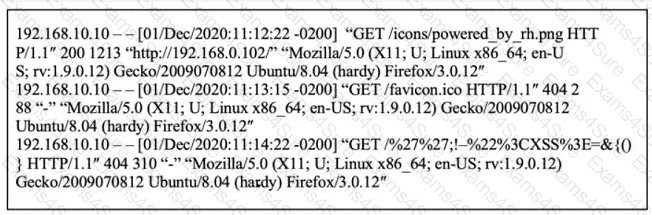
Refer to the exhibit.

Question # 15

What is occurring within the exhibit?

Options:

A.  

regular GET requests

B.  

XML External Entities attack

C.  

insecure deserialization

D.  

cross-site scripting attack

Discussion 0
Question # 16

Refer to the exhibit.

Question # 16

Which kind of attack method is depicted in this string?

Options:

A.  

cross-site scripting

B.  

man-in-the-middle

C.  

SQL injection

D.  

denial of service

Discussion 0
Question # 17

What are two differences in how tampered and untampered disk images affect a security incident? (Choose two.)

Options:

A.  

Untampered images are used in the security investigation process

B.  

Tampered images are used in the security investigation process

C.  

The image is tampered if the stored hash and the computed hash match

D.  

Tampered images are used in the incident recovery process

E.  

The image is untampered if the stored hash and the computed hash match

Discussion 0
Question # 18

An organization that develops high-end technology is going through an internal audit The organization uses two databases The main database stores patent information and a secondary database stores employee names and contact information A compliance team is asked to analyze the infrastructure and identify protected data Which two types of protected data should be identified? (Choose two)

Options:

A.  

Personally Identifiable Information (Pll)

B.  

Payment Card Industry (PCI)

C.  

Protected Hearth Information (PHI)

D.  

Intellectual Property (IP)

E.  

Sarbanes-Oxley (SOX)

Discussion 0
Question # 19

What is threat hunting?

Options:

A.  

Managing a vulnerability assessment report to mitigate potential threats.

B.  

Focusing on proactively detecting possible signs of intrusion and compromise.

C.  

Pursuing competitors and adversaries to infiltrate their system to acquire intelligence data.

D.  

Attempting to deliberately disrupt servers by altering their availability

Discussion 0
Question # 20

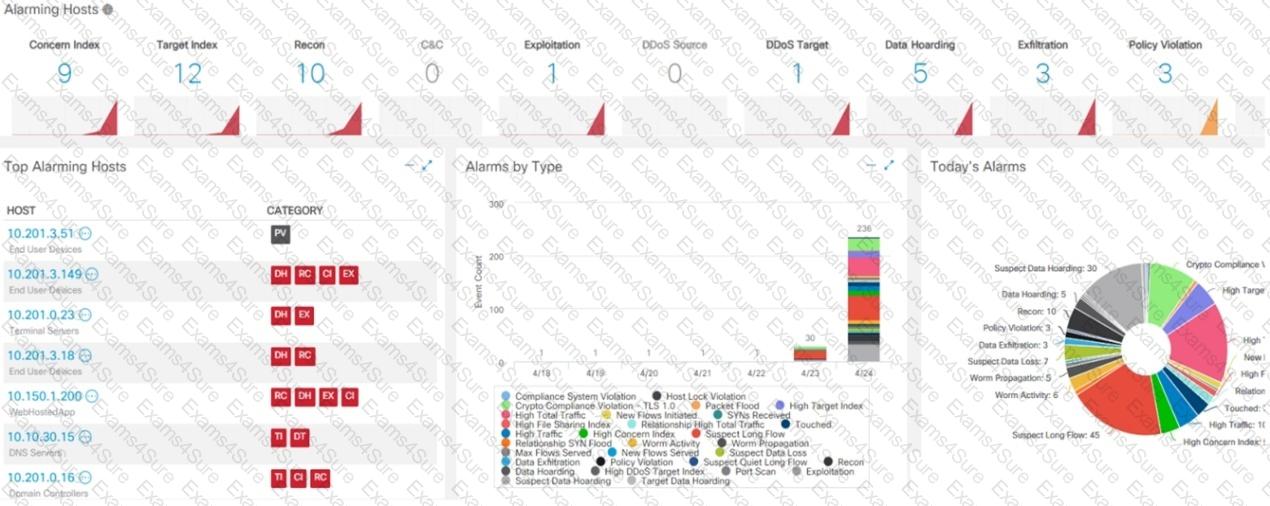
STION NO: 102

Refer to the exhibit.

Question # 20

What is the potential threat identified in this Stealthwatch dashboard?

Options:

A.  

A policy violation is active for host 10.10.101.24.

B.  

A host on the network is sending a DDoS attack to another inside host.

C.  

There are three active data exfiltration alerts.

D.  

A policy violation is active for host 10.201.3.149.

Discussion 0

Free Exams Sample Questions