
Pre-Summer Sale Limited Time 65% Discount Offer - Ends in 0d 00h 00m 00s - Coupon code: 65pass65

200-201 Understanding Cisco Cybersecurity Operations Fundamentals (CBROPS) is now Stable and With Pass Result | Test Your Knowledge for Free

Exams4sure Dumps

200-201 Practice Questions

Understanding Cisco Cybersecurity Operations Fundamentals (CBROPS)

Last Update 1 day ago
Total Questions : 476

Dive into our fully updated and stable 200-201 practice test platform, featuring all the latest CyberOps Associate exam questions added this week. Our preparation tool is more than just a Cisco study aid; it's a strategic advantage.

Our free CyberOps Associate practice questions crafted to reflect the domains and difficulty of the actual exam. The detailed rationales explain the 'why' behind each answer, reinforcing key concepts about 200-201. Use this test to pinpoint which areas you need to focus your study on.

200-201 PDF

200-201 PDF (Printable)
$48.3
$137.99

200-201 Testing Engine

200-201 PDF (Printable)
$52.5
$149.99

200-201 PDF + Testing Engine

200-201 PDF (Printable)
$65.45
$186.99
Question # 31

Question # 31

Refer to the exhibit. A SOC team member receives a case from his colleague with notes attached. The artifacts and alerts associated with the case must be analyzed and a conclusion must be provided. What is the cause of the alert?

Options:

A.  

An insider threat compromised the service account to delete sensitive data.

B.  

External attackers gained access and are exfiltrating data stealthily.

C.  

A ransomware attack is underway, encrypting files and deleting originals.

D.  

A misconfigured backup process malfunctioned, causing unexpected file changes.

Discussion 0
Question # 32

How does the approach of a behavioral detection system to identifying security threats compare to that of a rule-based detection system?

Options:

A.  

Rule-based detection is effective with fewer false positives, and behavioral adapts over time.

B.  

Behavioral detection is easier to deploy without rules, and rule-based needs historical data.

C.  

Behavioral detection is adaptive to deviations, and rule-based detection uses static rules.

D.  

Rule-based detection excels at APT hunts with updates, and behavioral focuses on anomalies.

Discussion 0
Question # 33

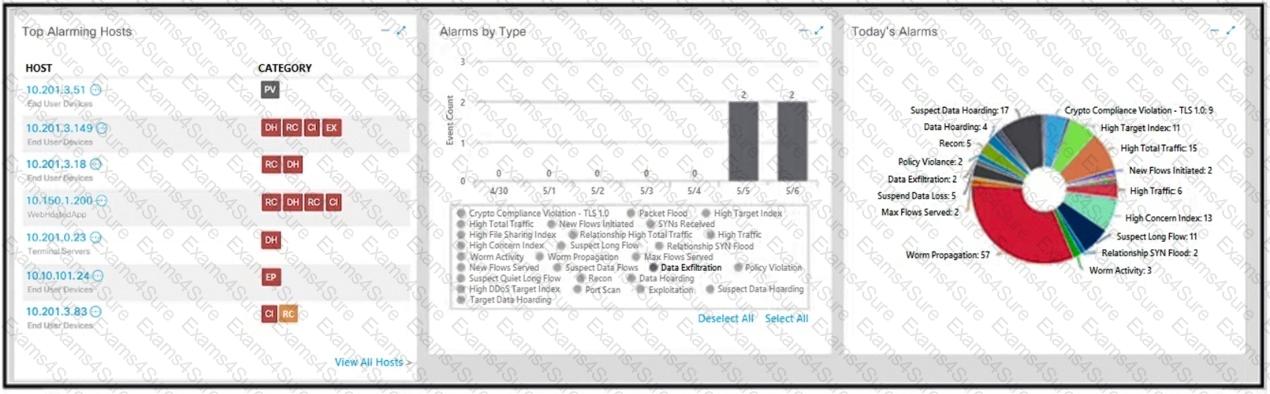
Refer to the exhibit.

Question # 33

What is the potential threat identified in this Stealthwatch dashboard?

Options:

A.  

A policy violation is active for host 10.10.101.24.

B.  

A host on the network is sending a DDoS attack to another inside host.

C.  

There are two active data exfiltration alerts.

D.  

A policy violation is active for host 10.201.3.149.

Discussion 0
Question # 34

What describes the impact of false-positive alerts compared to false-negative alerts?
Options:

A.  

A false negative is alerting for an XSS attack. An engineer investigates the alert and discovers that an XSS attack happened A false positive is when an XSS attack happens and no alert is raised

B.  

A false negative is a legitimate attack triggering a brute-force alert. An engineer investigates the alert and finds out someone intended to break into the system A false positive is when no alert and no attack is occurring

C.  

A false positive is an event alerting for a brute-force attack An engineer investigates the alert and discovers that a legitimate user entered the wrong credential several times A false negative is when a threat actor tries to brute-force attack a system and no alert is raised.

D.  

A false positive is an event alerting for an SQL injection attack An engineer investigates the alert and discovers that an attack attempt was blocked by IPS A false negative is when the attack gets detected but succeeds and results in a breach.

Discussion 0
Question # 35

Question # 35

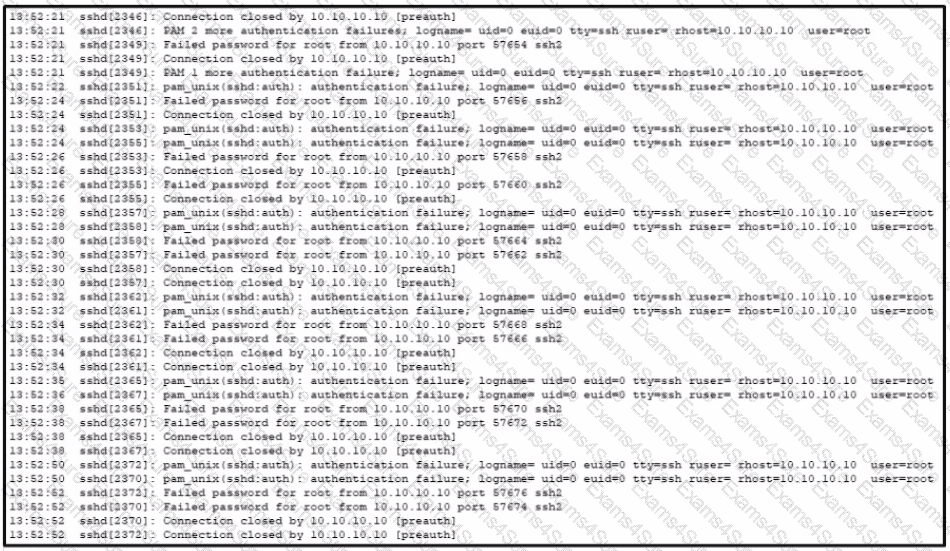
Refer to the exhibit A SOC analyst is examining the Auth.log file logs of one the breached systems What is the possible reason for this event log?

Options:

A.  

password cracking DoS attack on Windows endpoint

B.  

brute force attack on Windows from 10.10.10.10

C.  

regular Linux log and 10.10.10.10 is legitimate host

D.  

brute force attack on Linux from 10.10.10.10

Discussion 0
Question # 36

According to the NIST SP 800-86. which two types of data are considered volatile? (Choose two.)

Options:

A.  

swap files

B.  

temporary files

C.  

login sessions

D.  

dump files

E.  

free space

Discussion 0
Question # 37

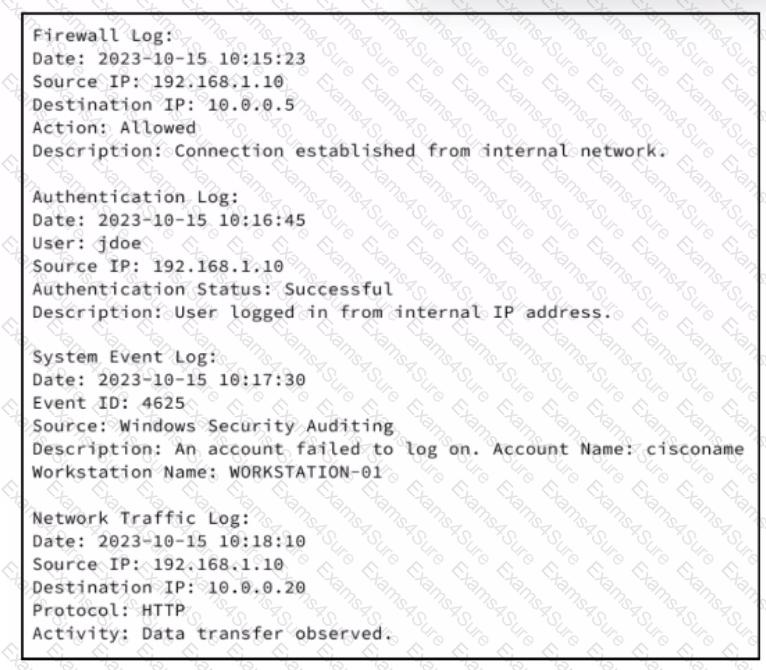
Refer to the exhibit.

Question # 37

An analyst receives an IDS alert pertaining to a possible data exfiltration attempt. An additional set of logs is collected from different systems and analyzed. Which type of evidence do the logs provide in relation to the primary alert from the IDS?

Options:

A.  

corroborative evidence

B.  

primary evidence

C.  

circumstantial evidence

D.  

secondary evidence

Discussion 0
Question # 38

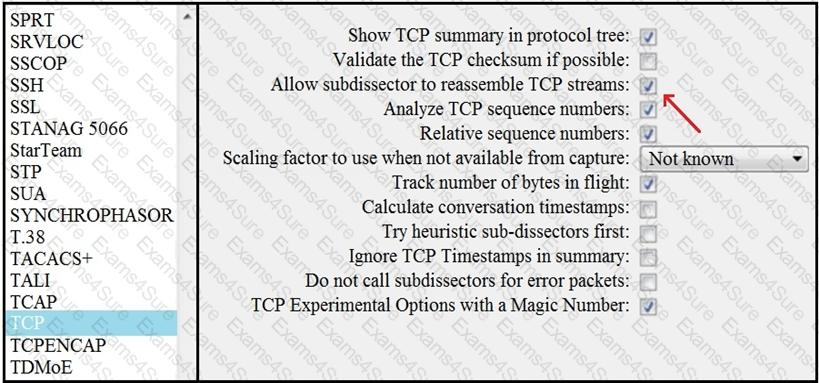
Refer to the exhibit.

Question # 38

What is the expected result when the "Allow subdissector to reassemble TCP streams" feature is enabled?
Options:

A.  

insert TCP subdissectors

B.  

extract a file from a packet capture

C.  

disable TCP streams

D.  

unfragment TCP

Discussion 0
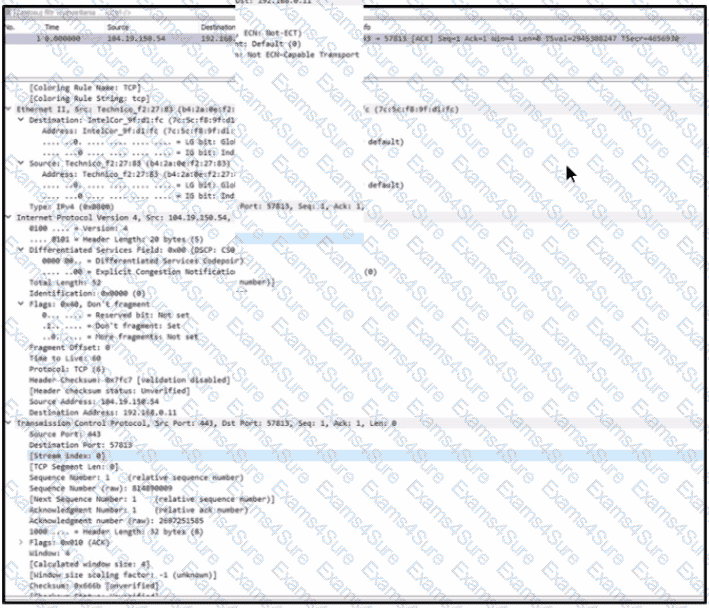
Question # 39

Question # 39

Refer to the exhibit. An engineer must use a 5-tuple approach to isolate a compromised host in a grouped set of logs.

Which data must the engineer use?

Options:

A.  

66

B.  

b4:2a0ef227 83

C.  

7c:5c:f8:9f:d1:fc

D.  

57813

Discussion 0
Question # 40

How does statistical detection differ from rule-based detection?

Options:

A.  

Statistical detection involves the evaluation of events, and rule-based detection requires an evaluated set of events to function.

B.  

Statistical detection defines legitimate data over time, and rule-based detection works on a predefined set of rules

C.  

Rule-based detection involves the evaluation of events, and statistical detection requires an evaluated set of events to function Rule-based detection defines

D.  

legitimate data over a period of time, and statistical detection works on a predefined set of rules

Discussion 0
Get 200-201 dumps and pass your exam in 24 hours!

Free Exams Sample Questions