
Weekend Sale Limited Time 70% Discount Offer - Ends in 0d 00h 00m 00s - Coupon code: merry71

Free Understanding Cisco Cybersecurity Operations Fundamentals (CBROPS) Practice Questions

Exams4sure Dumps

Exam style questions across every 200-201 domain

Last Update 3 days ago
Total Questions : 476

Start with our free 200-201 practice questions, carefully crafted to mirror the domains, phrasing, and difficulty of the real CyberOps Associate exam. Each 200-201 exam question comes with a detailed rationale that explains not just which answer is correct but why the others fall short. That's how concepts stick. Use the free set to benchmark yourself: identify your Cisco weak domains, see where you're losing marks, and build a focused study plan in minutes.

200-201 PDF

200-201 PDF (Printable)
$46.5
$154.99

200-201 Testing Engine

200-201 PDF (Printable)
$51
$169.99

200-201 PDF + Testing Engine

200-201 PDF (Printable)
$63.9
$212.99
Question # 21

Which security monitoring data type is associated with application server logs?

Options:

A.  

transaction data

B.  

session data

C.  

alert data

D.  

statistical data

Discussion 0
Question # 22

According to CVSS, what is attack complexity?

Options:

A.  

existing exploits available in the wild exploiting the vulnerability

B.  

existing circumstances beyond the attacker's control to exploit the vulnerability

C.  

number of actions an attacker should perform to exploit the vulnerability

D.  

number of patches available for certain attack mitigation and how complex the workarounds are

Discussion 0
Question # 23

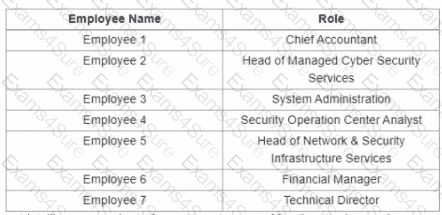
Refer to the exhibit.

Question # 23

A suspicious IP address is tagged by Threat Intelligence as a brute-force attempt source After the attacker produces many of failed login entries, it successfully compromises the account. Which stakeholder is responsible for the incident response detection step?

Options:

A.  

employee 5

B.  

employee 3

C.  

employee 4

D.  

employee 2

Discussion 0
Question # 24

What is the purpose of a host-based intrusion detection system (HIDS)?

Options:

A.  

A HIDS protects against threats via known denylisted hash databases of malware and ransomware.

B.  

A HIDS filters traffic according to configured firewall access control rules.

C.  

A HIDS detects threats using a combination of signature-based and anomaly-based detection methods.

D.  

A HIDS blocks potential anomalous user activity.

Discussion 0
Question # 25

An engineer must gather data for monitoring purposes from different network devices. The engineer needs to collect events from the local network and use that information for packet sniffing. The solution must create an exact copy of traffic and provide full fidelity. Which solution should the engineer use?

Options:

A.  

NAT

B.  

tap

C.  

SPAN ports

D.  

tunneling

Discussion 0
Question # 26

What is a ransomware attack?

Options:

A.  

It is a component of a malware attack used to establish a remote covert channel.

B.  

It is malicious software that steals confidential data.

C.  

It encrypts a victim’s data and prevents access to it.

D.  

The volume of data exceeds storage capacity.

Discussion 0
Question # 27

What is the function of a command and control server?

Options:

A.  

It enumerates open ports on a network device

B.  

It drops secondary payload into malware

C.  

It is used to regain control of the network after a compromise

D.  

It sends instruction to a compromised system

Discussion 0
Question # 28

How is NetFlow different from traffic mirroring?

Options:

A.  

NetFlow collects metadata and traffic mirroring clones data.

B.  

Traffic mirroring impacts switch performance and NetFlow does not.

C.  

Traffic mirroring costs less to operate than NetFlow.

D.  

NetFlow generates more data than traffic mirroring.

Discussion 0
Question # 29

What does cyber attribution identify in an investigation?

Options:

A.  

cause of an attack

B.  

exploit of an attack

C.  

vulnerabilities exploited

D.  

threat actors of an attack

Discussion 0
Question # 30

Which step in the incident response process researches an attacking host through logs in a SIEM?

Options:

A.  

detection and analysis

B.  

preparation

C.  

eradication

D.  

containment

Discussion 0

Free Exams Sample Questions