
Exam style questions across every Prince2-Practitioner domain
Last Update 3 days ago
Total Questions : 263
Start with our free Prince2-Practitioner practice questions, carefully crafted to mirror the domains, phrasing, and difficulty of the real PRINCE2 Certification exam. Each Prince2-Practitioner exam question comes with a detailed rationale that explains not just which answer is correct but why the others fall short. That's how concepts stick. Use the free set to benchmark yourself: identify your PRINCE2 weak domains, see where you're losing marks, and build a focused study plan in minutes.

Project Scenario – Health and Safety Training Project:
ABC Company is a well-established training company that uses a standard model to develop training materials and deliver courses to customers.
ABC Company has commissioned a project in response to recent changes in government legislation relating to health and safety on construction sites. The project will deliver “capability to provide health and safety training”, including the materials needed for classroom-based training and e-learning. The expected benefits for construction companies include a reduction in lost days and legal costs due to accidents.
The e-learning course will be developed by a specialist external consultancy. The materials for classroom-based training will be delivered by ABC Company’s development team. All course materials will be piloted before they are used. ABC Company will deliver training to its customers and also hopes to sell the course materials to other training companies as part of their operational business. ABC Company will use their own sales and marketing departments to promote the courses.
The legislation requires construction companies to comply with the new legislation within two years. The course materials and trainers have to be accredited by a government agency before courses can be delivered. ABC Company is planning to deliver pilot courses within five months of starting the project.
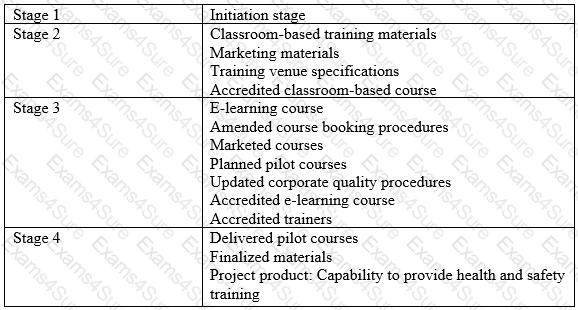
The ABC Company standard development model for new courses recommends the following stages:
End of the Project scenario.
Additional Information:
The Chief Executive Officer (CEO) founded the company five years ago. Under her leadership, ABC Company has grown quickly into a successful training company. It delivers a range of accredited professional training.
The Finance Director is also a founder member of ABC Company and is responsible for authorizing budgets for the Operations and Development Teams. She authorizes all large contracts personally.
The Purchasing Manager reports to the Finance Director and is responsible for managing and monitoring supplier contracts.
The Operations Director is responsible for the delivery off all training and for the training development budget. His department organizes courses, venues and trainers. They work with the Product and the Sales teams to provide a comprehensive training schedule. ABC Company’s IT manager reports to the Operations Director.
The Business Development Director has recently been appointed to identify new training needs and propose new products. She will work with the Operations. Director to ensure a cost-conscious approach and that appropriate development technologies are used for the health and safety course.
The Training Development Manager reports to the Business Development Director and is responsible for developing training materials and gaining accreditation, in accordance with the standard course development model. Course developers in his team have skills in a range of development technologies and are allocated to projects as needed.
The Training Delivery Manager, who reports to the Operations Director, is responsible for ensuring that internal and external trainers deliver ABC Company training courses to the required standard. He also checks course materials to ensure they are fit for purpose and of the required quality.
The Central Services Director has responsibility for corporate communications, facilities management and configuration management. He recently led a project to consolidate all company quality systems into one quality management system and set up a corporate quality department, now managed by the Corporate Quality Manager.
The Corporate Document Manager reports to the Central Services Director. She helped establish the company’s document management system and now operates it across the business. She manages a team of administrators and contracts staff when workload is high.
The Sales Director joined ABC Company two months ago and is keen to establish himself by suggesting new markets for the courses and material. All account managers and the marketing team report to him. They promote existing training courses to other training companies and existing customers.
End of the additional information.
An external consultant has signed a contract and agreed a work package to accredit the trainers. The Purchasing Manager will monitor the contract, which states the requirement to organize the accreditation with the Training Delivery Manager. The Training Delivery Manager has tried to contact the consultant but there has been no response. The project manager believes there is a risk that the consultant is prioritizing other clients’ work.
The Purchasing Manager has been assigned as the risk owner. Is this an appropriate approach to managing this risk, and why?
CLOSING A PROJECT
The Health and Safety Training Project is part of a strategic program for AB
C.
The updated benefits management approach needs to be checked when the products are being handed over. This check should ensure that it includes appropriate activities to assess whether the actual course sales meet the agreed forecast in the business case.Which role should undertake this review as part of the 'closing a project' process?
The senior user is concerned that the trainers' limited availability could delay their accreditation. This was discussed during the 'starting up a project' process, but during the 'initiating a project' process the project manager notices that it has not been recorded.
Which action should the project manager take FIRST?
Project Scenario – Health and Safety Training Project:
ABC Company is a well-established training company that uses a standard model to develop training materials and deliver courses to customers.
ABC Company has commissioned a project in response to recent changes in government legislation relating to health and safety on construction sites. The project will deliver “capability to provide health and safety training”, including the materials needed for classroom-based training and e-learning. The expected benefits for construction companies include a reduction in lost days and legal costs due to accidents.
The e-learning course will be developed by a specialist external consultancy. The materials for classroom-based training will be delivered by ABC Company’s development team. All course materials will be piloted before they are used. ABC Company will deliver training to its customers and also hopes to sell the course materials to other training companies as part of their operational business. ABC Company will use their own sales and marketing departments to promote the courses.
The legislation requires construction companies to comply with the new legislation within two years. The course materials and trainers have to be accredited by a government agency before courses can be delivered. ABC Company is planning to deliver pilot courses within five months of starting the project.
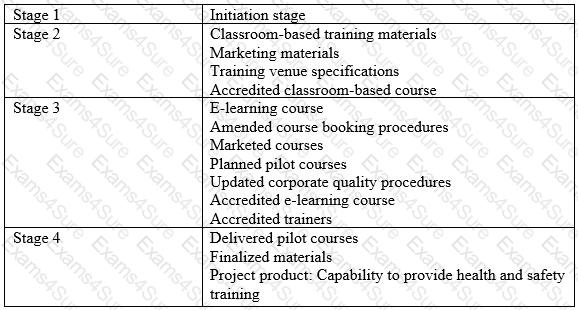
The ABC Company standard development model for new courses recommends the following stages:
End of the Project scenario.
Additional Information:
The Chief Executive Officer (CEO) founded the company five years ago. Under her leadership, ABC Company has grown quickly into a successful training company. It delivers a range of accredited professional training.
The Finance Director is also a founder member of ABC Company and is responsible for authorizing budgets for the Operations and Development Teams. She authorizes all large contracts personally.
The Purchasing Manager reports to the Finance Director and is responsible for managing and monitoring supplier contracts.
The Operations Director is responsible for the delivery off all training and for the training development budget. His department organizes courses, venues and trainers. They work with the Product and the Sales teams to provide a comprehensive training schedule. ABC Company’s IT manager reports to the Operations Director.
The Business Development Director has recently been appointed to identify new training needs and propose new products. She will work with the Operations. Director to ensure a cost-conscious approach and that appropriate development technologies are used for the health and safety course.
The Training Development Manager reports to the Business Development Director and is responsible for developing training materials and gaining accreditation, in accordance with the standard course development model. Course developers in his team have skills in a range of development technologies and are allocated to projects as needed.
The Training Delivery Manager, who reports to the Operations Director, is responsible for ensuring that internal and external trainers deliver ABC Company training courses to the required standard. He also checks course materials to ensure they are fit for purpose and of the required quality.
The Central Services Director has responsibility for corporate communications, facilities management and configuration management. He recently led a project to consolidate all company quality systems into one quality management system and set up a corporate quality department, now managed by the Corporate Quality Manager.
The Corporate Document Manager reports to the Central Services Director. She helped establish the company’s document management system and now operates it across the business. She manages a team of administrators and contracts staff when workload is high.
The Sales Director joined ABC Company two months ago and is keen to establish himself by suggesting new markets for the courses and material. All account managers and the marketing team report to him. They promote existing training courses to other training companies and existing customers.
End of the additional information.
The Health and Safety Training Project is part of a programme of strategic expansion, which is important for ABC Company’s continued operation. At the end of stage 2, the estimated project costs are greater than the expected benefits in the business case. The project board has reviewed the situation and asked programme management to decide whether the project should be closed prematurely.
Is this an appropriate application of the ‘manage by stages’ principle, and why?
During stage 3, the team manager reports that the work to update the 'corporate quality procedures' has been completed and the product is ready to be delivered.
What should project assurance do next?
ABC has experience of delivering training projects that respond to new legislation. Previous projects have had to change the acceptance criteria, due to further updates being made to legislation during the project.
What action should be taken to address this, and why?
A concern about possible subsidence damage has been recorded as an issue.
Is this an appropriate application of the issues practice, and why?
During the 'starting up a project' process, the project manager discusses the standard model for course development with the executive. The project manager then assesses how the Health and Safety Training Project will be delivered, including what products should be delivered in each stage.
Is this an appropriate way to carry out the ‘plan the initiation stage' activity, and why?
INITIATING A PROJECT
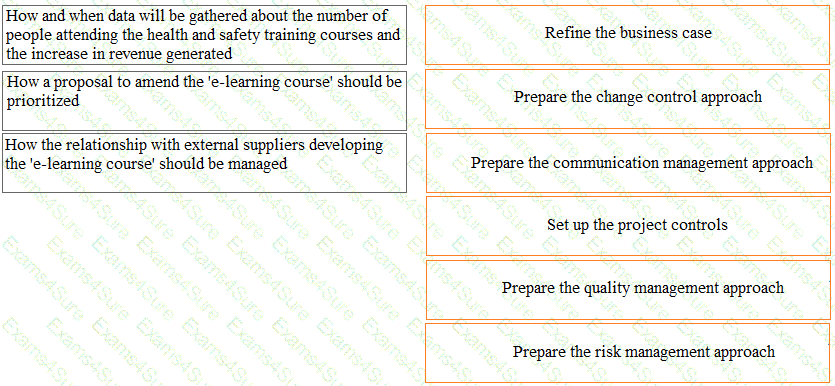
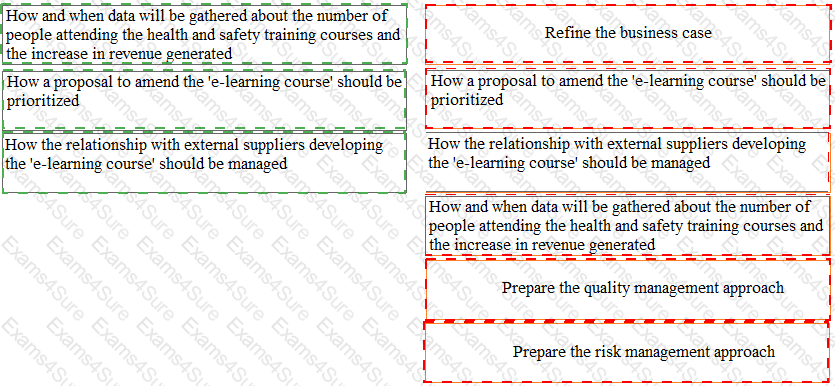
Here are three items of information relating to the ‘initiating a project’ process for the project.
As part of which activity (A-F) should this information be recorded?
Choose only one theme for each activity. Each theme can be used once, more than once, or not at all.
Scenario
Extract from the Project Product Description (with errors)
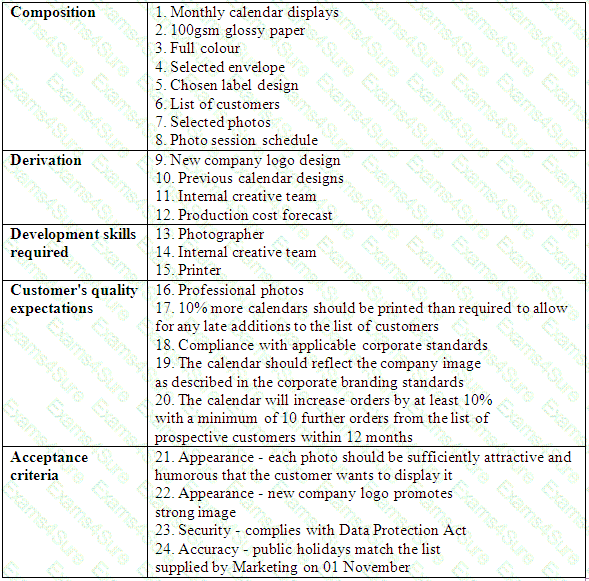
Which 2 statements apply to the Acceptance criteria section?



