
You are preparing for interviews with two members of top management. Based on the information that you gathered about the organization, you conclude that it is the top management who takes all the important decisions and closely supervises and controls employees. Based on this, which management style is practiced in the organization?
Audit criteria are a set of requirements used as a reference against which objective evidence is compared.
Which two of the following are not potential audit criteria?
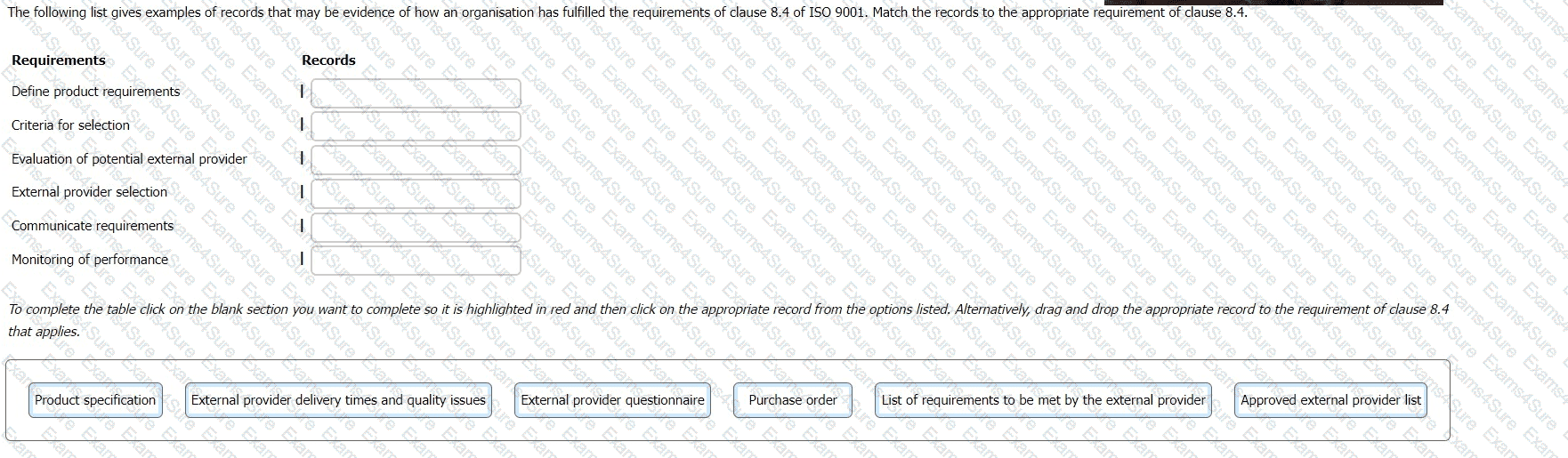
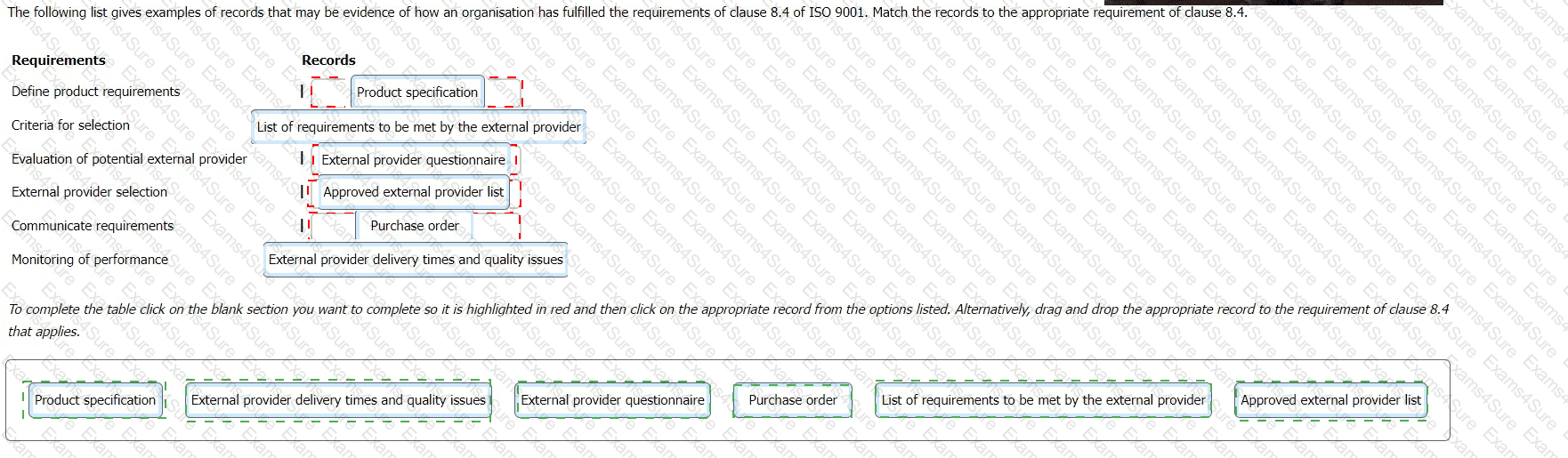
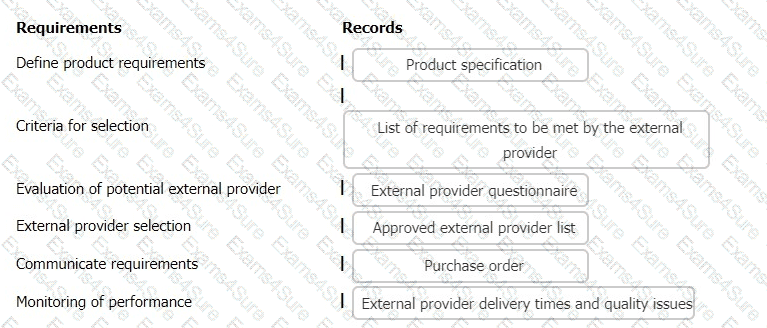
The following list gives examples of records that may be evidence of how an organisation has fulfilled the requirements of clause 8.4 of ISO 9001. Match the records to the appropriate requirement of clause 8.4.
Scenario 2:
Bell is a Canadian food manufacturing company that operates globally. Their main products include nuts, dried fruits, and confections. Bell has always prioritized product quality and has maintained a good reputation for many years. However, the company ' s production error rate increased significantly, leading to more customer complaints.
To increase efficiency and customer satisfaction, Bell implemented a Quality Management System (QMS) based on ISO 9001. The top management established a QMS implementation team comprising five middle managers from various departments, including Leslie, the quality manager.
Leslie was responsible for assigning responsibilities and authorities for QMS-related roles. He also suggested including a top management representative in the QMS team, but top management declined due to other priorities.
The team defined the QMS scope as:
" The scope of the QMS includes all activities related to food processing. "
Leslie established a quality policy and presented it to the team for review before top management approval. Top management also proposed a new strategy for handling customer complaints, requiring biweekly customer surveys to monitor customer perceptions.
Which situation presented in scenario 2 is NOT compliant with ISO 9001?
XYZ Corporation is an organisation that employs 100 people. As audit team leader, you are conducting a
certification audit at Stage 1. When reviewing the quality management system (QMS) documentation, you
find that quality objectives have been set for every employee in the organisation except top management.
The Quality Manager complains that this has created a lot of resistance to the QMS, and the Chief Executive
is asking questions about how much it will cost. He asks for your opinion on whether this is the correct
method of setting objectives.
Three months after Stage 1, you return to XYZ Corporation to conduct a Stage 2 certification audit as Audit
Team Leader with one other auditor. You find that the Quality Manager has cancelled the previous quality
objectives for all employees and replaced them with a single objective for himself. This states that " The
Quality Manager will drive multiple improvements in the QMS in the next year " . The Quality Manager indicates
that this gives him the authority to issue instructions to department managers when quality improvement is
needed. He says that this approach has the full backing of senior management. He shows you the latest
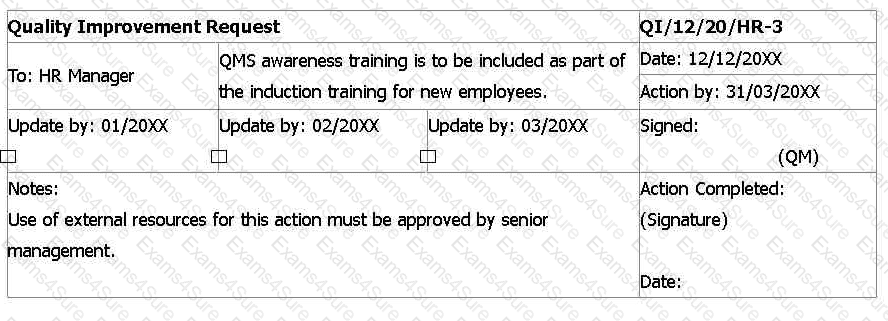
Quality Improvement Request that was included in the last management review.
After further auditing, the issues below were found. Select two statements that apply to the term
`nonconformity ' .
How can an organization ensure the objectivity and impartiality of the internal audit function?
Noitol is an organisation specialising in the design and production of e-learning training materials for the insurance market. During an ISO 9001 audit
of the development department, the auditor asks the Head of Development about the process used for validation of the final course design. She states that they usually ask customers to validate the product with volunteers. She says that the feedback received often leads to key improvements.
The auditor samples the design records for a recently completed course for the 247 Insurance organisation. Design verification was carried out but there was no validation report. The Head of Development advises that this customer required the product on an urgent basis, so the validation stage
was omitted. When asked, the Head estimates that this occurs about 50% of the time. She confirms that they always ask for feedback and often make changes. There is no record of feedback in the design file for the course.
The auditor raises a nonconformity against ISO 9001. Which one of the following options is the basis for the nonconformity?
Who would be defined as a witness during a witness audit?
Choose two of the following options:
Scenario 1: AL-TAX is a company located in California which provides financial and accounting services. The company manages the finances of 17 companies and now is seeking to expand their business even more The CEO of AL-TAX, Liam Durham, claims that the company seeks to provide top-notch services to their clients Recently, there were a number of new companies interested in the services provided by AL-TAX.
In order to fulfill the requirements of new clients and further improve quality, Liam discussed with other top management members the idea of implementing a quality management system (QMS) based on ISO 9001. During the discussion, one of the members of the top management claimed that the size of the company was not large enough to implement a QMS. In addition, another member claimed that a QMS is not applicable for the industry in which AL TAX operates. However, as the majority of the members voted for implementing the QMS. Liam initiated the project.
Initially, Liam hired an experienced consultant to help AL-TAX with the implementation of the QMS. They started by planning and developing processes and methods for the establishment of a QMS based on ISO 9001. Furthermore, they ensured that the quality policy is appropriate to the purpose and context of AL TAX and communicated to all employees. In addition, they also tried to follow a process that enables the company to ensure that its processes are adequately resourced and managed, and that improvement opportunities are determined.
During the implementation process, Liam and the consultant focused on determining the factors that could hinder their processes from achieving the planned results and implemented some preventive actions in order to avoid potential nonconformities Six months after the implementation of the QMS. AL-TAX conducted an internal audit. The results of the internal audit revealed that the QMS was not fulfilling all requirements of ISO 9001. A serious issue was that the QMS was not fulfilling the requirements of clause 5.1.2 Customer focus and had also not ensured clear and open communication channels with suppliers.
Throughout the next three years, the company worked on improving its QMS through the PDCA cycle in the respective areas. To assess the effectiveness of the intended actions while causing minimal disruptions, they tested changes that need to be made on a smaller scale. After taking necessary actions, AL-TAX decided to apply for certification against ISO 9001.
Based on the scenario above, answer the following question:
As stated in scenario 1, AL-TAX tested the effectiveness of the intended actions as part of the QMS improvement through the PDCA cycle. Which stage did it perform in this case?