
Which one of the following options best describes the purpose of a Stage 1 third-party audit?
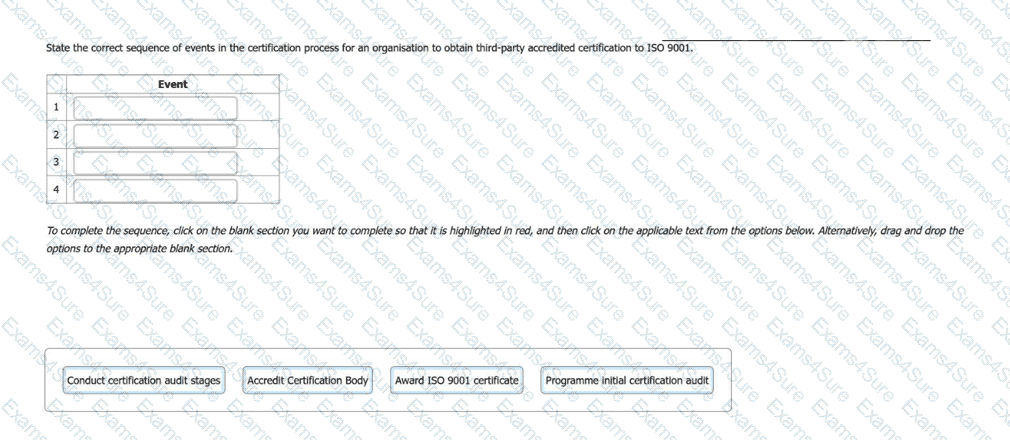
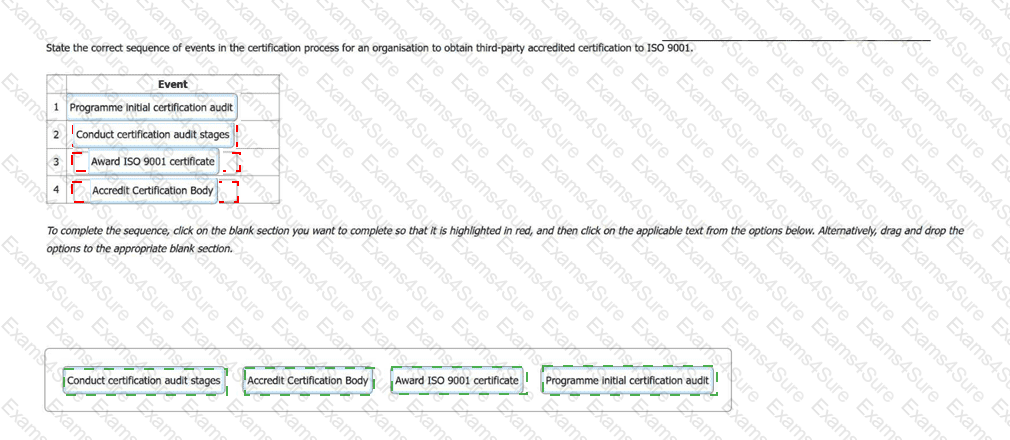
State the correct sequence of events in the certification process for an organisation to obtain third-party accredited certification to ISO 9001.
In a third-party audit to ISO 9001, select two options of when the organisation is required to act in response to reported findings.
The certification body has not been able to verify the implementation of corrective actions for any identified major nonconformity within six months after the last day of the Stage 2 audit. What must the certification body do in this case?
Select the term which best describes the quality management system process of modifying a non-conforming product to bring it within acceptance criteria.
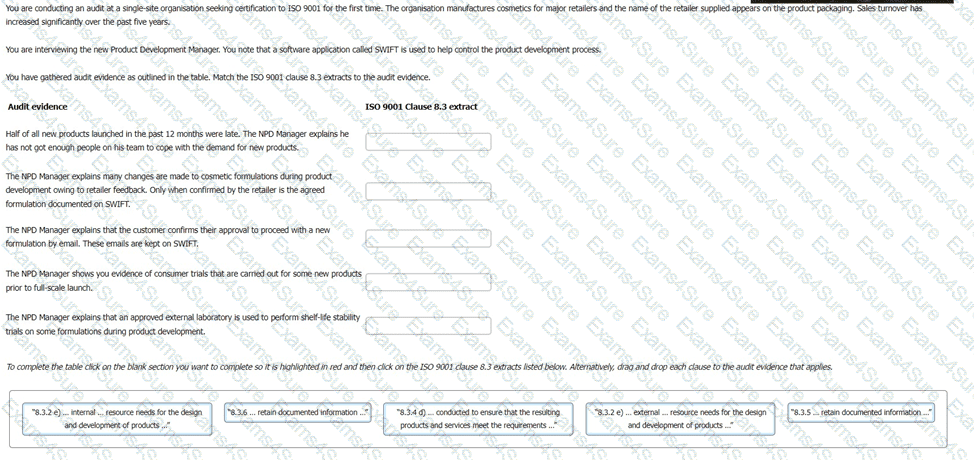
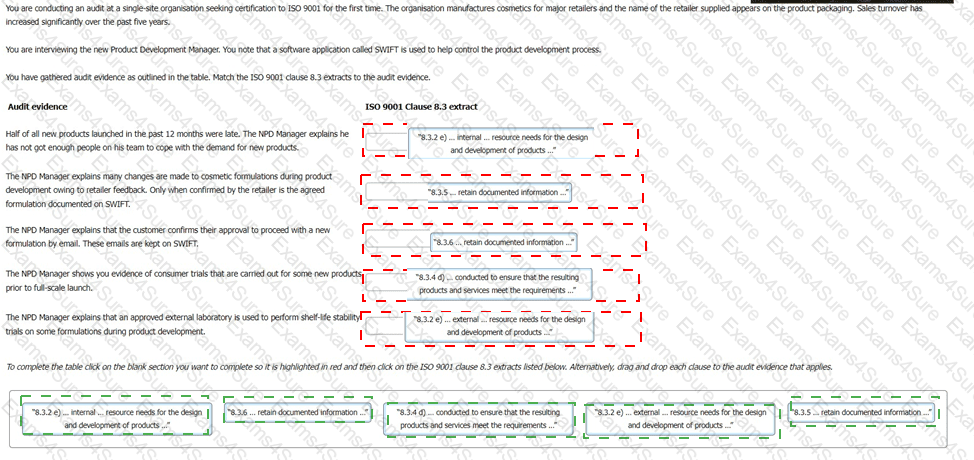
You are conducting an audit at a single-site organisation seeking certification to ISO 9001 for the first time. The organisation manufactures cosmetics for major retailers and the name of the retailer supplied appears on the product packaging. Sales turnover has increased significantly over the past five years
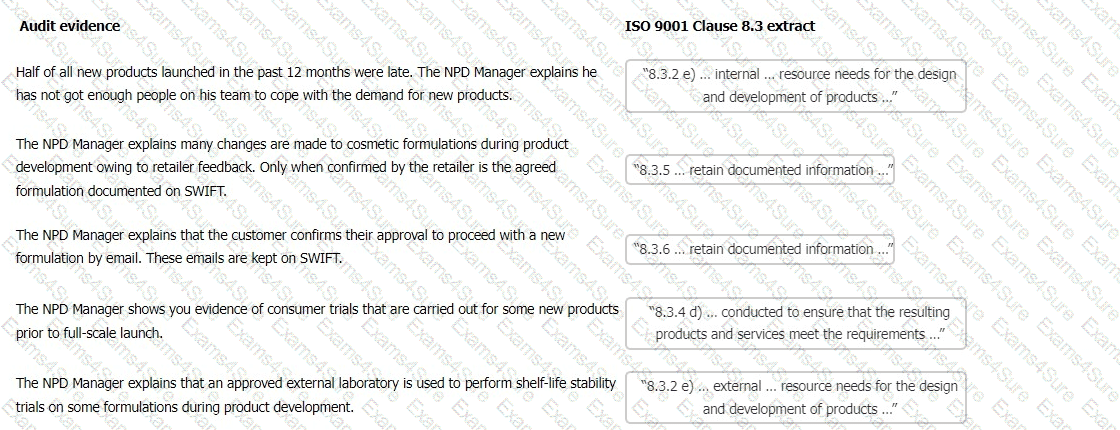
You are interviewing the new Product Development Manager. You note that a software application called SWIFT is used to help control the product development process.
You have gathered audit evidence as outlined in the table. Match the ISO 9001 clause 8.3 extracts to the audit evidence.
You work for organisation
A.
You are asked to lead an internal audit of A ' s quality management system. It has a head office in Plant A1 and a second Plant A2 nearby. Due to the COVID-19 pandemic, production in A2 was discontinued and it was rented to a logistics organisation B, not related toA.
There are no A employees working in A2. Organisation A expects to reassume production in A2 as soon as possible.Which of the following actions would you consider appropriate when planning the internal audit of A ' s quality management system?
You, as auditor, are in dialogue with the quality lead and managing director of a small business that supplies specialist
laboratory equipment and furniture.
You: " I ' d like to look at how you manage change in the organisation. What changes have you made as a business, say,
over the last 12 months? "
Auditee: " We have made some strategic changes, the main one being that we no longer manufacture our own products
in house. "
You: " That sounds like quite a significant change. What has been the impact of that? "
Auditee: " We now mainly sell other manufacturers ' products, under their brand names, and have outsourced
manufacture of our own brand products to one of our suppliers. Unfortunately, we had to make six members of our staff
redundant. This represents about 20% of our workforce, so this has been quite a challenging time. "
This scenario presents a number of audit trails to different ISO 9001 requirements.
Which three of the following requirements would be relevant audit trails for this scenario?
You are an auditor from a construction organisation who is conducting a second party audit to ISO 9001 at a steel rolling mill producing
structural steelwork. When auditing the rolling process, you find that the operator who is unloading the furnace does not use the
adjacent infrared pyrometer to measure the appropriate product temperature in readiness for the next production stage.
You: " How do you tell when the billet is ready for the rolling stage? "
Operator: " I ' ve done this job for 20 years. I can tell by the bright red colour. "
You: " What happens if the colour is wrong? "
Operator: " The billet goes back into the furnace. "
You: " Is the pyrometer ever used? "
Operator: " Only in borderline cases. "
You continue to interview the operator and find that around 25% of the billets are sent back to the furnace. This includes 80% of the borderline cases.
Select three options that would provide evidence of conformance with clause 9.1.1 of ISO 9001.