
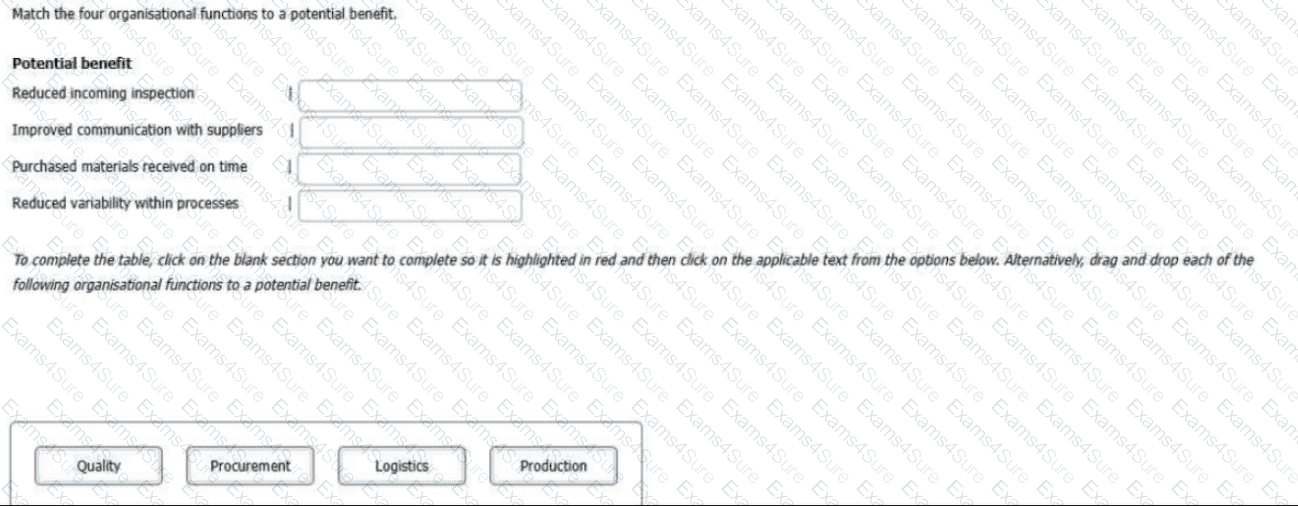
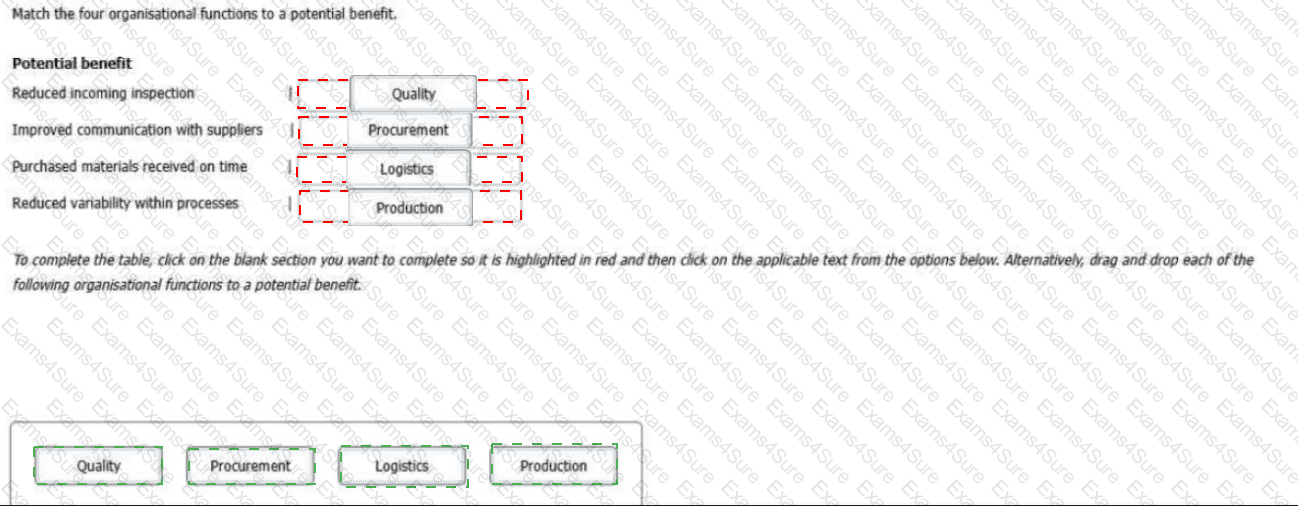
An organisation decides to purchase products and services only from ISO 9001 certified suppliers.
Match the four organisational functions to a potential benefit.
(A third-party audit has been planned at a single-site organisation. The audit team comprises one audit team leader, one auditor and one auditor who is undertaking his first third-party audit.
During the on-site audit, the auditor who is undertaking his first third-party audit shall...)
Which one of the following options is the definition of the context of an organisation?
(Which of the following two options could be considered the most likely potential threats to impartiality in an audit context?)
You work as an external quality consultant for an organisation, ' A ' , which provides packaged food to the public. You are asked to lead a team (you as the leader and two other auditors) to audit a supplier, ' B ' , to ISO 9001 which provides packaging materials to your organisation. It is 4 pm and the audit is close to an end; you are having an internal meeting with the team to decide what will be presented to the auditee during the Closing meeting. The Closing meeting was scheduled at 5 pm.
You, as Audit Team Leader, audited top management. You explain to the audit team that you identified two nonconformities:
a. There is no documented information on Top Management Reviews, as required in clause 9.3 of ISO 9001:2015.
b. There is no evidence of Top Management Commitment as required in clause 5.1 of ISO 9001:2015. (e.g., not ensuring the availability of resources
to operate the QMS, not ensuring the establishment of objectives, no promotion of improvement, no promotion of the process approach).
All agreed to present these two nonconformities. They went to meet the Top Management of ' B ' and noticed that the General Manager and three other managers (Production, Human Resources, and Sales) were present in the meeting room.
Considering the seriousness of the two nonconformities to Top Management, as audit team leader, from the following select the best option:
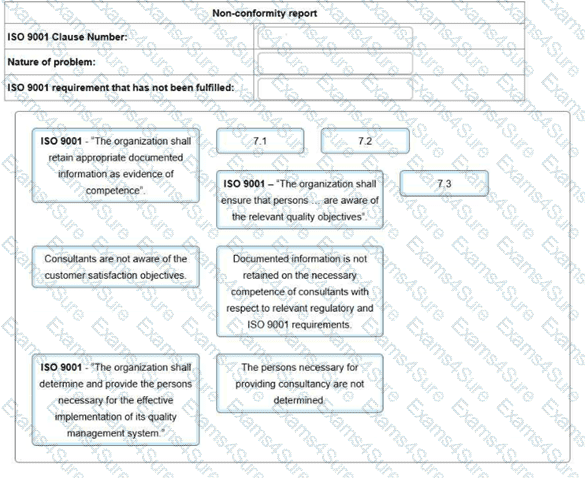
You are carrying out an audit to ISO 9001 at an organisation which offers consultancy services on the implementation of ISO 9001 quality management systems to manufacturers of cosmetics.
You are interviewing the Technical and Quality Director (TQD), who manages a team of biochemists responsible for providing ISO 9001 consultancy services to customers.
You: “How do you ensure your team’s competence concerning regulatory and ISO 9001 requirements?”
TQD: “We subcontract a part-time lead consultant who has years of experience working as a biochemist in the cosmetics industry. She is responsible for ensuring the team’s competency.”
You: “Do they retain any documented information on the individual competency of each consultant?”
TQD: “No. The lead consultant is a dedicated individual with lots of contacts in the sector. We rely on her decision on the consultants’ competency. She says that she thought that it was not necessary to keep documented information; however, after the event two weeks ago, which could not be solved due to the lack of documentation, she may consider in the future to plan which information we may need to keep.”
You: “How does the organisation enable the consultants you employ to maintain updated their competence on ISO 9001 and regulatory requirements?”
TQD: “As I said before, we leave that up to the lead consultant. She tells us when we need to employ more young consultants and when changes are introduced in the applicable regulations. Our regular survey shows that customers are quite satisfied with our consultants; last year’s objective of customer satisfaction was achieved. We gave a salary increase to consultants when they knew that the objectives had been achieved.”
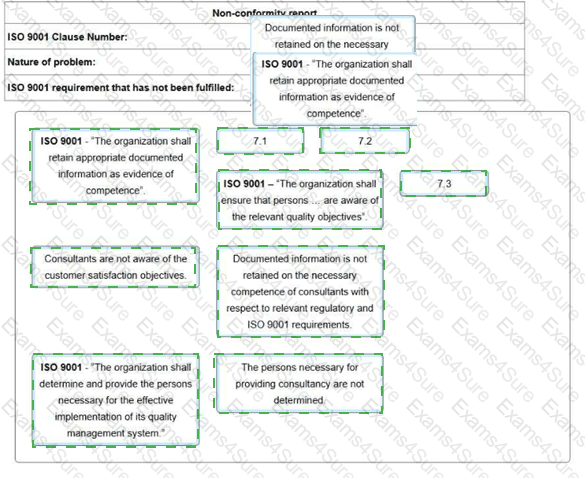
You decide to raise a non-conformity.
To complete the non-conformity report, click on the blank section you want to complete so it is highlighted in red and then click on the applicable text from the options below. Alternatively, drag and drop the options to the appropriate blank section.
Scenario 3:
Fin-Pro is a financial institution in Austria offering commercial banking, wealth management, and investment services. The company faced a significant loss of customers due to failing to improve service quality as they expanded.
To regain customer confidence, top management implemented a QMS based on ISO 9001. After a year, they contacted ACB, a local certification body, to pursue ISO 9001 certification.
The audit team was led by Emilia, an experienced lead auditor, and included three auditors. After an agreement was reached, ACB sent the audit objectives to the audit team.
The audit team began by gathering information about Fin-Pro’s understanding of ISO 9001 requirements. While reviewing documented information, they noticed missing records of training and awareness sessions. They conducted employee interviews to verify attendance.
The team also reviewed the organizational chart and job descriptions to confirm employee competence. They observed the company’s working environment (social, psychological, and physical conditions).
The audit team analyzed the evidence and prepared an audit report with findings and conclusions.
In scenario 3, the audit team required access to see the organizational chart and job descriptions to verify the employees’ competence. Based on audit best practices, is this acceptable?
One of the conflict resolution techniques is toning down. How is the conflict managed in that case?
Takitup is a small fabrication company that manufactures steel fencing, stairs and platforms for the construction sector. It has been certified to ISO 9001 for some time and has appointed a new Quality Manager. The audit plan during a surveillance audit is to cover the company’s improvement actions and the auditor asks to see the most recent management review meeting minutes.
Which two of the options would be relevant points for the auditor’s checklist for the audit?

Exam style questions across every ISO-9001-Lead-Auditor domain
Last Update 4 days ago
Total Questions : 267
Start with our free ISO-9001-Lead-Auditor practice questions, carefully crafted to mirror the domains, phrasing, and difficulty of the real ISO 9001 exam. Each ISO-9001-Lead-Auditor exam question comes with a detailed rationale that explains not just which answer is correct but why the others fall short. That's how concepts stick. Use the free set to benchmark yourself: identify your PECB weak domains, see where you're losing marks, and build a focused study plan in minutes.



