During a second-party audit of a dairy farm (by a potential customer) complying with ISO 9001:2015, the auditor verifies that there is large variability in the daily production of the milking yard. The current agreement with their only customer is to provide 2,000 litres per day. However, in the last two years, they have noticed an increasing variability in daily production.
If they produce less than 2,000 litres, they are penalised with a fine of 1.5 pesos for every litre that they do not provide. If they produce more than 2,000 litres, they use the extra milk to feed the pigs.
This process has been in operation for decades. The dairy farm was founded by the grandfather of the current owners, who did not want to alter the established practices.
The auditor raises a nonconformity on the basis that the process is not under control (Clause 8.1).
If you had been the auditor, which one of the following actions would you have accepted?
You are leading a Stage 2 certification audit of a multi-site organisation and have received the audit schedule below;
Head Office and Site 1 – Day 1
Site 2 (150 km from HQ) – Days 2 and 3
During Day 1 of the audit, the client informs you that the laboratory at Site 2 has been closed for decontamination due to a serious outbreak of an infectious disease among workers. In Site 2, all other functions could be audited as planned.
As the audit team leader, what would you do?
Choose the best acceptable action you could take:
You are carrying out an audit at a single-site organisation seeking certification to ISO 9001 for the first time. The organisation manufactures
cosmetics for major retailers.
You are interviewing the Manufacturing Manager (MM).
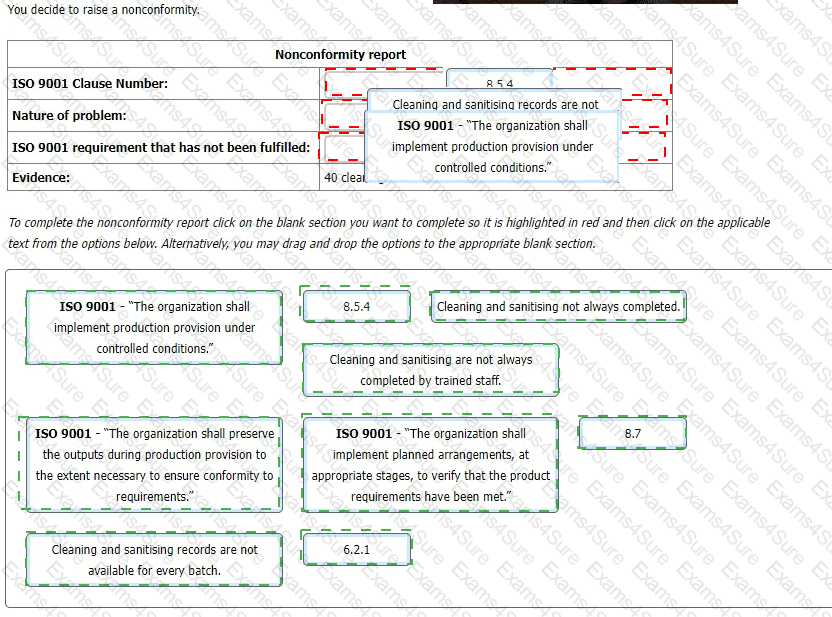
You: " I would like to begin by looking at the cleaning controls. "
MM: " We record the cleaning of the equipment at the end of every batch. This document details the minimum cleaning frequency and the
procedures to follow for all areas and each item of equipment. The person who carries out the cleaning puts their initial on the document and records
the time and date alongside. "
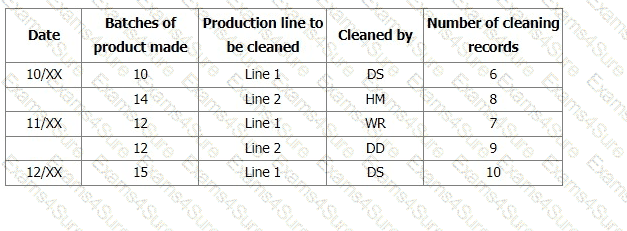
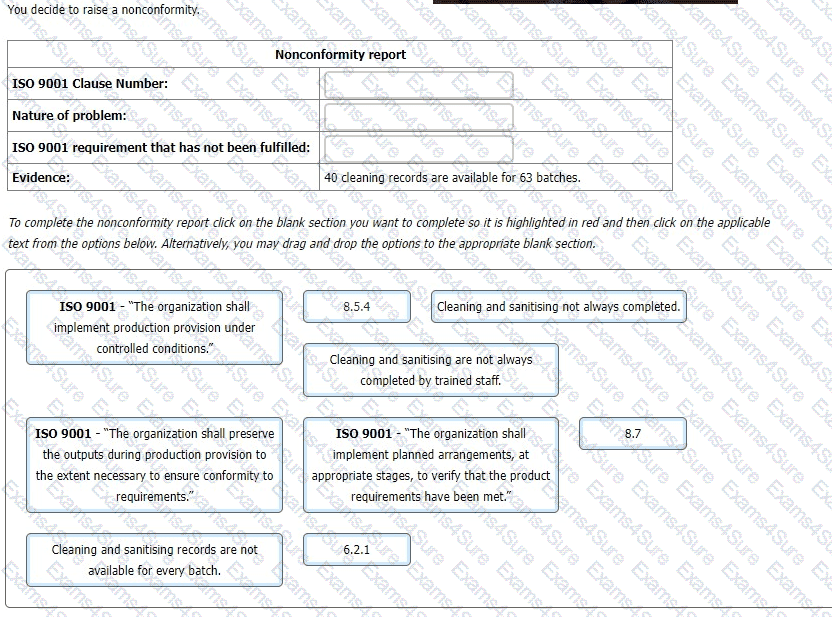
Narrative: You sample production records over 3-days and note down evidence of nonconformity as per the table below.
Scenario 7: POLKA is a car manufacturing company based in Stockholm, Sweden. The company has around 14,000 employees working in different sectors which help with the design, painting, assembling, and test drives of the final product. The company is widely known for its qualitative products and affordable prices. In order to retain their reputation, POLKA implemented a quality management system (QMS) based on ISO 9001.
Before applying for certification, the company decided to conduct an internal audit to check whether there are any nonconformities in their QMS and if the requirements of ISO 9001 are being fulfilled. The top management appointed Sean, the internal auditor, as the team leader of the internal audit team. Sean required from the top management to have unrestricted access to the employees and executives of POLKA and to the documented information. Furthermore, Sean required to establish a team with a large number of auditors, considering the size and the complexity of the organization. The top management of POLKA agreed with Sean ' s requirements.
The top management, in cooperation with Sean, assigned 10 more employees to the audit team. Following that. Sean planned the audit activities and assigned the roles and responsibilities to each auditor. They began by interviewing employees of different manufacturing departments to check whether they are aware of the process of the QMS implementation. While conducting these activities, one of the auditors asked Sean for permission to audit the department in which he worked on a daily basis, as he was very familiar with the processes of the department.
Along the way, the teams findings showed that the staff were trained, documented information was updated, and the QMS fulfilled the requirements of ISO 9001. The internal audit took three weeks to complete, and on the last week the audit team held a final meeting
The team shared their results and together drafted the audit report This report was submitted to the top management of the company. The report was maintained as documented information, and was available to the relevant interested parties.
Based on the scenario above, answer the following question:
According to Scenario 7, one of the auditors requested permission from Sean to audit the department in which he worked on a daily basis. Should Sean grant the auditor permission?
Scenario 5: Mechanical-Electro (ME) Audit Stages
Mechanical-Electro, better known as ME, is an American company that provides mechanical and electrical services in China. Their services range from air-conditioning systems, ventilation systems, plumbing, to installation of electrical equipment in automobile plants, electronic manufacturing facilities, and food processing plants.
Due to the fierce competition from local Chinese companies and failing to meet customer requirements, ME ' s revenue dropped significantly. In addition, customers ' trust and confidence in the company decreased, and the reputation of the company was damaged.
In light of these developments, the top management of ME decided to implement a quality management system (QMS) based on ISO 9001. After having an effective QMS in place for over a year, they applied for a certification audit.
A team of four auditors was appointed for the audit, including Li Na as the audit team leader. Initially, the audit team conducted a general review of ME ' s documents, including the quality policy, operational procedures, inventory lists, QMS scope, process documentation, training records, and previous audit reports.
Li Na stated that this would allow the team to maintain a systematic and structured approach to gathering documents for all audit stages. While reviewing the documented information, the team observed some minor issues but did not identify any major nonconformities. Therefore, Li Na claimed that it was not necessary to prepare a report or conduct a meeting with ME ' s representatives at that stage of the audit. She stated that all areas of concern would be discussed in the next phase of the audit.
Following the on-site activities and the opening meeting with ME ' s top management, the audit team structured an audit test plan to verify whether ME’s QMS conformed to Clause 8.2.1 (Customer Communication) of ISO 9001.
To do so, they gathered information through group interviews and sampling. Li Na conducted interviews with departmental managers in the first group and then with top management. In addition, she chose a sampling method that sufficiently represented customer complaints from both areas of ME ' s operations.
The team members were responsible for the sampling procedure. They selected a sample size of 4 out of 45 customer complaints received weekly for electrical services and 2 out of 10 complaints for mechanical services.
Afterward, the audit team evaluated the evidence against the audit criteria and generated the audit findings.
According to general principles of sampling procedure, did the audit team select a valid sample for electrical services?
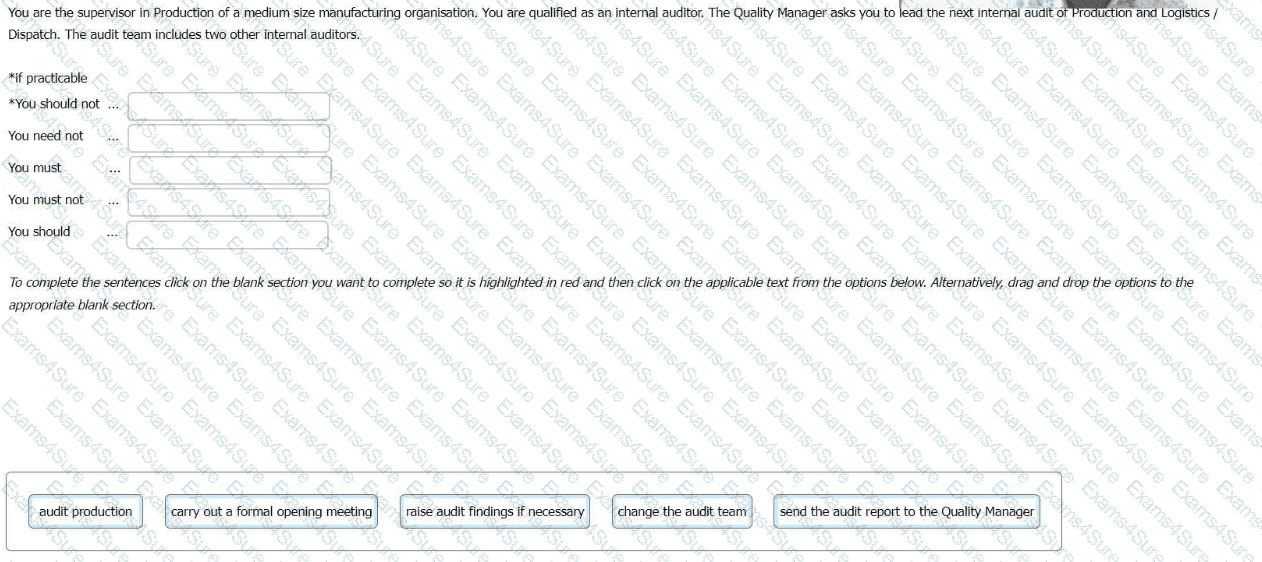
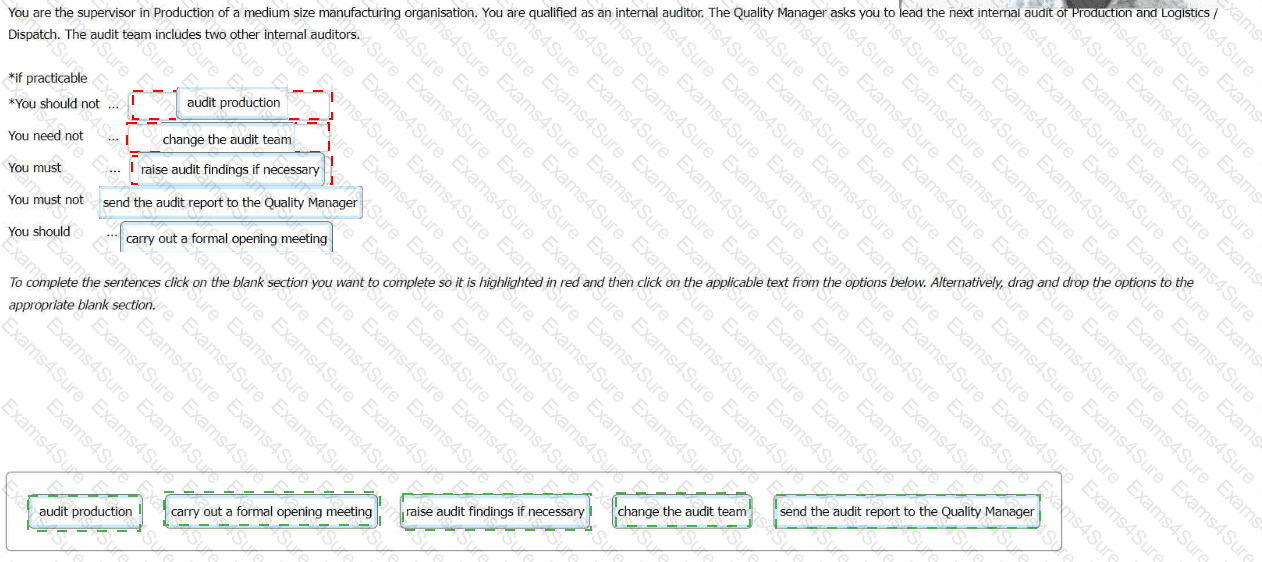
You are the supervisor in Production of a medium size manufacturing organisation. You are qualified as an internal auditor. The Quality Manager asks you to lead the next internal audit of Production and Logistics Dispatch. The audit team includes two other internal auditors.
Read the following role descriptions. Select two roles that are not directly involved in the audit process.
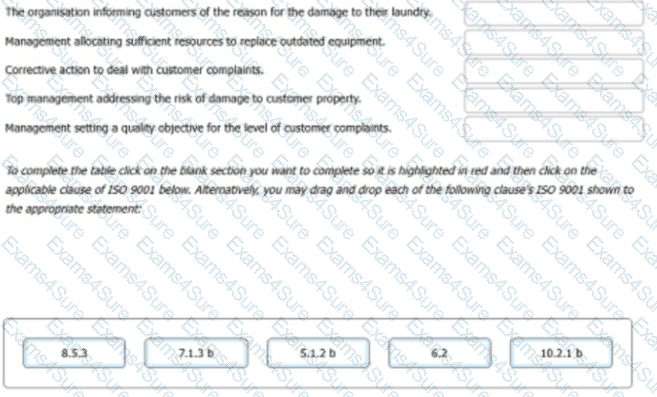
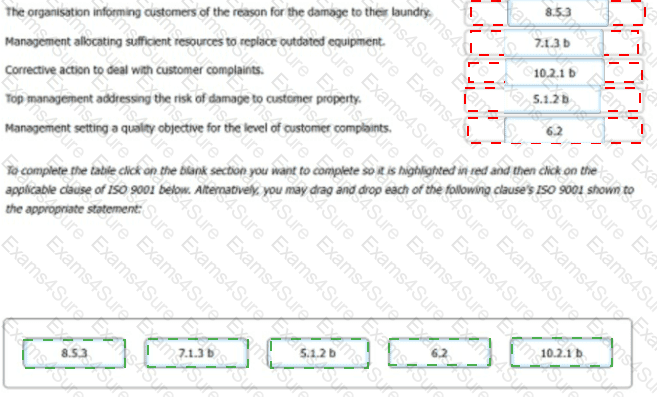
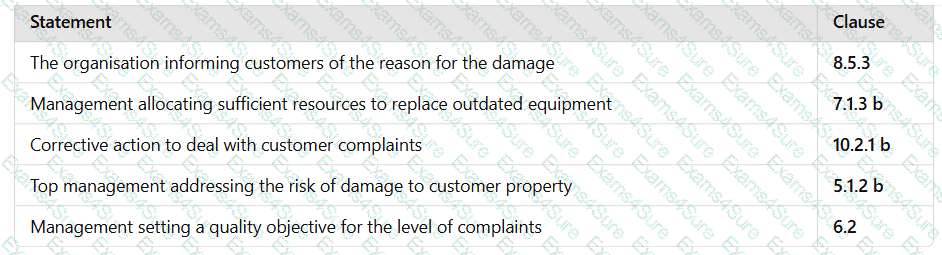
Whistiekleen is a national dry cleaning and laundry organisation with 50 shops. You are conducting a surveillance audit of the Head Office and are sampling customer complaints. You find that 80% of complaints originate from five shops in the same region. Most of these complaints relate to damage to customer laundry. The Quality Manager tells you that these are the oldest shops in the organisation. The deaning equipment needs replacing but the organisation cannot afford it now. You learn that the shop managers were told to dismiss most of the claims based on the poor quality of the laundered materials.
On raising the matter with senior management, you are told that there are plans to replace the equipment in these shops over the next five years.
Match the ISO 9001 Clauses to the statements.
 A screenshot of a computer AI-generated content may be incorrect.
In the context of a second-party audit, match the activity with the party responsible for conducting it.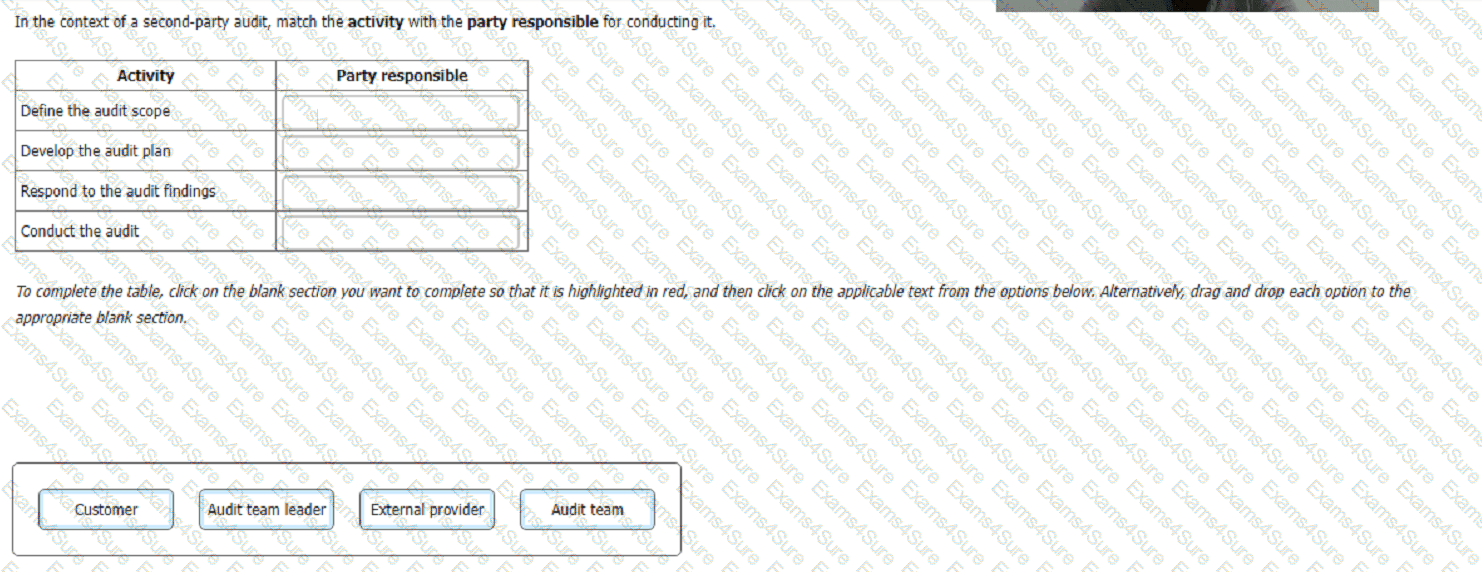
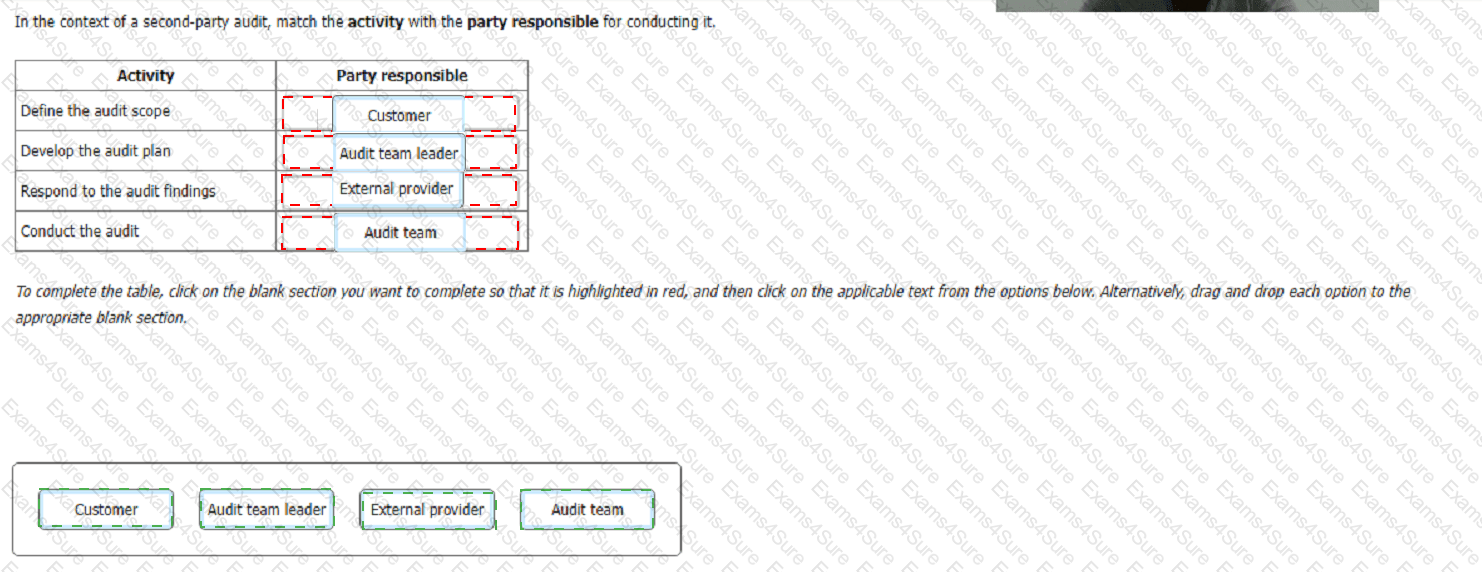
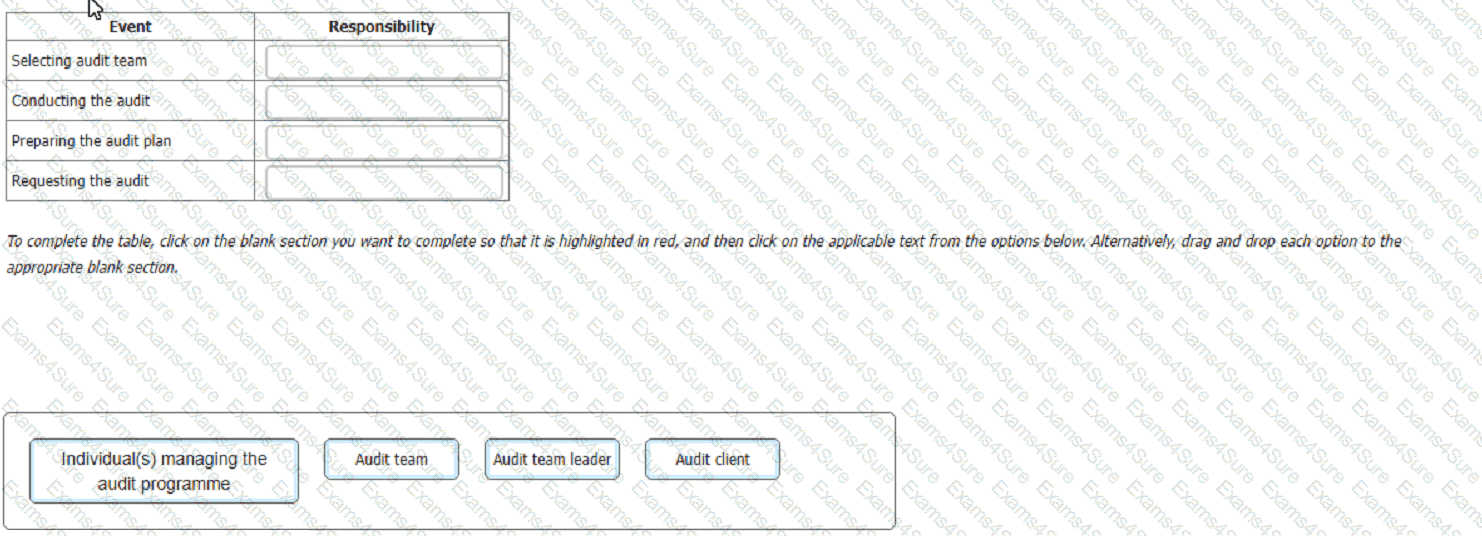
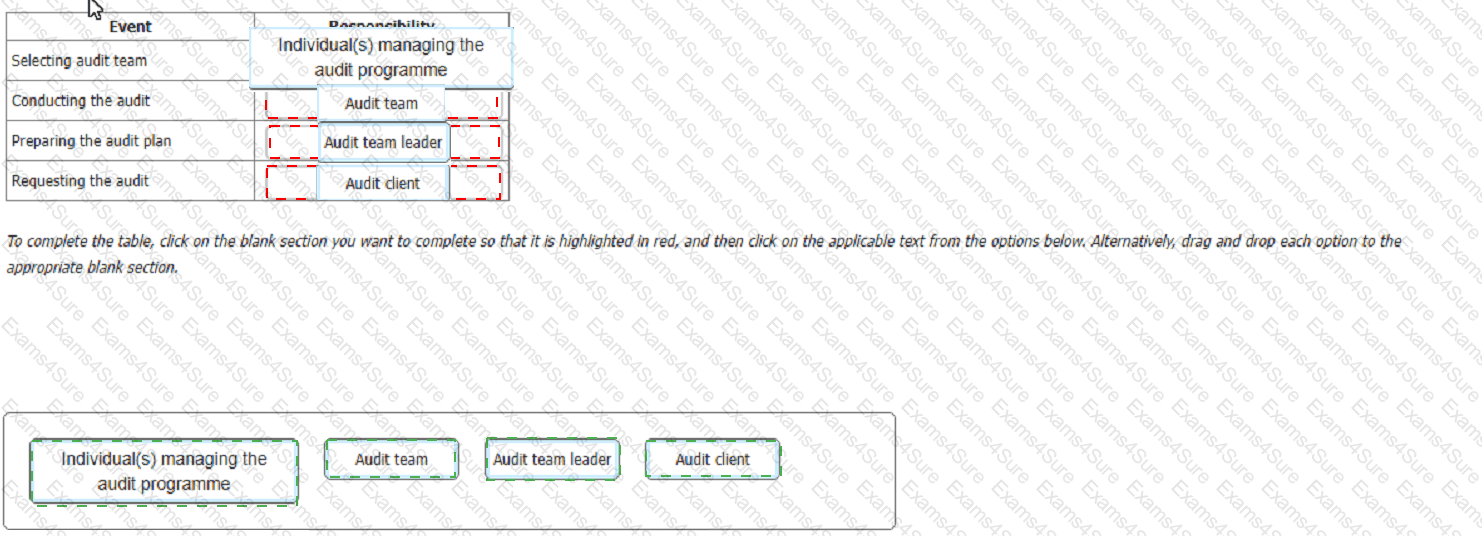
In the context of a third-party audit, match the event with the responsibility for conducting it.