
You are leading a Stage 2 certification audit of a multi-site organisation and have received the audit schedule below;
Head Office and Site 1 - Day 1
Site 2 (150 Km from HQ) - Days 2 and 3
During Day 1 of the audit, the dient informs you that the laboratory at Site 2 has been dosed for decontamination due to a serious outbreak of an infectious disease among workers. In Site 2, all other functions could be audited as planned.
As the audit team leader, what would you do?
Choose the best acceptable action you could take:
® Ask the audit Programme Manager for direction.
Complete the audit on day 3 and report back to the certification body for a certification decision.
Continue the audit on days 2 and 3 and return later to audit the Site 2 laboratory.
Immediately cancel the audit since the audit plan cannot be completed.
Who has the responsibility for assigning work to the audit team?
The procedures of an organisation require that all purchase orders have to be signed by the Purchasing Manager, or, in her absence, by the Production Manager. During an audit carried out in November 2020, an auditor determined that during three weeks in February 2020, the purchase orders were not signed. You raise a nonconformance under Clause 8.4.3 of ISO 9001:2015.
Which one of the following answers would you accept as a ' correction ' from the Purchasing Manager?
You are carrying out an annual surveillance audit at an organisation that has been certificated to ISO 9001 for two years. The organisation offers home cleaning services. The scope of the quality management system covers planning the weekly activities, providing cleaning materials, cleaning the whole property (including outdoor space) alarm installation, alarm servicing, alarm monitoring and response. The business operates from a single office and employs subcontract cleaners across the whole city.
You have just completed the opening meeting. You are interviewing the Managing Director (MD).
You: I would like to gain an understanding of how the quality management system has been supporting your business and its strategic direction.
MD: We are continuing to face difficult times. The market is extremely competitive, and customers typically look for the least expensive option when choosing home cleaning services. We have not yet seen any business benefit from our quality management system.
You: Tell me how you determine external and internal issues.
MD: We use PESTLE analysis (Political, economic, social, technological, legal, environmental).
You: Why did you not use the SWOT model (Strengths, Weaknesses, Opportunities, Threats)?
MD: I had used PESTLE in my previous job.
You: How have the outputs from your PESTLE been used?
Select two audit trails which would lead to a determination of how the PESTLE analysis would affect the planning of a QMS to ISO 9001.
Whistlekleen is a national dry cleaning and laundry organization with 50 shops. You are conducting a surveillance audit of the Head Office and are sampling customer complaints. You find that 80% of complaints originate from five shops in the same region. Most of these complaints relate to damage to customer laundry. The Quality Manager tells you that those are the oldest shops in the organization. The cleaning equipment needs replacing, but the organization cannot afford it now. Complaining customers are offered a financial incentive to close the complaint.
On raising the matter with senior management, you are told that there are plans to replace the equipment in these shops over the next five years.
Select the one option which correctly describes the non-conformity to be raised against ISO 9001.
You are carrying out an annual audit at an organisation that has been certificated to ISO 9001 for two years. The organisation offers home security
services. The scope of the quality management system covers alarm installation, alarm servicing, alarm monitoring and response. The business
operates from a single office and employs subcontract installers and service technicians across the country.
You have just completed the opening meeting. You are interviewing the Managing Director (MD).
You: " I would like to gain an understanding of how the quality management system has been supporting your business and its strategic direction. "
MD: " We are continuing to face difficult times. The market is extremely competitive, and customers typically look for the least expensive option when
choosing home security services. We have not yet seen any business benefit from our quality management system. "
You: " Tell me how you determine external and internal issues. "
MD: " We use SWOT analysis (Strengths Weaknesses, Opportunities, Threats). "
You: " How have the outputs from your SWOT been used? "
Select two of the following audit trails would you take to explore the extent to which the SWOT analysis and the outputs from this
have been used to enable the business to achieve the intended results(s) of its quality management system according to ISO 9001.
' XYZ ' has already sent to you a list with all documented procedures and work instructions related to the services provided to ' ABC ' (a quality manual is not included in the list).
To complete the audit planning which additional information would you ask to XYZ to submit? Select four.
You are an auditor and are in dialogue with the quality manager and the managing director of a small business that supplies specific IT
hardware and software for manufacturers of medical equipment.
You: " I would like to look at how you manage the design and development of your products.
Auditee: " We have made some strategic changes, the main one being that since last month we no longer produce the software of our
products in-house. "
You: " What has been the impact of that? "
Auditee: " We now subcontract the provision of the software needed for our hardware. This allowed us to concentrate our efforts on
the hardware and let specialised organisations develop the software. For the time being, we have subcontracted our software
requirements to three different organisations.
You: " What were the reasons for making the change? "
Auditee: " Our IT software section was a small operation, and we struggled to cope with new technologies. During busy periods, we
found it hard to meet lead times, and in quiet periods, we had staff with little to do. This was having an impact on customer
satisfaction. "
You: " How did you go about the change? "
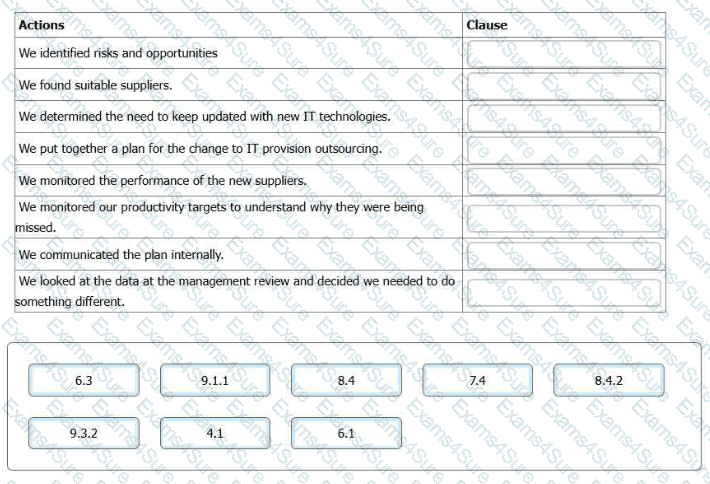
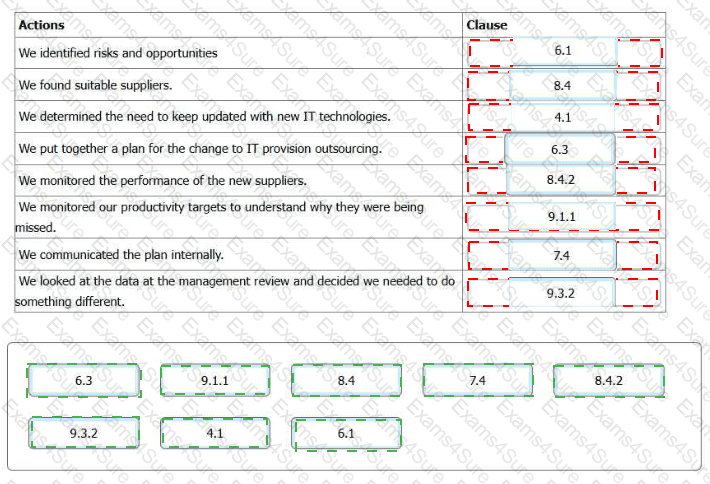
In relation to the auditor ' s question about how the change was managed, the auditee mentions the actions listed
below. Match the ISO 9001 clauses to show which action the requirement applies to.
To complete the table, click on the blank section you want to complete so it is highlighted in red and then click on the
ISO 9001 clauses listed below. Alternatively, drag and drop each clause to show which clause the action applies to.
(In the context of a third-party certification audit, please identify the four management responsibilities of the audit team leader in managing the audit and the audit team:)
Scenario 1: AL-TAX is a company located in California which provides financial and accounting services. The company manages the finances of 17 companies and now is seeking to expand their business even more The CEO of AL-TAX, Liam Durham, claims that the company seeks to provide top-notch services to their clients Recently, there were a number of new companies interested in the services provided by AL-TAX.
In order to fulfill the requirements of new clients and further improve quality, Liam discussed with other top management members the idea of implementing a quality management system (QMS) based on ISO 9001. During the discussion, one of the members of the top management claimed that the size of the company was not large enough to implement a QMS. In addition, another member claimed that a QMS is not applicable for the industry in which AL TAX operates. However, as the majority of the members voted for implementing the QMS. Liam initiated the project.
Initially, Liam hired an experienced consultant to help AL-TAX with the implementation of the QMS. They started by planning and developing processes and methods for the establishment of a QMS based on ISO 9001. Furthermore, they ensured that the quality policy is appropriate to the purpose and context of AL TAX and communicated to all employees. In addition, they also tried to follow a process that enables the company to ensure that its processes are adequately resourced and managed, and that improvement opportunities are determined.
During the implementation process, Liam and the consultant focused on determining the factors that could hinder their processes from achieving the planned results and implemented some preventive actions in order to avoid potential nonconformities Six months after the implementation of the QMS. AL-TAX conducted an internal audit. The results of the internal audit revealed that the QMS was not fulfilling all requirements of ISO 9001. A serious issue was that the QMS was not fulfilling the requirements of clause 5.1.2 Customer focus and had also not ensured clear and open communication channels with suppliers.
Throughout the next three years, the company worked on improving its QMS through the PDCA cycle in the respective areas. To assess the effectiveness of the intended actions while causing minimal disruptions, they tested changes that need to be made on a smaller scale. After taking necessary actions, AL-TAX decided to apply for certification against ISO 9001.
Based on the scenario above, answer the following question:
Scenario 1 indicates that AL-TAX did not ensure clear and open communication channels with interested parties. Which quality management principle did the organization not follow in this case?
Scenario 7: POLKA is a car manufacturing company based in Stockholm, Sweden. The company has around 14,000 employees working in different sectors which help with the design, painting, assembling, and test drives of the final product. The company is widely known for its qualitative products and affordable prices. In order to retain their reputation, POLKA implemented a quality management system (QMS) based on ISO 9001.
Before applying for certification, the company decided to conduct an internal audit to check whether there are any nonconformities in their QMS and if the requirements of ISO 9001 are being fulfilled. The top management appointed Sean, the internal auditor, as the team leader of the internal audit team. Sean required from the top management to have unrestricted access to the employees and executives of POLKA and to the documented information. Furthermore, Sean required to establish a team with a large number of auditors, considering the size and the complexity of the organization. The top management of POLKA agreed with Sean ' s requirements.
The top management, in cooperation with Sean, assigned 10 more employees to the audit team. Following that. Sean planned the audit activities and assigned the roles and responsibilities to each auditor. They began by interviewing employees of different manufacturing departments to check whether they are aware of the process of the QMS implementation. While conducting these activities, one of the auditors asked Sean for permission to audit the department in which he worked on a daily basis, as he was very familiar with the processes of the department.
Along the way, the teams findings showed that the staff were trained, documented information was updated, and the QMS fulfilled the requirements of ISO 9001. The internal audit took three weeks to complete, and on the last week the audit team held a final meeting
The team shared their results and together drafted the audit report This report was submitted to the top management of the company. The report was maintained as documented information, and was available to the relevant interested parties.
Based on the scenario above, answer the following question:
Scenario 7 states that Sean planned audit activities on his own. Is this acceptable?